

The fifth Hebrew Language Olympiad, run by the Department of Hebrew Language at Tel Aviv University, begins Monday with an online round for Hebrew learners abroad, in collaboration with the Consortium for Hebrew Teaching at Brandeis University.
The Olympiad invites pupils aged 12–18 to learn more about Hebrew through original linguistic challenges they rarely encounter in the regular school system – from puzzles on ancient Semitic languages and code-breaking to word meanings and idioms.
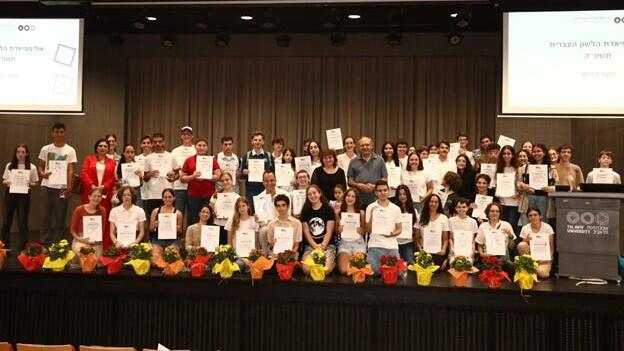
Winners of the Hebrew Olympiad 2025
(Photo: Yael Zur)
In the most recent Olympiad, a record 5,668 students from Israel and around the world took part over the course of the year. The competition has now expanded to include students whose mother tongue is not Hebrew.
The new circles of participants include an Israeli circle bringing together Jewish (secular, religious and ultra-Orthodox), Arab, Bedouin and Druze citizens of Israel; and a Jewish circle strengthening ties between Israel and the Diaspora.
In the track for Hebrew learners, 961 pupils took part: 690 Arabic-speaking pupils from Israel and 281 pupils from abroad. The overseas track was held in partnership with the Consortium for Hebrew Teaching at Brandeis University, with participants from the United States, Brazil, Germany, Hong Kong, Sweden, Russia, Cyprus, Switzerland, England and Egypt.
"Curiosity and knowledge about unique structure of the Hebrew language and its use strengthen the process of acquiring it, as well as learners' motivation to study it and function in it as a second language," according to Professor Vardit Ringvald of the Consortium for Hebrew Teaching at Brandeis University.
Among last year’s overseas winners is Mahmoud, a teenage Hebrew learner from Egypt, who says languages are his way of building bridges.
“Hebrew, like any language, is a way to bring human beings closer together. To me, languages are not just sounds that come out of the mouth; they are also a way for us to understand one another and to make the peace we so desperately need in our time," he said.
Mahmoud entered the Olympiad on the recommendation of an Israeli friend who had previously won in the competition.
“I greatly appreciate the idea of holding such an Olympiad. Language studies don’t receive enough recognition or respect, and it’s important to encourage more people to learn and teach in this field," he said. "Every word we learn is another step towards the shared existence we urgently need. Knowing that there are people who encourage this gave me hope for a better world. In the end, genuine communication is the basis of lasting peace.”
In Israel, first place with outstanding distinction went to Maayan Bar-Helmer, an 11th-grader who, for the first time in the Olympiad’s history, answered 100% of the questions correctly.
“The young people who achieve such impressive results in the Hebrew Language Olympiad are a ray of light, filling us with hope and expectation for the future. Their love for the Hebrew language and the knowledge they demonstrate are reflected in their success," said Dr. Einat Gonen of the Department of Hebrew Language and Semitic Linguistics at Tel Aviv University.
The next Olympiad cycle starts Monday, with an online qualifying round for Hebrew learners abroad, followed by further stages in early 2026.
The Olympiad is open to pupils in grades 7–12 (ages 12–18) in Israel and worldwide. It is held in cooperation with the Academy of the Hebrew Language, Education Ministry and the Consortium for Hebrew Teaching at Brandeis University, and is sponsored by Check Point and Final, with the support of the Koret Center for Jewish Civilization.