

For the past six weeks, the website of the Barby club in Jaffa looked like a graveyard of concerts: Israel’s biggest artists kept appearing there in events that it was unclear when they would actually be able to take place.
Until Thursday, the gates too remained locked, except for a brief period before Passover, and even then only to pack food shipments for workers in the music industry, who once again found themselves without an income and without anyone giving them so much as a glance.
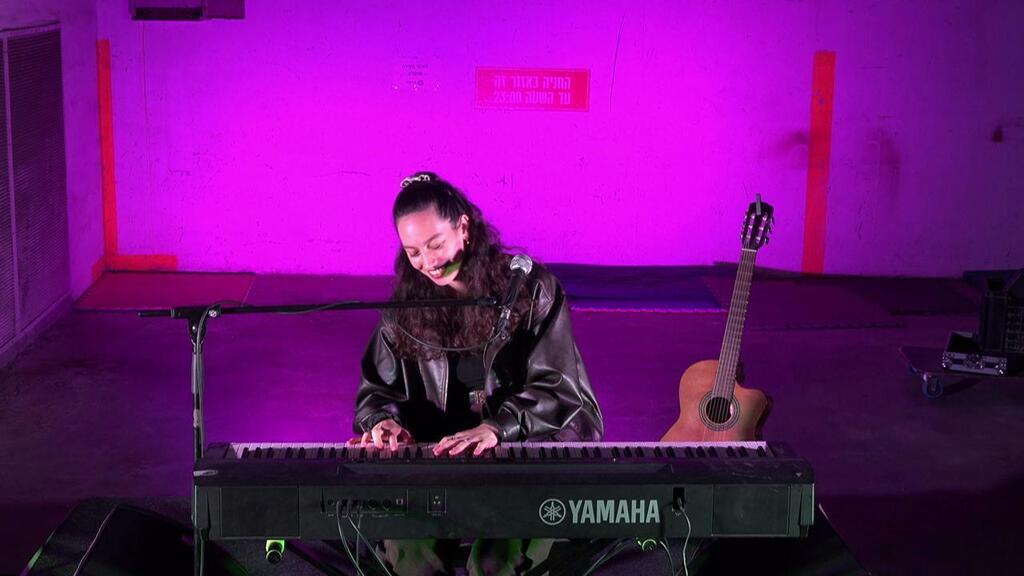
Alma Gov performs at the Gan Ha’ir parking garage
(Video: Shira Shabtai, courtesy of Tel Aviv’s Youth Unit)


And so it was across the city once known as “the city that never stops,” which until days ago would empty out at sunset and leave behind a post-apocalyptic quiet. Life under the shadow of the sirens migrated underground, where tent cities sprang up in the central bus station, Dizengoff Center and Habima Theater.
Yet even in such an extreme situation, something still had to happen. And it did, for example, on level minus two of Gan Ha’ir in Tel Aviv, where stages were set up beneath low ceilings, amid exposed pipes and industrial ventilation ducts. Even the Tel Aviv Museum unveiled works stored in its protected basements, and in rehearsal rooms beneath the Recanati Auditorium, it displayed selected pieces from the exhibition End of Day: 100 Years of the New Objectivity Movement.
At the time, the artists were still trying to recover from what was then called “the Great War,” not imagining that another would soon arrive. This endless loop feels all too familiar.
If not for the circumstances, one might almost have thought this was a new underground scene in the Berlin mold. But the truth was far from a hot trend: it was simply a temporary and necessary solution for people who desperately needed to replace the Home Front Command’s warning sounds with something a little more sane.
Gallery
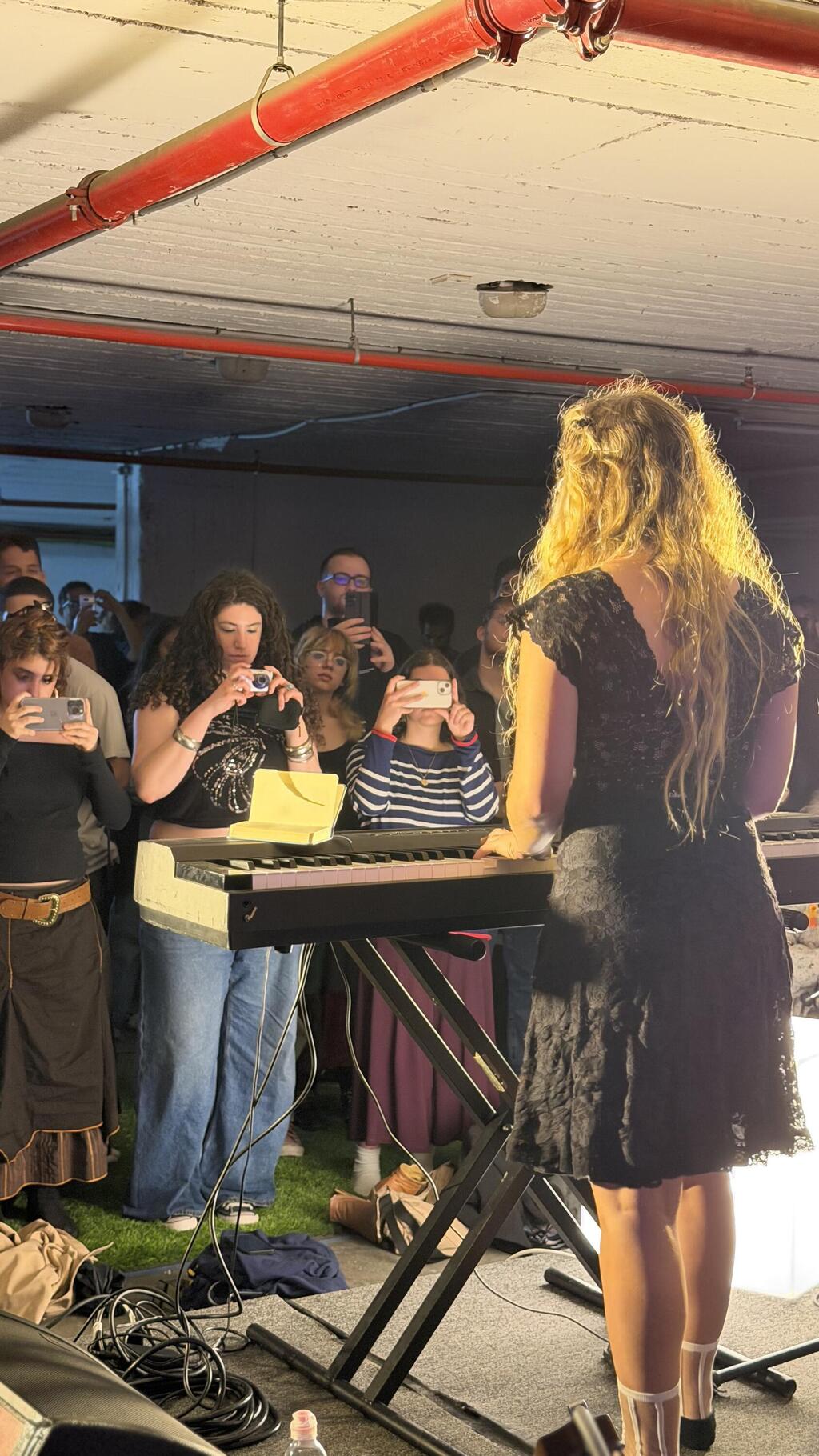
Daniel Rubin performs at the Gan Ha’ir parking garage
(Photo: Yaniv Grady, courtesy of the Inbal Center for Culture)
This was not how Daniel Rubin imagined her first performance after the birth of her first daughter, but songs she wrote following Oct. 7, such as Beautiful as Hell // Very Sad, capture a familiar essence that has become routine.
“When the end of the world drew near, we wanted to have children,” she sang in the Gan Ha’ir parking garage, as part of a free initiative by the Inbal Center for Culture. To get on the improvised stage, Rubin left Abigail, her infant daughter, with her grandparents in the Sharon region, where they had temporarily moved after an Iranian missile struck near their home in Tel Aviv.
The rough intimacy of the space created a one-time meeting between Rubin and an audience seated on white plastic chairs, like some secret moment belonging only to a club of devoted fans. Her moving cover of Keren Ann’s hit Not Going Anywhere gave way, in Hebrew translation, to a positive mantra: “Friends come and go suddenly, I stay where I am.” Longing and pain return in Portugal, a song dedicated to people close to her who left the country: “In an aching body / 100 tons on the heart / I wish this is as low as it gets.” On level minus two — as low as it gets — there was already no air left.
A week later, the same stage hosted Alma Gov, in another initiative by the youth department of the Tel Aviv municipality. The plastic chairs were replaced by mats spread across the concrete floor, washed in pink neon lights. The moment the right song came on — This Is the End, in this case — the audience rose, danced and sang together: “There is no future here, there is no future here.”
Alma Gov performs at the Gan Ha’ir parking garage
(Photo: Shira Shabtai, courtesy of Tel Aviv’s Youth Department)
Gov also performed Leah Shabbat’s Only Life, which recently found new life in a version by Abigail Rose. “All I want is to live my life in peace, I don’t want wars,” sang the performer, who herself studied music at the arts boarding school in the Gaza border region and knows the bleeding dissonance hidden behind some of the country’s most beautiful landscapes.
In the south of the city too, a local answer was being formulated to the dark clubs of Europe’s industrial zones, as March 2 also hosted intimate performances by artists such as Roy Rick, Noam Rotem and Rotem Bar Or.
And, meanwhile, Hamartef, a new space inaugurated during the war at Beit Radical, offered a lineup of parties and performances. One of them was by the alternative pop group Kiki Malinki. Their song Until It Passes neatly expresses the blanket of anxiety that enveloped us for more than five weeks.
Lead singer Yasmin Raviv sings, “I don’t mean to ruin the mood / I’m just a little afraid the end is very near,” and later sharpens the fear, while also reminding listeners how to shield themselves from it: “You do understand that people die every day / And that we too could suddenly go just like them / What if the sirens start? We’ll just head for the stairs.”
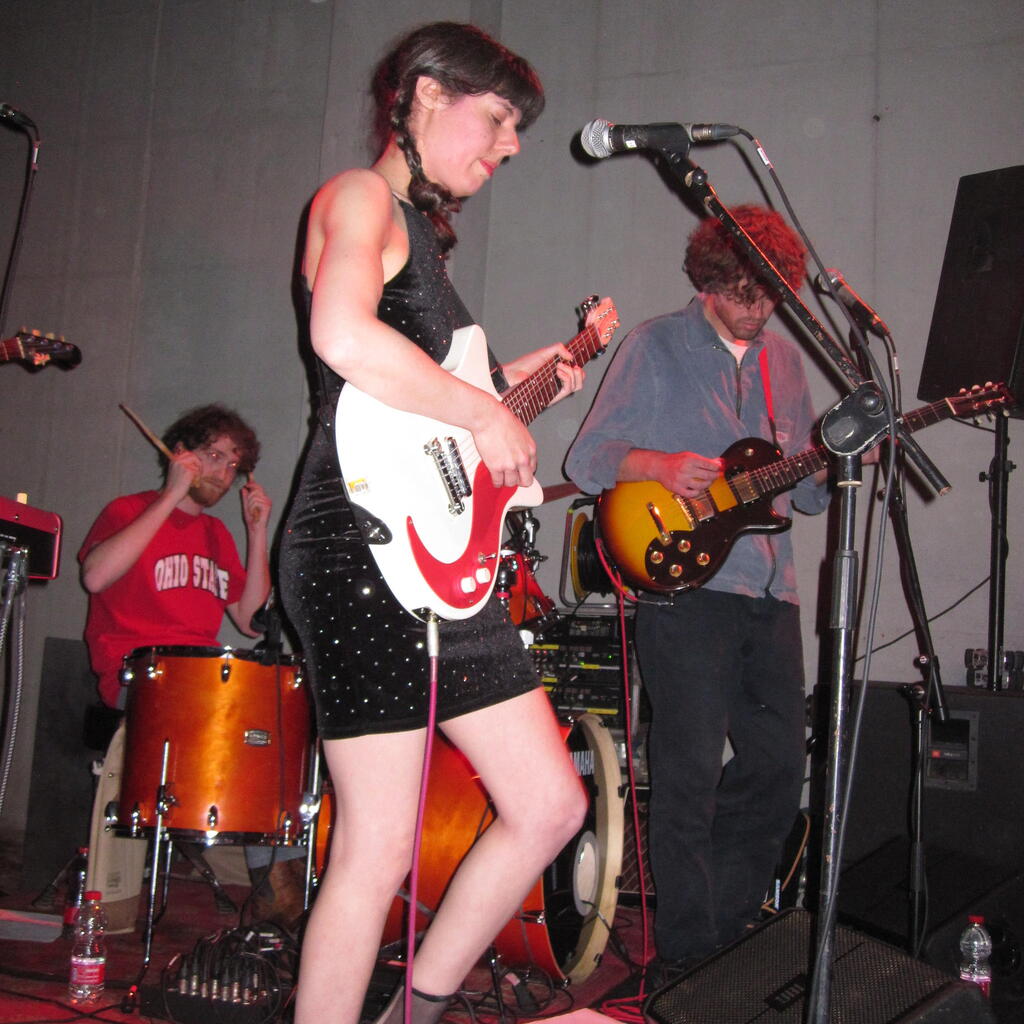
Kiki Malinki perform at Beit Radical
(Photo: Emanuela Stavsky)
Not far from there, at Beit Hetzeirim on Herzl Street, 50 lucky people who paid 35 shekels gathered for an alternative to the launch performance of Shining Black, Hila Ruach’s new album. As one of the artists whose Barby show was canceled, she too had to make do with what looked like the protected-space version of the veteran U.S. public radio format Tiny Desk.
War or no war, this is entirely Hila Ruach’s year. If Charli XCX had Brat summer in 2024, Israel armed itself with a Shining Black spring, complete with matching aesthetics: flip-flops and socks, a folding stool and bleary eyes from lack of sleep.
Back in 2022, Ruach was already savvy enough to turn the prophetic line “Living inside the Iranian nuclear core” — written by Tehila Hakimi — into a sharp, attitude-filled song. In June 2025, the track became the perfect soundtrack to Operation Rising Lion. Eight months later, all of us are living — and that too in the best-case scenario — inside yet another war with Iran.
Just before performing Maybe It’s Over — a far more fitting expression than “the event has ended” — Ruach nervously checked how many of those present knew the words to the song, which was released only recently and stretches to almost six minutes.
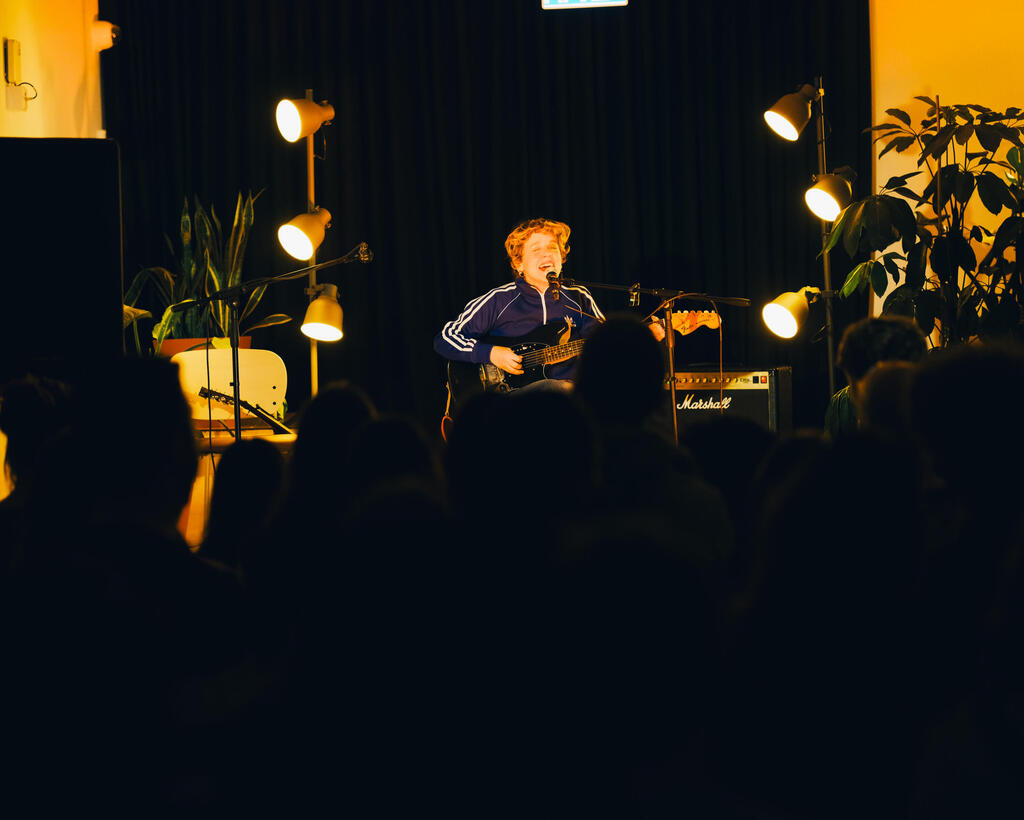
Hila Ruach performs at Beit Hetzeirim
(Photo: Ido Asulin, courtesy of Tel Aviv’s Youth Department)
The obvious answer, of course, was “everyone,” especially the punchline: “You can die at the crosswalk / In front of the kiosk / You can also simply not wake up tomorrow.” Ruach, too, knows how to turn paralyzing anxiety of death into a polished musical gem, one that glitters with the influence of Yahli Sobol, who also got his moment of glory on the shelter stages.
On the way out of the parking garage, the smell of jasmine blossom hits the nostrils, a reminder that nature goes on as usual, even if the feeling on the dark, empty street in the early night is that curfew passed long ago. I get on my bicycle and take the quickest route home, before another siren comes.
The music is in my headphones, and suddenly I hear my own voice blending with Ruach’s: “I’m afraid / And I want / What else can be said / I think nothing.”