

At 70, Erez Kaminski doesn’t describe himself as “someone with stuff.” He talks like a curator, an investigator and sometimes, like a man who simply refuses to let memory evaporate.
Kaminski has been collecting for 54 years. His story begins far from NBA arenas and auction headlines. It starts with a father who loved art, a teenage son who absorbed that obsession and one formative purchase: a Salvador Dalí lithograph at a Tel Aviv gallery.
That first step matters, because Kaminski’s story isn’t really about sports. It’s about how collecting evolves. How one passion turns into another. And how, over time, a collection stops being a hobby and becomes a parallel life.
Kaminski began collecting at 17, influenced by a home where art was more than decoration. Later, he moved to Los Angeles, and like many Angelenos of that era, he found himself drawn to the Lakers. He had season tickets at the Forum. He was there. He felt the electricity.
And that’s where the pivot happened: from art to sports memorabilia, from galleries to arenas, from canvases to jerseys, sneakers, photos and signatures.
For decades, the growing archive sat mostly in boxes. Life moved forward. The collection waited.
Then came the wake-up call: a heart attack, a knee injury. Events that force a person to slow down, open what’s been sealed, and ask what matters. Kaminski began unpacking, cataloging and framing. Not casually. With what he calls “American-level precision.”
The real game: authentication
When it comes to serious collecting, authentication is king. Kaminski talks about the industry the way a forensic analyst talks about evidence. In the world of high-end sports memorabilia, a signature is not a signature unless it’s verified. He points to major authentication companies such as PSA and Beckett, which examine signatures using professional methods and issue certificates, often with lifetime guarantees.
But the sharpest distinction, he says, is between a signed jersey and a match-worn jersey.
A signed jersey can be valuable, sure. A match-worn jersey is a different ballgame. Companies like MEARS specialize in verifying whether a jersey was actually worn in an official game. That means tracing it through documentation, photo matching, manufacturing details and coordination with brands and sports organizations.
The gap in value can be extreme. Kaminski gives an example: a game-worn Lionel Messi jersey could reach around $300,000, while a shirt worn for official appearances might sit closer to $5,000. Same player. Same fabric. Completely different story.
And the warning is blunt: the internet is flooded with fakes. Without documentation, a collector isn’t collecting. He’s gambling.
The 'three aces' and one-of-a-kind handprints
Among Kaminski’s rarest items is a piece that sounds like myth until you understand the chain of custody. It’s a set of handprints from what he calls “the three aces”: Michael Jordan, LeBron James and Kobe Bryant.
Gallery
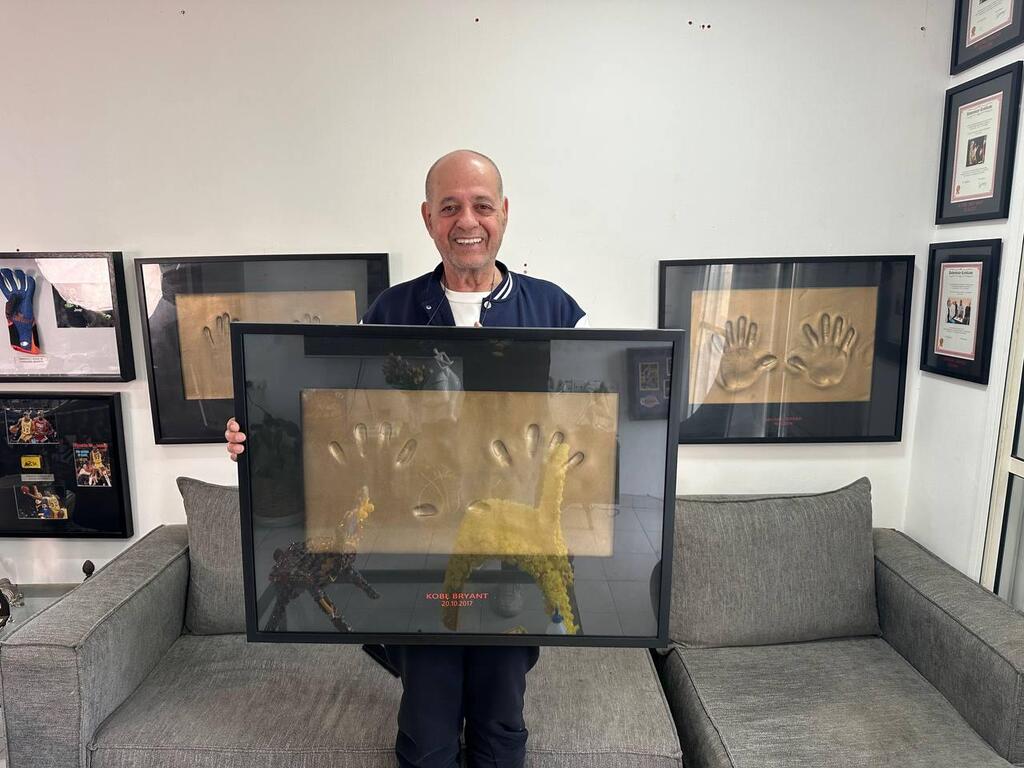
Collector Erez Kaminski holds a framed set of Kobe Bryant handprints from a limited edition series
(Photo: Bar Gindy)
The project began at Nike’s flagship store in Paris, where a French artist named Sacha took the hand impressions of Jordan (2006), LeBron (2009) and Kobe (2017). Kaminski acquired a limited edition run of only 18 sets.
Then he did something that reveals how deeply collectors think about supply: he bought the original mold from the artist, specifically to prevent additional copies from ever being made.
After Kobe Bryant’s tragic death, Kaminski says the value of the piece surged. The auction house Goldin reportedly contacted him about it. He mentions that a similar trio had sold for $48,000 in the past, and estimates that if Jordan and LeBron were to sign the piece, valuations could start in the $200,000 range.
What’s striking isn’t only the money. It’s the logic behind it: scarcity, provenance, narrative and cultural weight, all fused into one object.
Alongside well-known figures like Ken Goldin, whose company runs one of the world’s leading sports memorabilia auction platforms, and the broader auction network through which elite items circulate globally, Kaminski points to a newer force shaping the market: investor groups.
He describes young investors forming buying syndicates, using algorithms to spot trends in sports collectibles as an alternative to real estate or traditional portfolios. Some, he says, manage sports memorabilia portfolios worth over $100 million.
In this world, a championship-game Jordan sneaker can be discussed in the same breath as a luxury asset. A rare baseball card can hit numbers that feel surreal. For purists, this can sound like pollution. For others, it’s a sign that the collecting culture has become financially legible.
Preservation is part of the price
Collecting isn’t only buying. It’s protecting—Kaminski highlights how dust, oxidation, pests and time can damage paper and fabric. Proper framing is not decoration. It’s conservation: special backing boards, stitching without glue, UV-protective glass and controlled spacing.
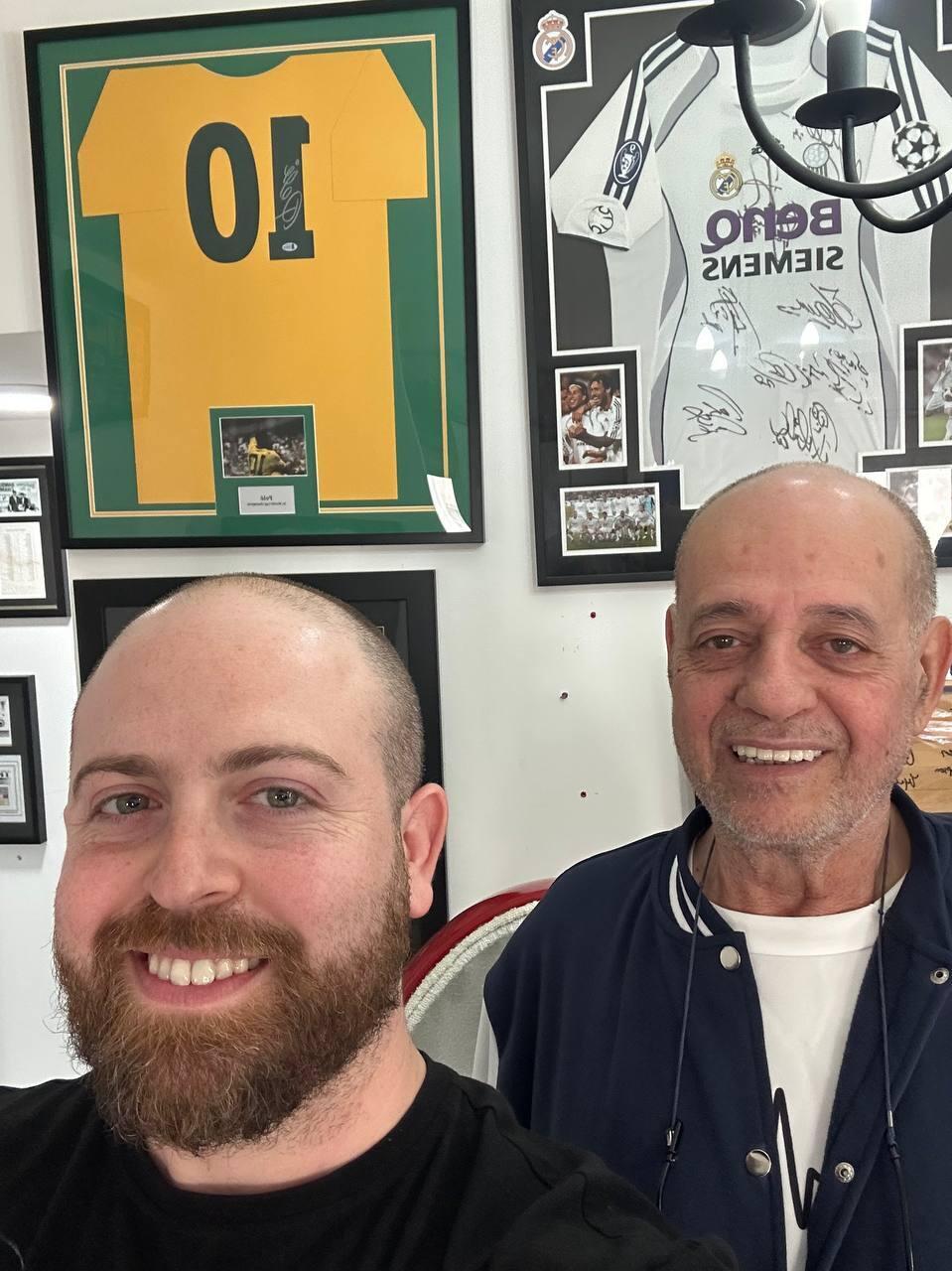
Bar Gindy, left, host of the People and Collectors podcast, poses with collector Erez Kaminski in front of framed sports memorabilia
(Photo: Bar Gindy)
It’s expensive, and he notes that in Israel, it can be especially challenging to find the right expertise at the right price.
He also offers advice that sounds simple but carries decades of experience: don’t throw anything in the trash.
Not because every old paper will become a fortune, but because value is often invisible until time reveals it. And because collecting, at its best, is not only about resale. It’s about connection, memory and the emotional charge that turns an object into a story.
He also emphasizes something rare in any market: generosity. Kaminski says he’s available on Facebook to answer questions for young collectors without charge, simply to pass the knowledge forward. In a world of fakes, hype and headline prices, that might be the most authentic item of all.
- For more stories from Erez and other collectors, check out the People and Collectors podcast. The full interview is available with subtitles in English and 50 other languages.