

Salvador Litvak’s Guns & Moses—co-written with Nina Davidovich Litvak—arrived in U.S. theaters this summer with a premise so audacious it borders on prophetic: a Chabad rabbi in California’s high desert transforms from a beloved community leader into a gunslinger hunting down neo-Nazis after violence tears apart his congregation.
Premiering at the Los Angeles Jewish Film Festival in 2024 and released nationwide on July 18, 2025 (with a second limited run September 7–11), the film is not built to win Best Picture. Instead, it offers something rarer—a bold meditation on Jewish identity, exile and the rediscovery of strength in an age of rising antisemitism.
Guns & Moses trailer
(Video: Courtesy of LB Entertainment)


Litvak grounds his film in real-world trauma. The story is haunted by echoes of the 2019 Poway synagogue shooting, the Tree of Life massacre and most explicitly the October 7 attacks in Israel. In fact, Litvak himself appears in a post-credits scene, directly invoking October 7 and urging Jewish audiences to arm themselves and embrace vigilance. For some, this bluntness will be controversial. For others, it will feel like a wake-up call that pulls no punches. Either way, it situates Guns & Moses not as escapist pulp but as a commentary on the cultural crossroads where American Jewry now stands.
The nebbish Jew vs. the muscular Jew
At its core, the film dramatizes a tension that has defined modern Jewish life: the old Jew of exile, timid and assimilated, versus the “muscular Jew” envisioned by Max Nordau and embodied by Israel’s founding generation.
Rabbi Mo Zaltzman—played with remarkable sensitivity by Mark Feuerstein—is the vessel through which this transformation occurs. At the film’s start, Mo is a gentle, Yiddish-speaking rabbi who embodies continuity and exile. By the end, he is something altogether different: a Hebrew-inflected, gun-trained defender of his flock.
The film uses language itself as a metaphor, with Yiddish phrases fading from the soundtrack as the rabbi hardens into his new identity. The message is clear: the Jew of exile cannot survive the present moment unless he becomes the Jew of strength.
Feuerstein’s performance anchors the film. He channels the soul of a beautiful, loving rabbi wrestling with the dissonance between tradition and survival. If I didn’t know he hadn’t grown up as a Hasidic Jew, I would have believed he had. He inhabits the world of a practicing rabbi so convincingly that his transformation feels lived, not performed.
Mark Feuerstein’s deepening legacy
I’ve followed Mark Feuerstein’s career for years—from his charming turn in Royal Pains, to his supporting role in Defiance alongside Daniel Craig, to what I believe was his finest work before this film: in his searing performance in Hotel Cocaine, Feuerstein delivered one of the most fantastic monologues in recent television history—almost on par with Sam Rockwell’s viral turn in The White Lotus—a performance so powerful it should have earned him an Emmy.
Gallery
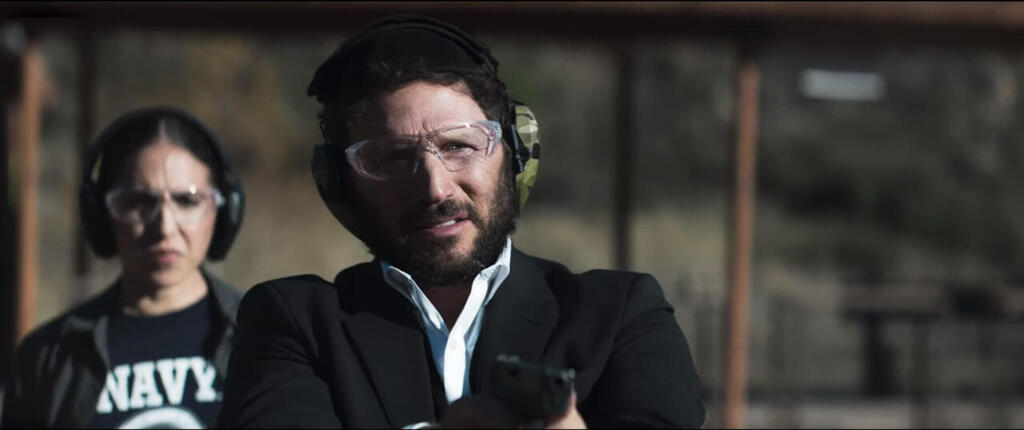
Arming himself and setting out on a mission of revenge. From Guns & Moses
(Photo: Courtesy of LB Entertainment)
Moreover, Hotel Cocaine missed its own potential by failing to recognize that Feuerstein was the true star, embodying the complex life of a drug-addicted, celebrity-babysitting Jewish hotelier with a dream in Miami.
That legacy makes his work in Guns & Moses even more meaningful. This isn’t the “performance of his career”—because that honor, for me, still belongs to Hotel Cocaine. But it is a remarkable addition to his repertoire of Jewish characters. As Rabbi Mo Feuerstein, he channels the sensitivity and nuance of a man caught between faith and survival, a man who realizes that piety alone is not enough to protect his community.
Feuerstein himself has said: “This story represents the struggle that I have not only had with my own identity since October 7, but clearly also represents the struggle that many of my friends are going through, as well as Jews in America. The friends we thought we once had are no longer friends. The people we thought we could rely on, we can no longer rely on. And the one thing that must be clear is that we have to rely on ourselves to strengthen our own individual identities to strengthen the Jewish people as a whole.”
That raw honesty infuses his performance, making Rabbi Mo’s journey feel personal, urgent and devastatingly honest.
A cast of gravitas
The supporting cast adds muscle and gravitas. Neal McDonough, as Mayor Donovan Kirk, is magnetic. McDonough has long been typecast as menacing or duplicitous, and here he revels in it. Every scene drips with his trademark intensity. He elevates what could have been a stock villain into a layered antagonist, the kind of presence McDonough is famous for delivering.
Then there is Christopher Lloyd, as Holocaust survivor Saul Fassbender. Frail yet burning with memory, Lloyd offers a chilling performance that unsettles to the core. Watching Doc Brown himself embody the trauma of a survivor is surreal and harrowing, but it works, leaving an imprint that lasts long after the credits roll.
Dermot Mulroney plays Alan Rosner, a quintessential community leader. Although his role is minor, he effectively illustrates the duality of philanthropists who fund community projects while concealing ruthless business practices. The film commendably highlights that the challenges within the Jewish community are both external and internal.
Style and substance
Stylistically, Guns & Moses has been described as Tarantino-esque, and Litvak certainly borrows from pulp aesthetics: noir lighting, stylized violence and surreal set pieces (including a solar-panel field shootout).
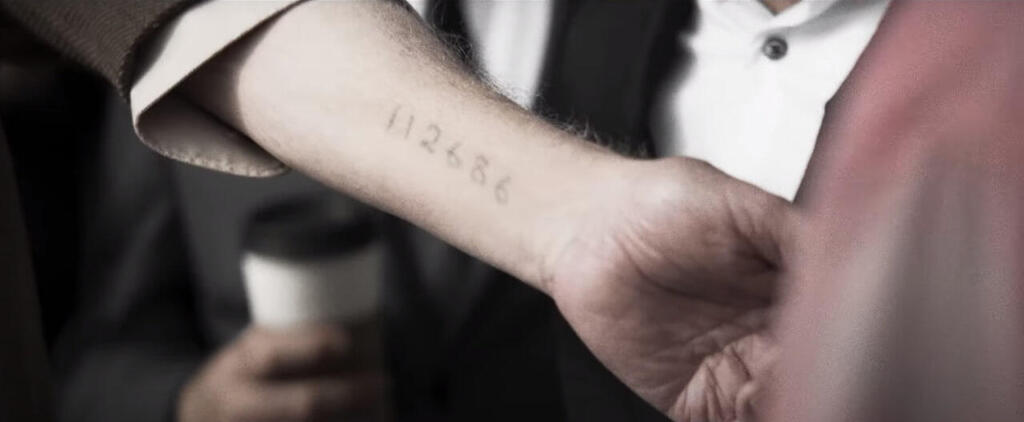
'Never Again' - from the trailer for Guns & Moses
(Photo: Courtesy of LB Entertainment)
Yet this is less a revenge fantasy than a detective mystery. Much of the film follows Rabbi Mo as he unravels the plot against his community. Yes, the pacing veers unevenly between meditative dialogue and bursts of action. Yes, some twists feel predictable. But what is precise and vital to note is that Litvak isn’t chasing perfection of craft—he’s chasing urgency of message. And on that front, he delivers.
A call to identity
What lingers after Guns & Moses is not its plot mechanics but its existential question: Can Jews afford to remain the nebbish Jews of exile in a world that increasingly demands self-defense? The answer, Litvak argues, is no.
The final transformation of Rabbi Mo is both heartbreaking and inspiring. Heartbreaking because it signals the death of innocence; inspiring because it embodies survival. The exile Jew disappears, and the muscular Jew emerges. This is why, despite its imperfections, Guns & Moses is a film every American Jew should see. Not because it is perfect cinema—it is not. Not because it will win Oscars—it will not. But it forces a community that has long sought safety in assimilation to confront the reality that those days are over. In the end, Litvak has crafted less a film than a mirror, and the reflection is both terrifying and necessary.
Conclusion
Guns & Moses is messy, uneven and occasionally overwrought. It is also essential. Mark Feuerstein builds on a career of powerful Jewish roles—with a performance here that is tender, nuanced and utterly convincing. Neal McDonough is magnetic as the duplicitous mayor, Christopher Lloyd chills as a Holocaust survivor and Dermot Mulroney embodies the all-too-familiar community macher.
Beyond the acting and aesthetics, Litvak’s film matters because it dares to demand what few works of Jewish art have ever demanded of American Jews: to shed the illusions of exile and embrace strength, sovereignty and self-defense. This may not be the film Hollywood rewards—but it is the film the Jewish people, especially in North America, desperately need.
- Adam Scott Bellos is the founder and CEO of The Israel Innovation Fund (TIIF), dedicated to strengthening Jewish identity through culture, language and innovation. He is the author of Never Again Is Not Enough: Why Hebraization Is the Only Way to Save the Diaspora and writes widely on Zionism, antisemitism and the future of Jewish life.