

At 25, Noa Neta Moati is already pushing boundaries in the Israeli art world. A graduate of Beit Berl College’s art and education program, she now lives in Kfar Saba and is presenting her final exhibition, “Woman. Power. Identity,” at the Janco Dada Museum in Ein Hod. Her work—immersive, vulnerable and confrontational—draws on a virtual world she first discovered as a child.
Moati remembers stumbling upon IMVU, an avatar-based social platform with a distinctly sexual edge, when she was just nine years old. The characters wore exaggeratedly provocative outfits, the chat carried overt sexual undertones and she hid it from her mother. “Sexuality was part of me, even as a child,” she explains, “but I didn’t have a name for it yet. The game fascinated me, and it was also a way to meet people, because in reality, social life was harder.”

Years later, she returned to IMVU—not to play, but to build art from it. Her childhood avatar had been nothing like her: straight hair, slim body, smooth curves erased. For her exhibition, she wanted something different, something braver—an avatar that looked like her. Yet in IMVU, every detail costs money: a fold of flesh, a curl of hair, a dimple. To create an avatar her size, she realized she would have to spend a small fortune. Instead, she found a workaround. “My solution was to become a virtual prostitute,” she says without hesitation.
Get the Ynetnews app on your smartphone: Google Play: https://bit.ly/4eJ37pE | Apple App Store: https://bit.ly/3ZL7iNv
She constructed a glamour avatar, all glossy curves in the style of Kim Kardashian, and wandered through chat rooms offering virtual sex in exchange for the “gifts” she needed to buy the features of her real body. “The pixels did the work,” she recalls. “I was curious about what really excites people. Some told me they reached orgasms in real life.”
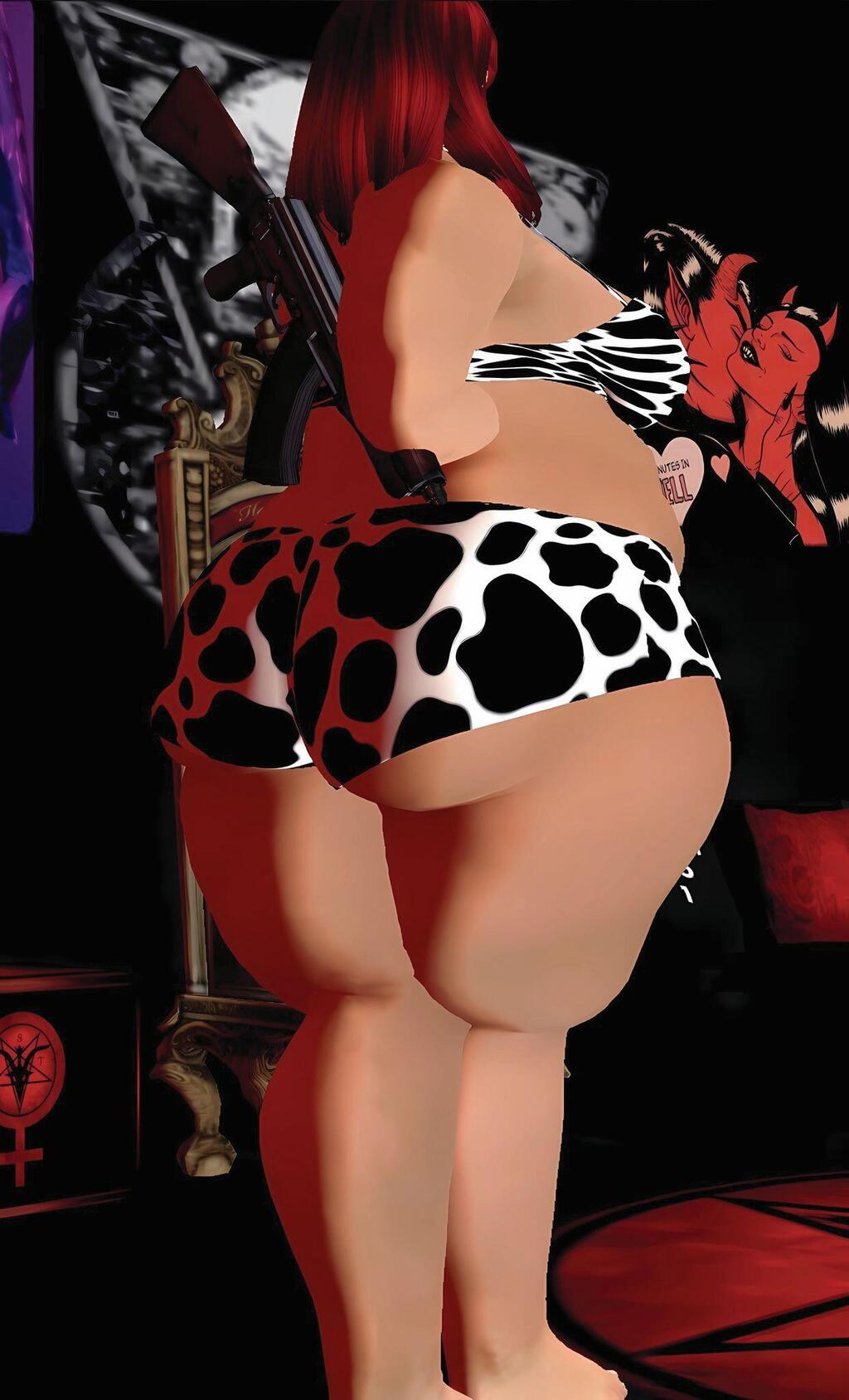
(Photo: From the exhibit)
But when she finally assembled an avatar that looked like herself, the response shocked her. Users jeered at her new figure, calling it ugly and kicking her from rooms. “People don’t want to see a body like mine, even virtually,” she says. The rejection mirrored her real-life experience. “My existence is taboo. If you’re fat, confident, sexual and dress however you want—it terrifies people. In Israel, being a fat woman is like a death sentence. But I love my body, and I project that love.”
Her exhibition doesn’t hide from this confrontation. Visitors encounter two video works from IMVU, three massive four-meter prints of her avatar, and even a carpet that invites them to recline and inhabit her world. Vulnerability is built into the experience. “It’s frightening,” she admits. “There’s always the fear people won’t understand, or they’ll diminish me, because I’m dealing directly with my body.”
Moati’s candor extends beyond art into her views on sexuality. She describes herself as a deeply sensual person, whose first sexual experience came at 17, though self-discovery started much earlier. “If I weren’t an artist, I’d be a sexologist,” she says. She approaches men boldly, much like her old hyper-feminine avatar once did: “I love going up to the most masculine men and making the first move. I like embarrassing them.”
'My existence is taboo. If you’re fat, confident, sexual and dress however you want—it terrifies people. In Israel, being a fat woman is like a death sentence. But I love my body, and I project that love.'
At 25, Noa Neta Moati is already pushing boundaries in the Israeli art worlאd. A graduate of Beit Berl College’s art and education program, she now lives in Kfar Saba and is presenting her final exhibition, “Woman. Power. Identity,” at the Janco Dada Museum in Ein Hod. Her work—immersive, vulnerable and confrontational—draws on a virtual world she first discovered as a child.
At the heart of her art lies that demand: to be seen in her entirety, without disguise, without shame. Or, as she puts it more simply: “You don’t need to fulfill all your fantasies at once.”