

Trash rarely changes anyone’s life. But for Ophir, it did. In 1982, as a child growing up near the sea, he picked up a discarded Coca-Cola can on a beach in Netanya and decided it was too beautiful to throw away. Four decades later, that same impulse has turned into one of Israel’s most unusual private collections: more than 4,000 Coca-Cola cans, carefully organized in sets, traded across continents and tracked like an archive.
Ophir’s collection isn’t built around regular cans you grab from a kiosk. He focuses on commemorative cans: limited releases printed with sports, culture, advertising campaigns, festivals and events, mostly produced up to the year 2000. “After that, the cans became less interesting,” he explains, pointing to today’s tall, “sleek” formats. His mission is the classic size, the bold graphics and the stories behind them.
Walk into his display and the first surprise is scale. Four thousand cans are not four thousand random items. Many are organized in complete “sets,” groups that can include 12, 24, 30 or more cans, depending on the campaign. Ophir built this world twice. The first time, as a kid, he arranged cans in pyramids on shelves. The second time began in 2018, decades after he packed the collection into boxes at his parents’ home and promised himself he’d return.
Life got in the way, then enabled it. He met Yael, his future wife, who worked as a flight attendant and could bring back cans from abroad, though she wasn’t thrilled when vacations became scavenger hunts. Later, after moving to Kibbutz Tzora and building a home, he finally had a dedicated space. The early days weren’t perfect: he forgot the collector’s cardinal rule - never display cans in direct sunlight. Some faded quickly, forcing him to shade and protect the collection like a gallery.
Gallery
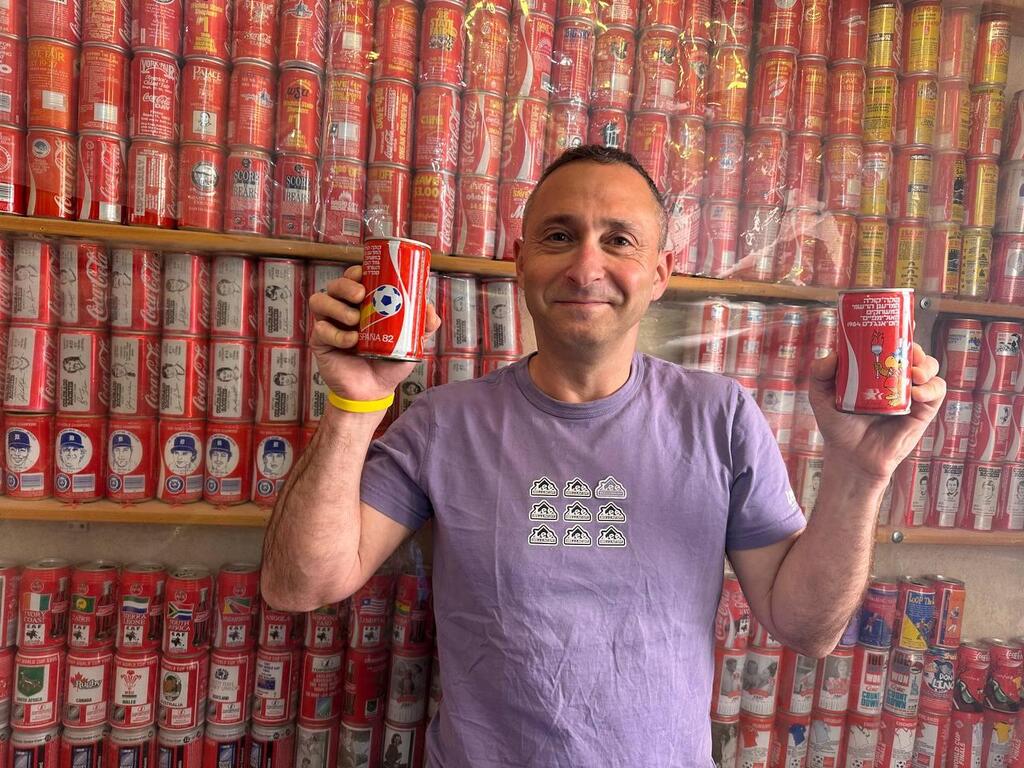
Coca-Cola can collector Ophir holds two rare cans from his collection at his home in Kibbutz Tzora. Behind him are hundreds of vintage cans arranged by theme, country and campaign
(Photo: Bar Gindy)
The modern era of the collection began when Ophir re-entered the collector network. At first, he tried old-school Israeli internet forums and came up empty. Then a fellow collector told him the truth: “All the collectors are on Facebook.” Ophir opened an account, stepped out of anonymity and suddenly found himself inside a global system driven by one powerful currency: trust.
Cans are traded, not just bought. The collector term is “trade,” a direct exchange based on what each side needs. Ophir’s leverage is Israel. International collectors want Israeli editions, especially limited commemorative sets like Eurovision or Olympic-themed releases. In return, he receives rare international cans that would be almost impossible to source locally. “It’s all based on reputation,” he says. “If you’re not honest about condition, you’re finished.”
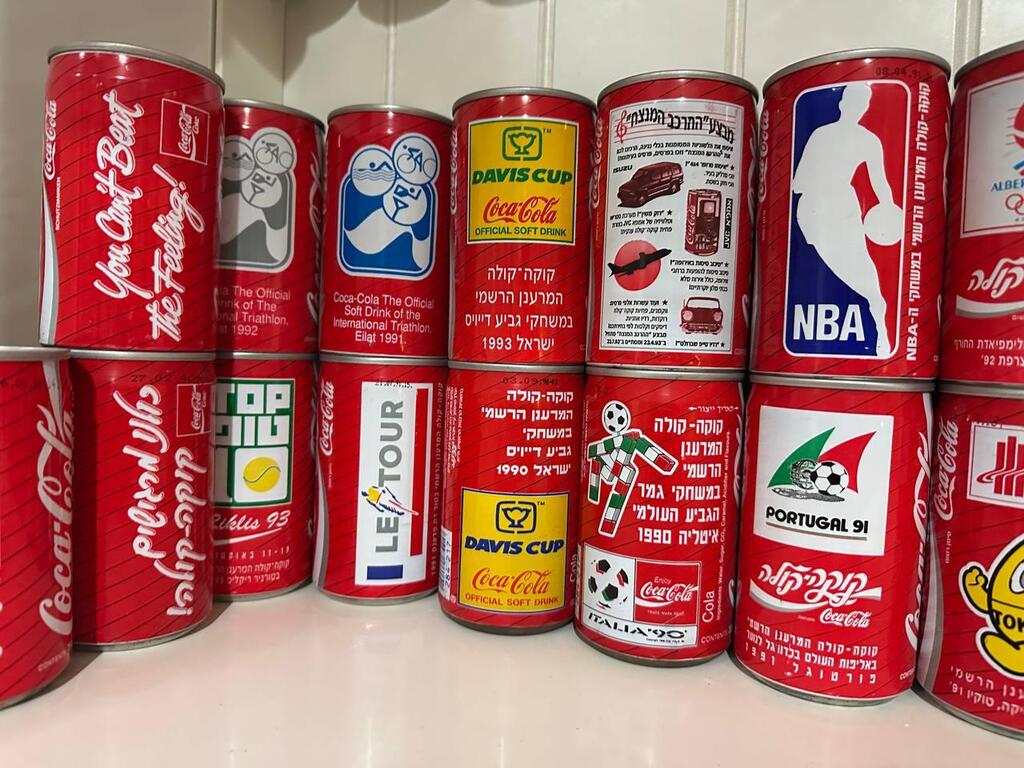
Commemorative Coca-Cola cans are displayed at the home of Israeli collector Ophir in Kibbutz Tzora. The collection focuses on limited-edition cans produced for sports tournaments, cultural events and advertising campaigns, mostly prior to the year 2000
(Photo: Bar Gindy)
There is no official global price guide. Value is fluid: the same can might be worth $1 to one collector and $100 to another. Still, serious collectors develop an internal benchmark based on auctions, past trades and scarcity. Ophir has sold individual cans for $150 and even $400, though he says most of his growth comes through trading. His strategy is pure collector logic: first, secure the can in any condition and upgrade later when a better version appears.
Some of his most prized items are not even commercial products. One example is a personalized can produced for Ronen Liwski, a legendary Israeli collector who once donated thousands of cans to Coca-Cola’s visitor center in Bnei Brak. Coca-Cola created a special can in Liwski’s honor, never sold in stores, and Ophir managed to get one after persistent requests. For European collectors, Ophir says, that type of story can be as valuable as the item itself.

Bar Gindy, left, host of the People & Collectors podcast, poses with Coca-Cola can collector Ophir inside Ophir’s home collection room in Kibbutz Tzora
(Photo: Bar Gindy)
Not every story is romantic. Ophir admits he was scammed once in a trade with someone from Colombia who provided a fake tracking number. Since then, he cross-checks names with other collectors before shipping. But he insists the community is overwhelmingly reliable: “Ninety-nine percent of the people I met are amazing.”
So why does a 53-year-old man dedicate years to chasing old cans? Ophir calls his space “my empire.” When he is stressed, he goes upstairs, sits quietly and looks at the walls. Each can represents a chase, a negotiation, a friendship, an achievement. “It gives me peace,” he says. “It takes me back to my childhood.”
But Ophir has one request: if you have old Coca-Cola cans lying around in a storage room, attic or warehouse, don’t let them rot. He needs them - not only for his shelves, but to keep trading and keep the hunt alive.
- For more stories from Ophir and other collectors, check out the People and Collectors podcast. The full interview is available with subtitles in English and 50 other languages.