

The first sign that a visit to Sam Halaby’s House of Colors in Daliyat al-Karmel, a predominantly Druze town on Mount Carmel near Haifa, will be anything but conventional comes before the interview has even begun.
Outside sits a car drenched in streams of pink, blue, yellow and green. At first glance, it looks more like an art installation than a working vehicle, making it all the more surprising when we climb inside, the engine starts and Halaby drives us through the village. People turn, smile and reach for their phones, while he watches their reactions with obvious delight.
Sam Halaby's House of Colors
(Video: Yael Feldman Shavit)


A Ferrari worth millions, he says, might earn a quick expression of admiration. His painted car makes strangers stop, laugh, photograph it and become part of the experience. “That is the power of art,” he says.
The remark captures both Halaby and his work. His art is exuberant, physical and difficult to observe from a distance. It spills across canvases, furniture and entire rooms. It is serious without behaving seriously, and deeply personal without becoming inaccessible.
That combination has now brought the Israeli Druze artist to the United States, where he is currently visiting as part of a July 6-18 tour. Halaby was selected as one of the 2026 Spotlight Artists at the Hamptons Fine Art Fair in Southampton, New York.
Gallery
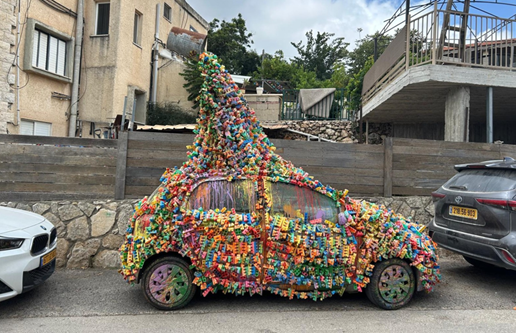
Artist Sam Halaby's paint-covered car sits outside his House of Colors in Daliyat al-Karmel, where it serves as both transportation and a mobile work of art
(Photo: Yael Feldman Shavit)
Represented by Corridor Contemporary, he appeared on the fair’s featured list alongside internationally recognized artists including photographer and musician Julian Lennon. Halaby says he only fully understood the significance of the selection when people began sending him screenshots. “Then I saw myself there with John Lennon’s son and other very big names,” he says. “It was emotional.”
The recognition is part of a career that has accelerated rapidly. Halaby says there was once a time when he would speak about having one exhibition in the next two years. Now his schedule includes several major shows within months, from Italy and New York to Canada and Miami. “My life has changed from one extreme to the other,” he says. “I never expected to reach this point.”
Yet the center of Halaby’s artistic universe remains the House of Colors, the former family home in Daliyat al-Karmel that he turned into an immersive artwork. From the moment visitors enter, nearly every surface seems to have been claimed by paint. Color pours across walls, ceilings, floors, staircases, furniture and household objects. Some rooms feel playful and almost childlike. Others are heavier, marked by darker shades, violent drips and thick eruptions of paint.
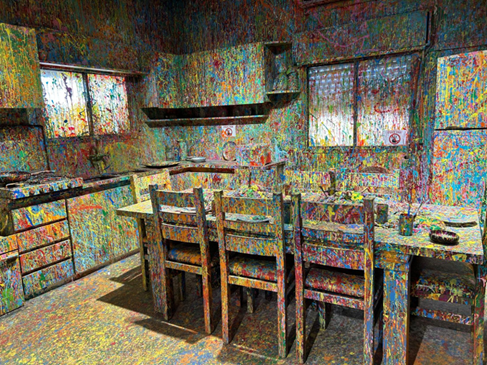
Nearly every surface inside Halaby's House of Colors is covered in layers of paint, transforming the family home into an immersive art installation
(Photo: Yael Feldman Shavit)
Color fills nearly every corner of the house, extending even into cupboards and drawers. One space, however, is deliberately left entirely white: a quiet, colorless area dedicated to Halaby’s mother, whose memory lies at the emotional heart of the work. The contrast reflects his own journey from a childhood shaped by hardship toward the joyful, exuberant world he has created around himself.
“The house is based on sadness and loss,” he says. “I don’t know what was stronger, whether I wanted to color my past or take revenge on it. It was a mixture of feelings.”
Born and raised in Daliyat al-Karmel, Halaby began painting professionally at 13 to help support his family. Becoming an artist was not the path expected of a talented boy in the village, he says. A more conventional profession, perhaps medicine, would have been easier for others to understand.
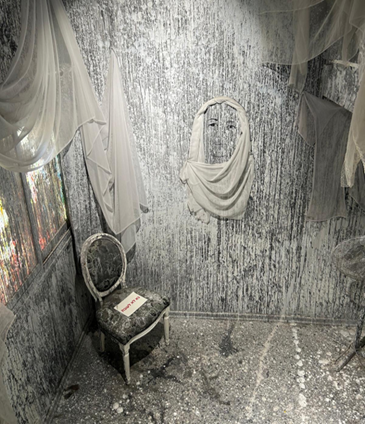
A white memorial room dedicated to Halaby's late mother stands in stark contrast to the vibrant colors that fill the rest of the house
(Photo: Yael Feldman Shavit)
His mother became the emotional heart of his work. Before her death, she encouraged him to convert pain into ambition. “She told me the sorrow would lead me to great things,” he says. “That I should transform it into success, passion and determination.”
After she died, Halaby began painting the parts of the home connected to her memory, trying to preserve what was warm and beautiful in a difficult past. Other sections became outlets for anger linked to his father, expressed through thrown paint, harsh movement and uncontrolled splashes. The result is not simply a brightly decorated house. It is a map of memory.
Tenderness and rage exist side by side. Domestic objects remain recognizable beneath layers of paint. Visitors do not stand quietly before a framed work. They walk through it, sit inside it and become part of the composition.
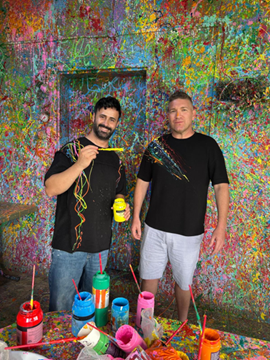
Israeli Druze artist Sam Halaby, left, creates a custom painted T-shirt for a visitor during an impromptu demonstration at his House of Colors in Daliyat al-Karmel
(Photo: Yael Feldman Shavit)
The experience is emotional, but it is also fun. Halaby jokes constantly, teases the people around him and turns a drive through Daliyat al-Karmel into an informal performance. Neighbors wave. Passersby recognize him. The painted car becomes a moving exhibition, and Halaby seems as interested in the people photographing it as they are in him. “I love people,” he says. “I love listening to a mother who is proud of her son, a father who is proud of his daughter, a grandmother telling her stories.”
At one point, a visitor interrupts the interview with an unusual request: He wants Halaby to splash paint across his T-shirt. A small crowd quickly gathers as the artist gets to work, transforming the plain shirt into a one-of-a-kind piece before their eyes. What begins as a spontaneous favor becomes a miniature performance, complete with cheers, cameras and the sense that anything around Halaby can become art.
That openness is central to his appeal. Halaby’s art does not demand prior knowledge or familiarity with gallery culture. Its impact is immediate: color, movement, scale and emotion.
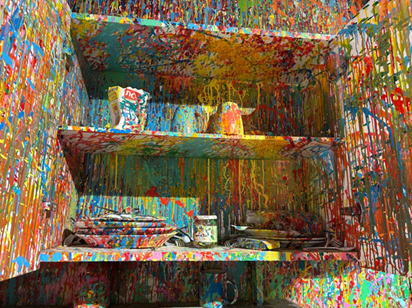
Paint covers shelves, walls and everyday household objects throughout Halaby's House of Colors, blurring the line between art and daily life
(Photo: Yael Feldman Shavit)
He has extended the same language beyond the house to clothing, sculptures, public installations and large commercial spaces. His representatives say his work and creative videos have generated more than 2 billion views across digital platforms. The online attention also brought him an audience he did not expect: children.
Halaby says young viewers now recognize him in restaurants and shopping centers. They stare openly, without the restraint adults often impose on themselves. “It is a beautiful, innocent audience,” he says. “There is magic in it.” He makes a particular effort to meet children at risk and speak to them about hardship. “I tell them that difficulties and complicated situations can make us stronger and better people,” he says.
Halaby’s own path was far from straightforward. His breakthrough came at a charity auction about nine years ago, where he says organizers initially questioned whether a young Druze painter belonged alongside established artists. His work ultimately fetched the highest price at the event. A later exhibition in Tel Aviv drew large crowds, and his work has since appeared in museums, galleries and art fairs in Israel and abroad.
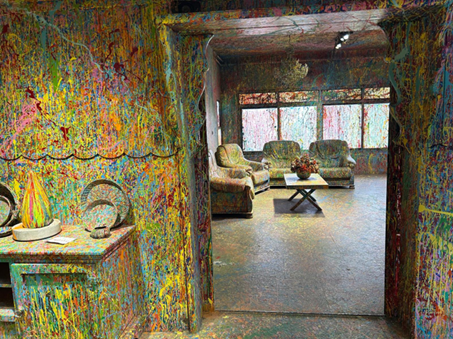
A view through adjoining rooms inside Halaby's House of Colors, where paint transforms the family's former home into a walk-through artwork
(Photo: Yael Feldman Shavit)
Halaby believes his Druze identity gives him an unusual role overseas. He represents Israel while challenging the assumption that every Israeli is Jewish, presenting instead a country made up of Jews, Druze, Muslims and Christians. He rejects descriptions of Druze citizens as merely “contributing” to Israel, arguing that such language implies they stand outside the national story. For him, the Druze-Jewish alliance began before the state’s establishment and developed into a covenant of blood, brotherhood and shared life.
“We are Israelis,” he says. “We love the flag. We grow up loving the flag. It is not that we are living in a country that is not ours. This is us. This is our country.” That sense of belonging, he added, should extend to anyone who embraces the country. “There is room here for everyone who wants to be Israeli, from every community and every religion.” Asked what message he hopes to deliver to Americans, he resists offering a polished slogan. “My message will pass through the art,” he says.
Perhaps that is where Halaby’s work draws its deepest power. The color does not conceal the past; it confronts it. By transforming a family home marked by loss into a place of wonder, he allows grief to remain present without allowing it to rule. The viewer is not kept at a distance, but invited to walk through that transformation and become part of it. What emerges is more than optimism. It is an act of reclamation, turning private pain into a shared experience that others can enter, interpret and carry with them.