

When Herut Davidson posts in Arabic, she knows some viewers will curse her or accuse her of propaganda. Others, sometimes quietly and sometimes from countries where contact with Israelis remains taboo, tell her that hearing an Israeli Jewish woman speak their language has changed the way they see Israelis.
Davidson, an Israeli content creator, has built an audience of more than 90,000 followers across TikTok, where she posts as hurriya.it.is.me, and Instagram, where she posts as hurriya.its_my_name. Her mission is unusual and increasingly sensitive: speaking directly to Arab audiences in Arabic at a time when war, polarization, and competing narratives have deepened mistrust across the region.
Her videos are part of a fragile experiment in direct regional engagement that grew after the Abraham Accords and has been tested by the Hamas-led attack of October 7, 2023, and the Gaza war that followed. For Davidson, Arabic is not only a language skill. It is a way to challenge assumptions, reduce fear, and speak across a divide that formal diplomacy alone cannot close.
The path to that mission began long before social media, in the environment where Davidson grew up.
“I think everything started when I grew up in a small village, actually in the West Bank, in the Shomron area,” Davidson said. “And there I had no choice to understand what is going on around me, but I really experienced it every single day.”
She described growing up exposed to tension, trauma, and complexity, saying those early experiences pushed her to learn more about the society around her. Raised in a religious environment, Davidson chose to do national service after high school rather than military service, as is common for some religious Israeli women.
Her first year of national service took her to Jaffa, a mixed city where she encountered a social reality different from the one she had known. She said the experience gave her a first real opportunity to know Arab society in Israel from closer range.
That encounter led her to Arabic. Davidson came to see the language not only as a means of communication but as a doorway into culture, religion, family life, and society.
Davidson later studied Middle Eastern studies and Islam at Shalem College in Jerusalem, where she learned both spoken and literary Arabic from Palestinian and Jewish teachers. She said the experience changed the way she lived in Israel.
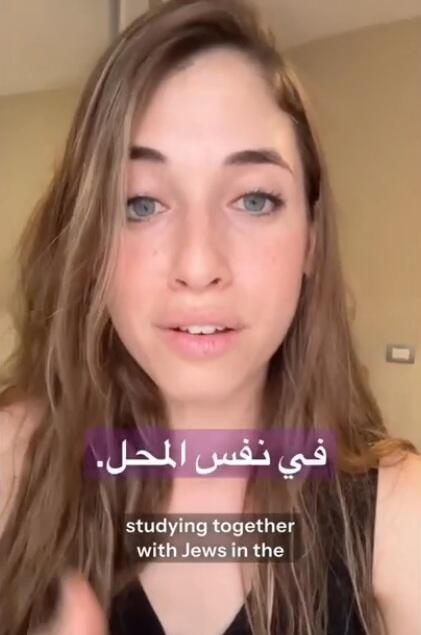
“It was an amazing experience for me,” she said. “And it's really changed my life in Israel, knowing Arabic.”
Arabic has a complicated place in Israel. It is widely used by Arab citizens, Palestinians in east Jerusalem, and Palestinians in the West Bank and Gaza, but many Jewish Israelis do not learn it as a practical spoken language. Davidson said that gap feeds suspicion in ordinary encounters, from public transportation to shops and pharmacies.
“Before I learned Arabic, when I was like, for example, in a public transportation, whatever it will be, and I heard Arabic, I was afraid,” she said. “Like, I thought they talk about me, and they want to do something bad. Because this is the trauma experience that we have as Israelis in Israel.”
Understanding Arabic, she said, made the language less threatening and more human. She recalled speaking Arabic with an Arab worker in a pharmacy and seeing him become more comfortable and curious.
For Davidson, that is the practical meaning of bridge-building. She does not present Arabic as a solution to the Israeli-Palestinian conflict, but as a tool that can reduce fear and build trust.
“I think it can change the situation,” she said. “It can improve so many things. It won't solve big problems, but it will be like, so, so, so different.”
Although Davidson’s engagement with Arabic began before October 7, she said the Hamas-led attack and the war that followed transformed her language skills into a public mission. Hamas-led attackers killed about 1,200 people in Israel and abducted 251 people to Gaza that day, according to Israeli tallies. Israel’s ensuing war against Hamas has caused vast destruction in Gaza, where Gaza health officials say nearly 73,000 people have been killed.
“My way started before October 7, but October 7 really shaped it into social media actions,” she said. “I had the language before, because this is what I believe in.”
After the attack, Davidson said she felt a responsibility to use Arabic to present her own perspective directly to Arab-speaking audiences. She said she became increasingly troubled by what she saw as a narrow representation of Israel in regional and international media.
“As a young Jewish woman, I must use my Arabic to share my point of view and my perspective about what is going on,” she said.
Davidson said the turning point came when she saw how Israel was being discussed abroad, especially in parts of the Arab media environment.
“What really was the point that I decided that I must do something, it was after October 7, when I saw the whole world hate Israel, blame Israel about everything, and especially in the Arab world,” she said.
She argued that many audiences were seeing only one side of the conflict and not the daily fear experienced by Israelis under rocket fire.
“I wanted to bring an authentic point of view about what is going on, like, hey guys, I'm getting down to the shelter because there are rockets,” Davidson said. “This is such a simple situation that we, as Israelis, experience so much.”
(Photo: Screenshot)
For Davidson, one of the most troubling elements was what she described as the disappearance of October 7 from parts of the public conversation.
“I think the fact that October 7 really doesn't exist in the world, but October 8 is what matters,” she said. “People really, a day after, maybe a few hours after the attack itself, that happened on the morning of October 7, they already started to share that Israel is attacking, that Israel attacks Gaza, or Israel does this and that, and, like, ignoring simple facts about what happened.”
She said many people she encountered online did not understand the context of the war or the impact of the attack on Israeli society.
“People don't really understand, they just see the war that came after, but they didn't see the context, they didn't see what is going on,” she said.
Davidson also pointed to the hostages taken into Gaza and said some viewers told her they had not previously heard about the killings, abductions, and sexual violence reported after October 7.
“I posted a video about the sexual, brutal actions that Hamas did back then, and some of them wrote to me, this is the first time that I hear what Hamas did that day,” she said.
Her online name, “Hurriya,” has also drawn attention. In Arabic, “hurriya” means freedom. Davidson explained that the name is not a political slogan but a translation of her Hebrew name, Herut—a word also associated in Israel with Menachem Begin’s right-wing Herut party, a precursor to Likud.
“My name in Hebrew is Herut,” she said. “It has no politics connections. My name is Herut because my parents gave me that name, because I was born in Pesach.”
Passover is also known in Hebrew as Hag HaHerut, the festival of freedom, because of the biblical story of the Israelites’ liberation from slavery in Egypt. Davidson said the Arabic version of her name carries the same meaning.
One of Davidson’s main messages is that more Israelis should learn Arabic, not only as a formal subject but as a practical language of daily life. She said this was one of the reasons she began posting videos online.
“One of the reasons that I started to post videos on social media was also to bring the message and awareness for Israelis, how important and possible it is to learn Arabic,” she said.
Her message is not aimed only at Arab audiences. She also wants Jewish Israelis to recognize Arabic as a regional language that can make daily life less alienating and less fearful.
Davidson said language can build trust, especially in a country where Jewish and Arab citizens often live near one another but remain socially distant. Israelis need Arabic, she said, not only because of Israel’s Arab minority but also because Israel is part of the Middle East.
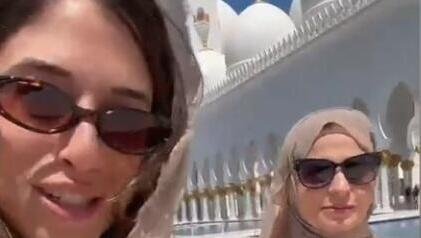
A recent visit to the United Arab Emirates gave Davidson a glimpse of how far regional relationships can go when public contact is possible. She traveled to Abu Dhabi to take part in the third International Dialogue of Civilizations and Tolerance Conference, convened by Women Champions for Change, and said she was struck by the ability to say openly that she was from Israel while visiting a Muslim country.
Davidson said she was excited by the prospect of real partnership with people in a Muslim country where she could openly identify as Israeli.
“I was super excited about it,” she said.
She said the UAE gave her a sense of possibility for the broader region.
“I felt that the UAE really gave me hope about the Arab world, and about the Muslim world,” she said. “That it is possible to have connection with Israel. And it is possible to build something together.”
Davidson contrasted that openness with the barriers still present in other countries. Lebanon’s anti-normalization framework is not a single simple “no talking” statute; it is rooted in several legal provisions, including the 1955 boycott law, and can make public contact or dealings with Israelis legally risky for Lebanese citizens.
Davidson described those restrictions in blunt terms.
“You know, in Lebanon, there is a law that it's forbidden to talk to Israelis,” she said. “Just the talking. Not even do something. Not even go somewhere.”
Her interactions online, she said, reflect both realities: hostility and quiet support. Some Lebanese users, she said, privately expressed appreciation for her comments about peace but could not publicly collaborate with her or tag her.
“We saw your video, and we are super excited about it, and thank you for sharing that, thank you for saying your opinion, and your wish for peace,” she recalled them saying. “We also want the same thing, just to know that we cannot allow this tag or this collab, because it's just forbidden. But we really support it.”
Davidson said she tries to communicate not only through language but also through cultural and religious respect. She pointed to a recent video from a mosque visit as an example, saying she wanted to show respect for Islam and invite others to learn about Jewish religion and culture in return.
During her visit to Abu Dhabi, Davidson also met creators from the UAE and Bahrain. She said she admired those willing to appear publicly with her despite the backlash they may face in the Arab world.
“I really appreciate that they're brave to share their point of view against so much, against, I would say the mainstream in the Arab world,” she said. “I super appreciate when a Muslim talked to me, and also agreed to be on my social media page, and be tagged.”
Such interactions, she said, would have seemed almost impossible before the Abraham Accords.
“I think it's so new for all of us, like it couldn't happen six years ago,” she said.
For Davidson, social media has become both a battleground and an opportunity. She said traditional media often leaves citizens dependent on official or dominant narratives, while social platforms allow individuals to speak directly.
That access comes with a cost. Producing content during war has taken an emotional toll, Davidson said, especially when videos force her to process violent material while deciding how to frame her message publicly.
“Wow, it is very hard,” she said. “Sometimes I'm like, I'm so overwhelmed, and I'm so like, I cannot, what, like making a video about what is going on right now, like I don't have any energies to do it. I need to deal with my, you know, with my own stress.”
One of the most difficult videos she posted, she said, was about sexual violence committed by Hamas on October 7. She said she had to watch difficult material while editing the post and sometimes had to step back to protect herself emotionally.
Speaking about war also means being forced into political categories, she said, even when she is trying to speak from personal experience.
“Bringing something about the war, it's always politic,” she said. “It's always like, you cannot really separate it between your opinion about war and politics.”
Davidson emphasized that she does not claim to represent all Israelis.
“I'm not presenting the Israelis, I'm presenting myself,” she said. “Like bringing my voice.”
The backlash has been severe. Davidson said some of the worst responses included Holocaust-related abuse.
“One is ‘Hitler was right,’ and comments about the Holocaust,” she said. “My grandmother and my grandfather, they ran away from Europe back then, this is how they survived, all their families were killed, and I think this kind of comments really, really hurts me.”
She also recalled a message from a Palestinian user who justified violence against Israelis.
“A Palestinian wrote me, ‘You stole our land, so everything is … allowed to do, including rape, it is justified, because you stole our land,’” Davidson said. “So, … I don't think I need to explain more.”
Other messages, Davidson said, have convinced her that her work can shift perceptions, even if only gradually.
“I got a comment from, actually it was from a few different countries, … ‘Thanks to your content, I now know more about Judaism and about Israelis, and I don't hate them anymore,’” she said.
For Davidson, that is the point. She said she is not trying to make Arab viewers love Israel or Israelis, but to make room for reconsideration.
“I don't look for their love,” she said. “But I do look for their flexibility of, like, changing their mind about what is going on, or, like, open their mind, you know, and to make them understand that there is more than what they have told you.”
That may not be diplomacy in the grand, treaty-signing sense. But for Davidson, a message from someone who says they no longer hate Israelis is enough to keep speaking.