

“The Circle – Designing New Realities,” a new exhibition opening at the Design Museum Holon on Thursday and running through May 2027, sets a fairly ambitious bar with its title alone. And “The Circle” is indeed an impressive and thought-provoking exhibition. That is true not only of the objects on display but also of the approach it takes: an exploration of ecology and humanity’s impact on the environment — and the environment’s impact on humanity.
But this time, instead of the familiar narrative of global disaster and biblical-scale catastrophe, the exhibition invites visitors to follow a more optimistic scenario. Can technological advances help us design objects that will lead to a better future?
“The Circle” exhibition at the Design Museum Holon highlights sustainable design and solutions to the climate crisis
(Credit: Rotem Cohen)


The museum spent about 2 and a half years working on “The Circle,” a large-scale exhibition that spans all of its galleries. It features dozens of projects from Israel and abroad across a range of design fields, including industrial design, fashion design, architecture and visual communication. It also presents developments by startup companies, as well as projects created in collaboration with leading Israeli research institutions, including the Weizmann Institute of Science, the Technion-Israel Institute of Technology and Shenkar.
Some of the projects on display are already in use or are expected to enter use soon. Others offer conceptual proposals — ideas intended to open the imagination and encourage visitors to believe in a different reality, perhaps even to embrace a word that has become almost taboo in Israel: hope.

'We don’t get discouraged by the ‘no’ we receive'
And if hope is what we are talking about, the exhibition’s international dimension cannot be ignored. While creators from abroad are taking part, bringing them on board appears to be becoming increasingly difficult.
There are quite a few international names in the exhibition. How complicated was that in the current circumstances?
Liraz Cohen Mordechai, the museum’s acting chief curator: “There are local designers and creators here alongside international ones — from Spain, Mexico, the United States, Canada, Germany and other countries. And this is indeed a very nontrivial thing during the period we are in. As a museum, we have the ability to bring an international perspective, as we have done in almost every exhibition presented here in the past. (Maarten Baas, Patricia Urquiola, Oki Sato, Marcel Wanders, Stefan Sagmeister and Jessica Walsh are among the names)
“As a museum, we don’t get discouraged by the ‘no’ we receive from one creator or another. As the only design museum in Israel, it is important for us to exhibit creators from abroad alongside supporting local creators, and to do everything we can to bring things from outside in. That is part of our role.”
Talia Yanover, who curated the exhibition with Lior Hermoni, manager of the Design Museum’s Aharon Feiner Eden Materials Library, adds: “It was definitely complicated. We had conversations that began and then came back to us with the news that partners or colleagues thought it wasn’t a good idea to participate in the exhibition, or conversations that began and then simply disappeared…”
Cohen Mordechai: “Many times, it isn’t necessarily because the creator themselves has a problem with exhibiting in Israel, but because they are concerned about how they will be perceived by the international community of creators if they exhibit at a museum in Israel.”
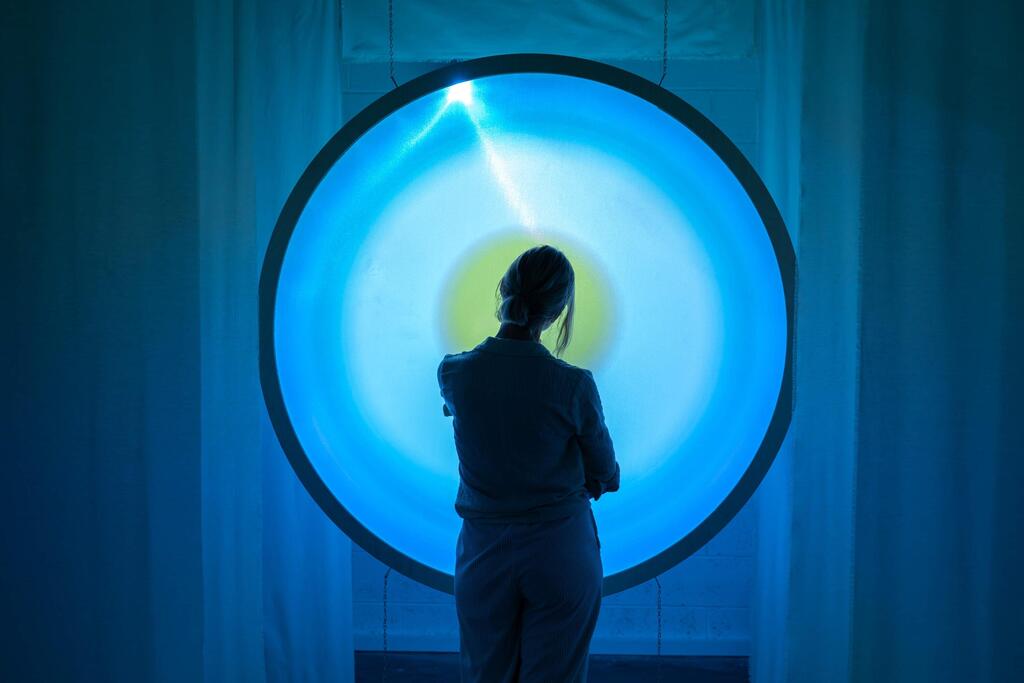
'Pulse Now' by Olga Stadniuk
(Photo: Daniel Hanoch)
The waste left behind by an exhibition
It is not only the exhibits themselves that embody the principles of sustainable design. In an admirable effort, the museum has also sought to apply the exhibition’s principles to the way it is presented.
“Exhibition design, at its core, is also something that isn’t very sustainable. In the end, you produce all kinds of display elements and when the exhibition ends, they become waste,” Cohen Mordechai explains as we meet her and the exhibition’s curators during installation.
“Throughout the process, we tried to think about what options, alongside the aesthetics and appearance expected at museum standards, would also embody these principles,” she says. “We are the only design museum in Israel, and we take this role and our desire to be at the forefront and bring innovation very seriously.
“The idea behind the exhibition is circular design. It is about trying to take from nature what nature knows how to do best and most effectively, combined with innovation, technology and science. We are used to talking about climate in ways that are very frightening and overwhelming. This exhibition is asking not to create fear, but to talk about solutions. Instead of talking about what the problem is, talk about what can be done.”
“We don’t want to be afraid to dream — it’s a very significant tool in design and innovation,” Yanover says. “We realized during our research for this exhibition that we are part of a closed system.”
What does that mean?
“In the world, there is actually no waste. Waste is a fiction. It isn’t a real thing, because it remains with us. It doesn’t disappear from the planet. Everything is one system. We are proposing that design be viewed as something that can encompass the entire system.”
Active optimism, despite everything
Cohen Mordechai was appointed to the position following the resignation of Mia Dvash, the legendary curator of the Design Museum Holon, amid tensions and disagreements between Holon’s cultural institutions and the municipality that led to the closure or downsizing of several institutions. Among them are the Center for Puppetry and the Center for Digital Art, an institution that produced significant projects in Israel’s art scene and whose operations are set to be significantly reduced. The move led Udi Edelman, who headed the center for years, to resign.
For now, the Design Museum’s budgets appear to have remained unchanged, and the municipality continues to recognize the museum’s importance to Israel’s visual and material culture.
Cohen Mordechai, who also serves as acting curator of the Israel Cartoon Museum, as her predecessor did, acknowledges the weight on her shoulders and those of the museum but is not afraid.
“The burden of proof is enormous. We feel it and we know it. All eyes are on us. The museum has an incredible team, which is a blessing, and from our perspective, we are continuing to be at the forefront of design in Israel,” she says.
Yanover agrees: “This is a very complicated period in the country. There will be elections soon, and we don’t know what will happen here, from the outside or within. Part of our mission, all of us, as we really felt it, was to try to create an exhibition with some kind of positive message amid all this chaos. This is active optimism.”
Five projects not to miss at 'The Circle'
GENNY+ by Watergen
GENNY+ by Watergen
(Credit: GENNY+ by Watergen)
There could hardly be a more relevant time, amid the current water crisis at Israel’s desalination facilities, to present Watergen’s device — a home or office water dispenser that produces drinking water from humidity in the air while using minimal resources.
The device extracts drinking water from the air and subjects it to carbon filtration and mineralization, restoring minerals to make it high-quality drinking water. The process was demonstrated for us during installation of the exhibition.
The company also produces industrial-scale devices that are not displayed at the Design Museum Holon. One can only hope that exposure through the exhibition will help advance such solutions among the Israeli public.
'Orchard' — Ofer Assaf and the MTRL Laboratory at the Technion
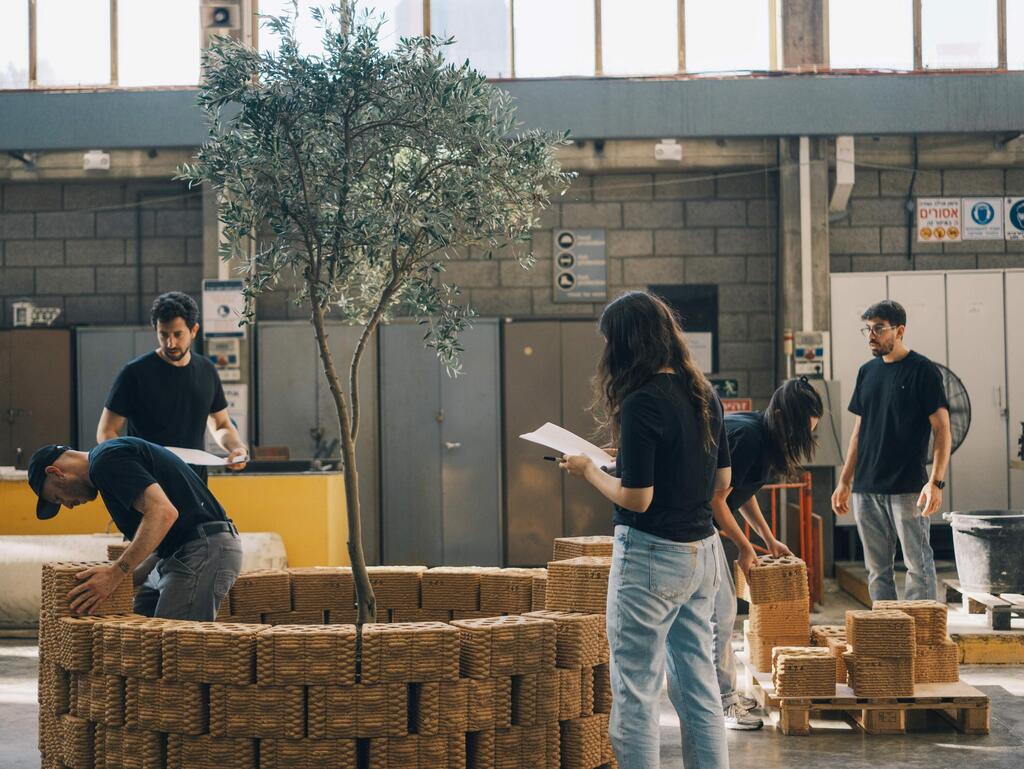
'Orchard,' a project by Ofer Assaf and the MTRL Laboratory at the Technion
(Photo: Ido Asulin)
The first work visitors encounter on the exhibition’s entrance floor is “Orchard,” a kind of architectural pavilion built from bricks 3D-printed from earth. The bricks are made with no waste and are designed to protect young trees while they are still vulnerable to the elements.
The design incorporates shelter and habitats for elements of the ecosystem, including bees, birds and fungi. The project examines how contemporary digital tools can be combined with local materials and principles of ecological architecture.
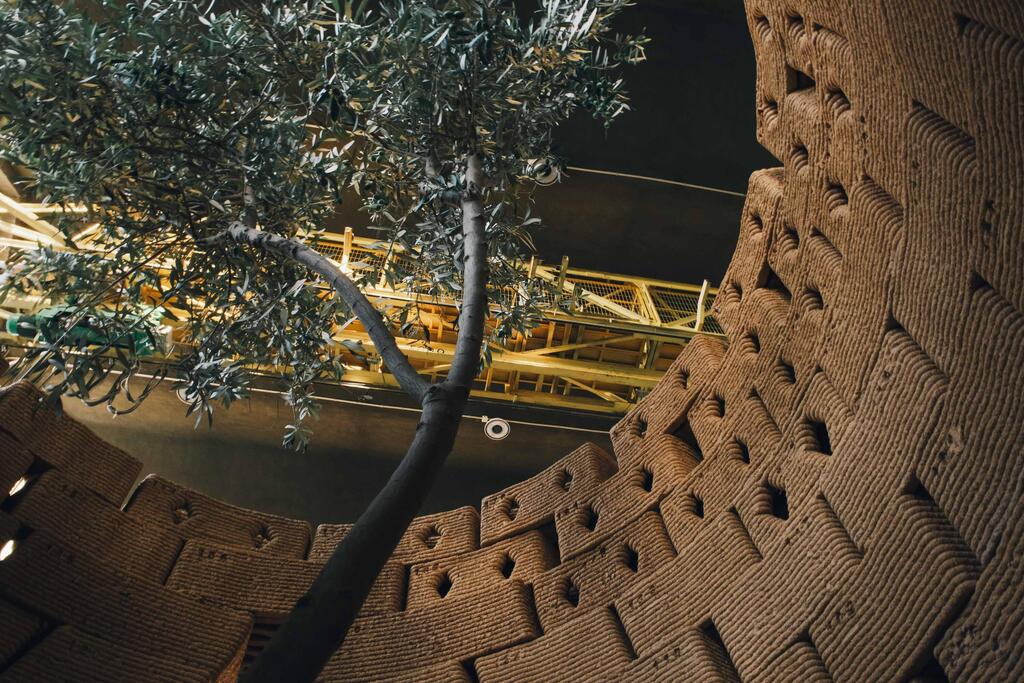
A pavilion made of 3D-printed earth bricks with no material waste
(Photo: Ido Asulin)
To uphold the exhibition’s principles, the olive tree standing inside the pavilion is a real olive tree. It is monitored by the creators and provided with optimal conditions for growth even within the enclosed exhibition space.
'Mitumba' — Merav Gazit and Maya Arazi
No fewer than 200 pieces of clothing destined for burial are displayed as blocks in the exhibition, much as they are transported in huge containers to developing countries for disposal. Most of the clothes are still wearable and some have never been worn.
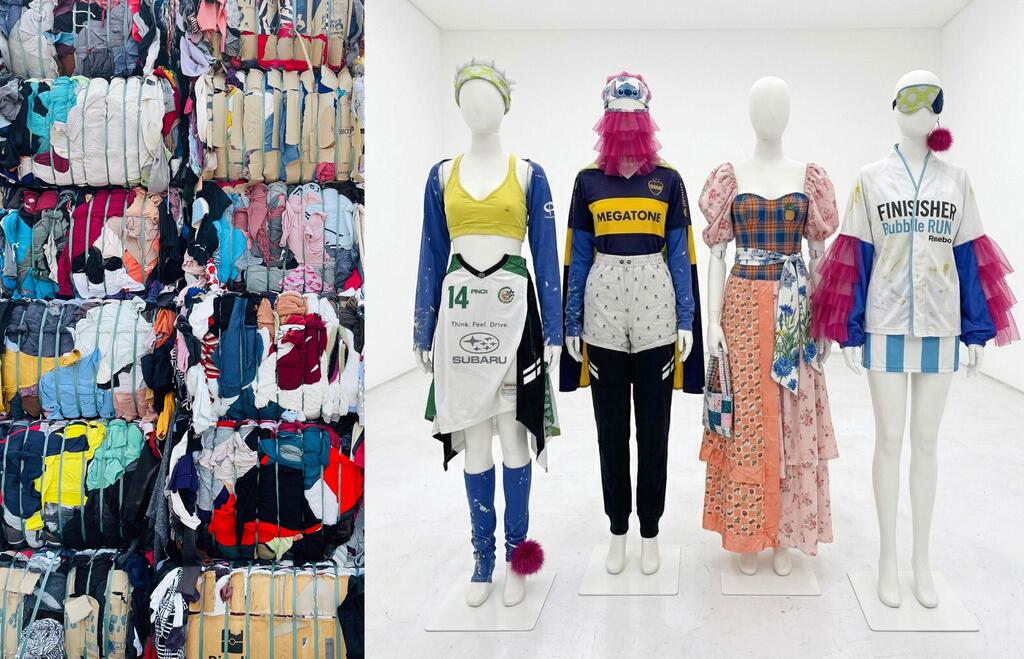
'Mitumba' — Merav Gazit and Maya Arazi
(Photo: Courtesy of the creators)
According to the exhibition’s curators, data indicate that even if the entire fashion industry — one of the world’s most polluting industries — were to stop producing clothing immediately, there are currently enough garments in existence to meet humanity’s needs for another 50 to 70 years without producing additional items.
Beyond the visual impact, the shock created by the sheer mass of clothing piles echoes the iconic installation “Venus of the Rags” by Italian artist Michelangelo Pistoletto, in which a marble statue of Venus bows her head before a huge pile of discarded textiles.
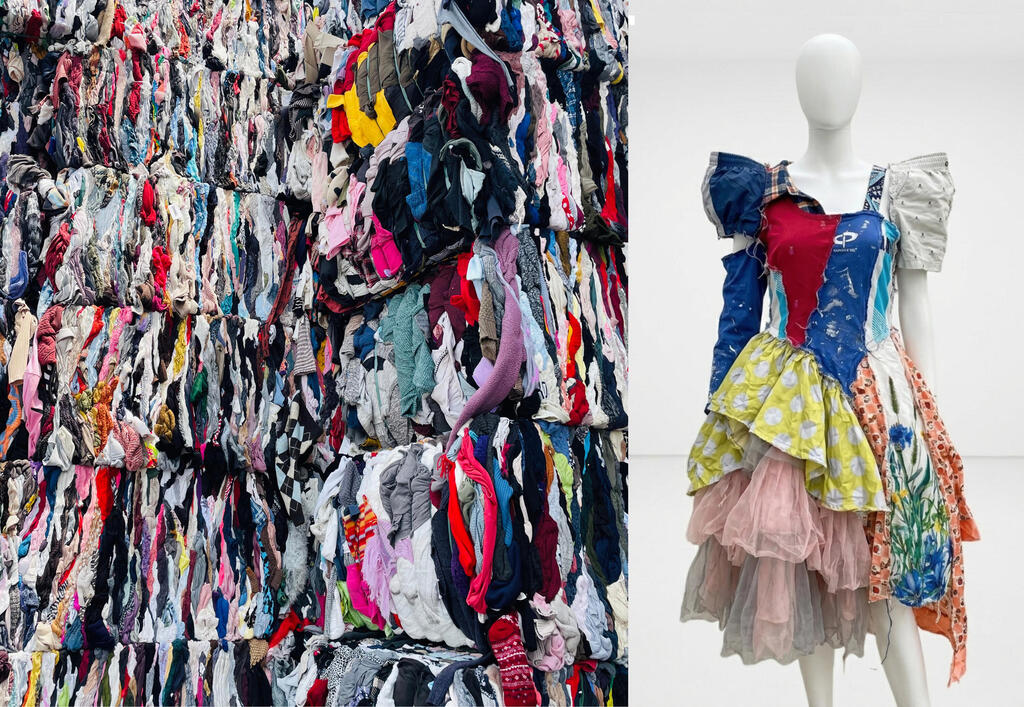
Piles of clothing illustrating the environmental impact of the fashion industry
(Photo: Courtesy of the creators)
There is also a technological punchline. The garments destined for disposal are transformed through artificial intelligence into colorful and bizarre clothing systems that treat clothes as data and begin to move beyond the human, generating what can be perceived as “glitches” or as an expansion of our understanding.
TOMGROW TECH
Tomgrow is an Israeli agtech startup that produces gel-like cubes containing nutrients for plants, replacing the need for soil. Instead of regular watering, the plants can be watered twice a year while still maintaining a thriving green space.
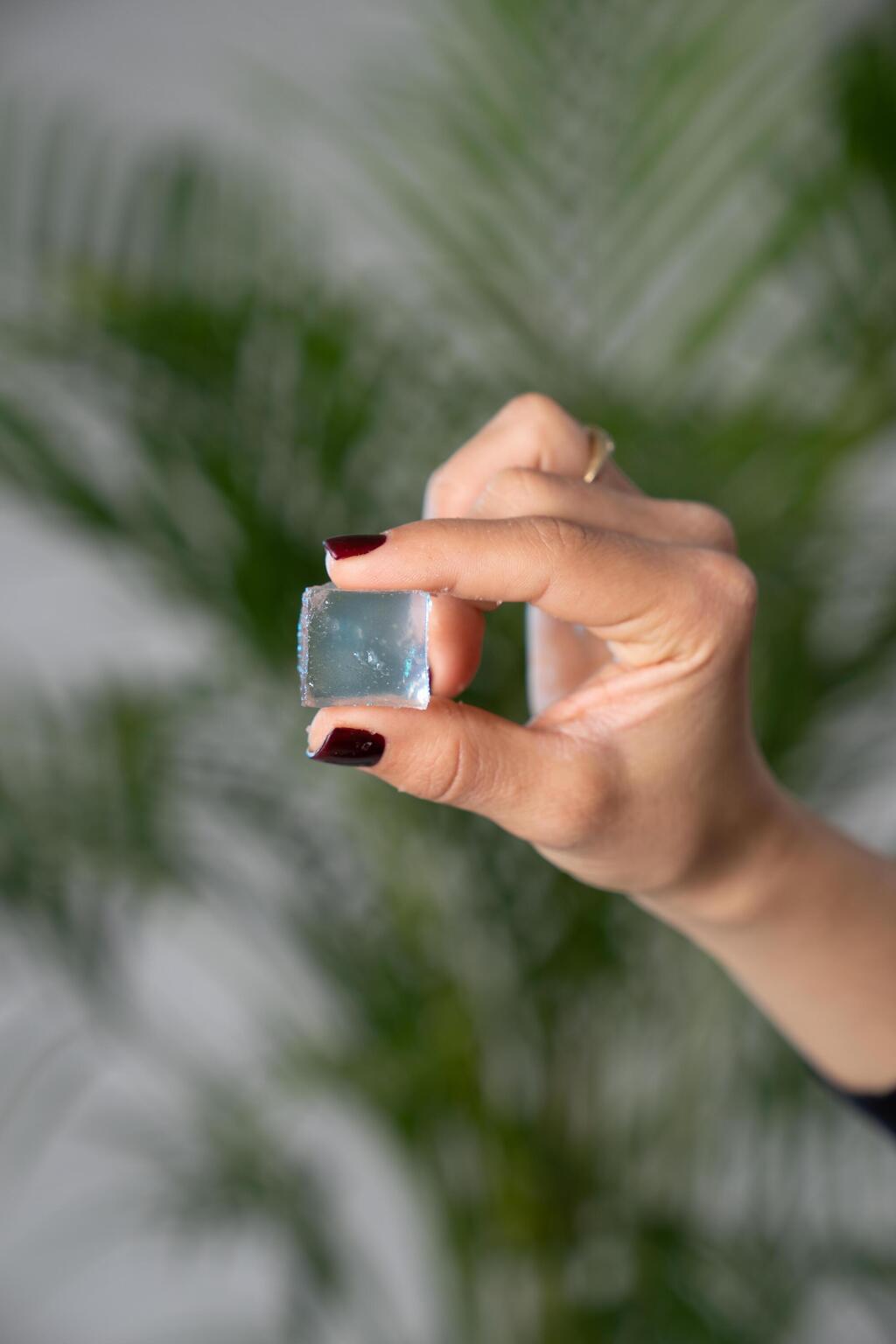
An Israeli startup has developed gel cubes that allow plants to be watered only twice a year
(Photo: Courtesy of Tomgrow)
Beyond saving water and resources in large spaces such as offices and hotels, the technology could also be a potential lifesaver for home users who cannot seem to stop killing their plants by failing to water them.
“Solarpunk” — Gilad Rozenkof, Replica
A speculative futuristic video work that explores what Israel’s urban environment might look like in a future where technology is also harnessed to serve ecological goals.
In a sense, Rozenkof’s commissioned work encapsulates the idea behind the entire exhibition: to create a fantasy that is neither childish nor implausible or excessively wild about a possible path for humanity, one in which it chooses to apply tools to improve the climate situation.
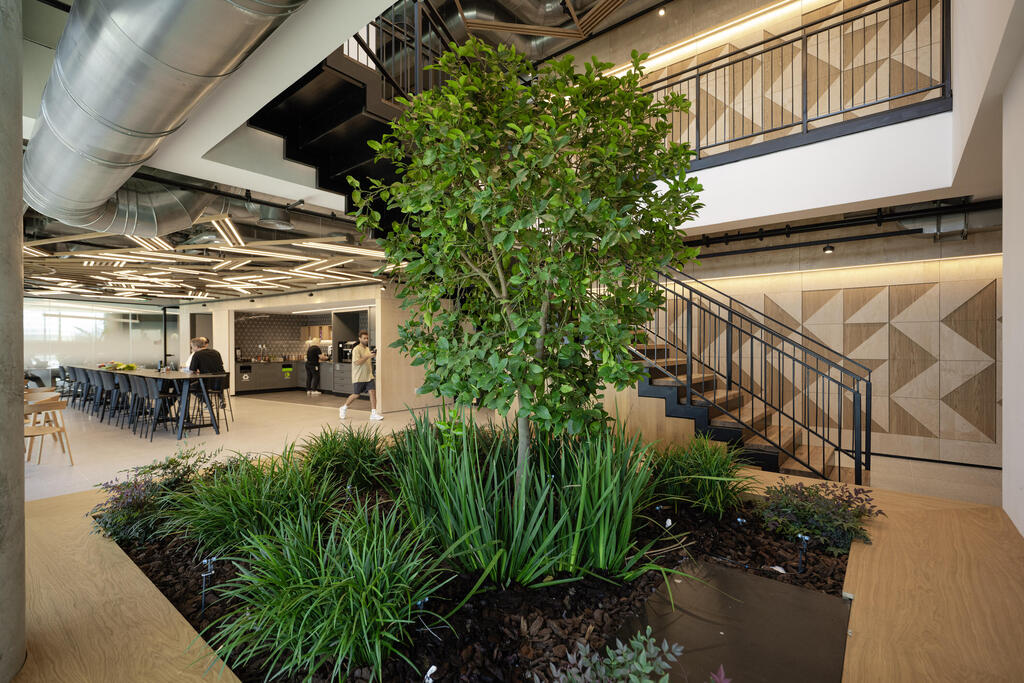
Greenery incorporated into a space without the need for frequent watering. Space design by Auerbach Halevy Architects
(Photo: Michael Tumarkin)