

When Japanese experts single out an 18-year-old Israeli as a contender to win the judo world championship, it is a compliment worth taking seriously. In judo’s homeland, every weight category is being analyzed in depth ahead of the tournament opening Sunday morning in Baku. For the Japanese, this is the high point of the season, especially with less than two years remaining before the Los Angeles Olympics. And in the under-60 kilogram category, the name of Izhak Ashpiz of Rishon LeZion has been highlighted.
Ashpiz will step onto the mat in Azerbaijan, another country where judo holds a prominent place, as much more than a prospect. The Japanese experts have plenty to base their assessment on: in the first nine months of the year, he recorded 22 wins against only four losses, a success rate of nearly 85%, and turned podium finishes into a habit. He enters the senior world championships as the No. 2 seed, behind Azerbaijan’s Balabay Aghayev, who defeated him twice this year.
A year ago, Ashpiz was eliminated in the first round of the European Championships. This time, he arrives with a completely different status — though he still received a very difficult opening-round draw against Giorgi Sardalashvili, the world champion from two years ago and last year’s European champion. The two met late last season, before Ashpiz’s breakthrough, when the Georgian defeated him comfortably.
Gallery
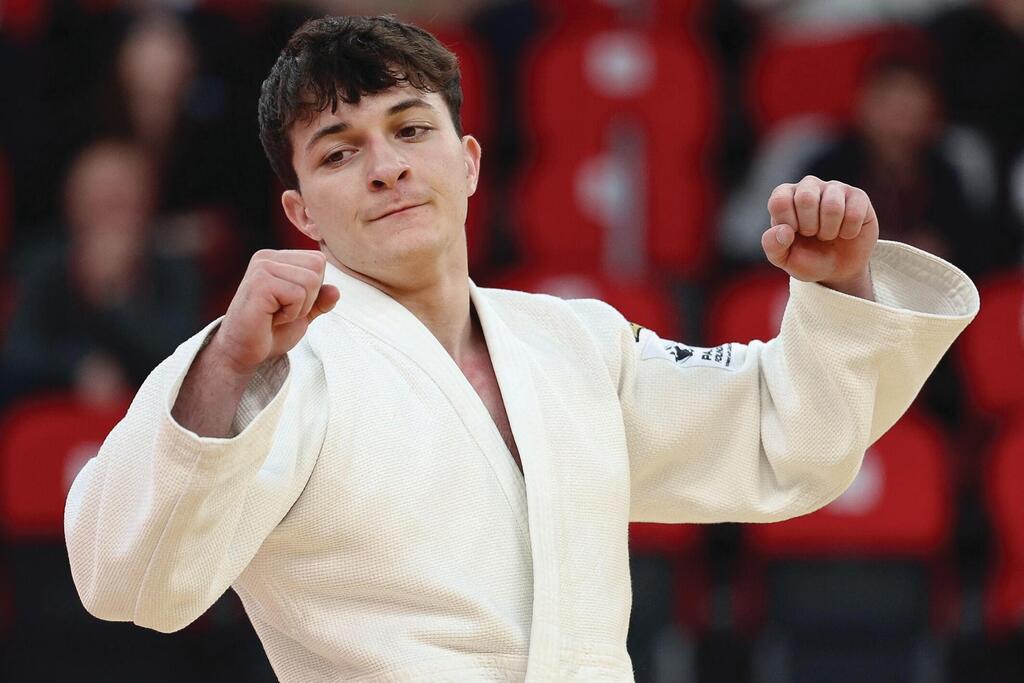
Izhak Ashpiz is tipped as a medal contender in the judo world championships
(Photo: Giorgi Arjevanidze/ AFP)
In Israeli judo, it is difficult to remember a breakthrough like this at such a young age, even looking back to the early years of Arik Ze’evi and Oren Smadja. Ashpiz displays attacking, stylish and entertaining judo. His talent was known even before this year: he had already won both the cadet world championship and European championship. But his rapid rise to the top of the senior ranks, against experienced and decorated opponents, has made him one of the standout stories in the sport.
Right on time
This breakthrough is coming exactly when Israeli men’s judo needs it most. Ashpiz is its great — and only — hope at this level, after an entire generation of successful athletes retired following the Paris Games and left a huge void behind.
For more than a decade, association chairman Moshe Ponte preferred to invest at the top, in athletes who had already produced results, while neglecting the base of the pyramid. Now, with the veterans having left the mat, it is becoming clear how little was built behind them. Into that reality stepped a teenager who began in a class included in his parents’ country club membership in Rishon LeZion.
The explanation for the excitement around him can be found in the stops he made this year. In February, he won bronze at the Paris Grand Slam, one of the most prestigious and difficult events on the circuit, often described as the Wimbledon of judo. On the way, he produced one of the most significant wins of his career, beating reigning world champion Ryuju Nagayama of Japan.
A month later came gold at the Tbilisi Grand Slam. Within two tournaments, Ashpiz already had two medals from that level of competition. Even in judo, where young talents can surprise on a given day, such a run at age 18 is unusual.
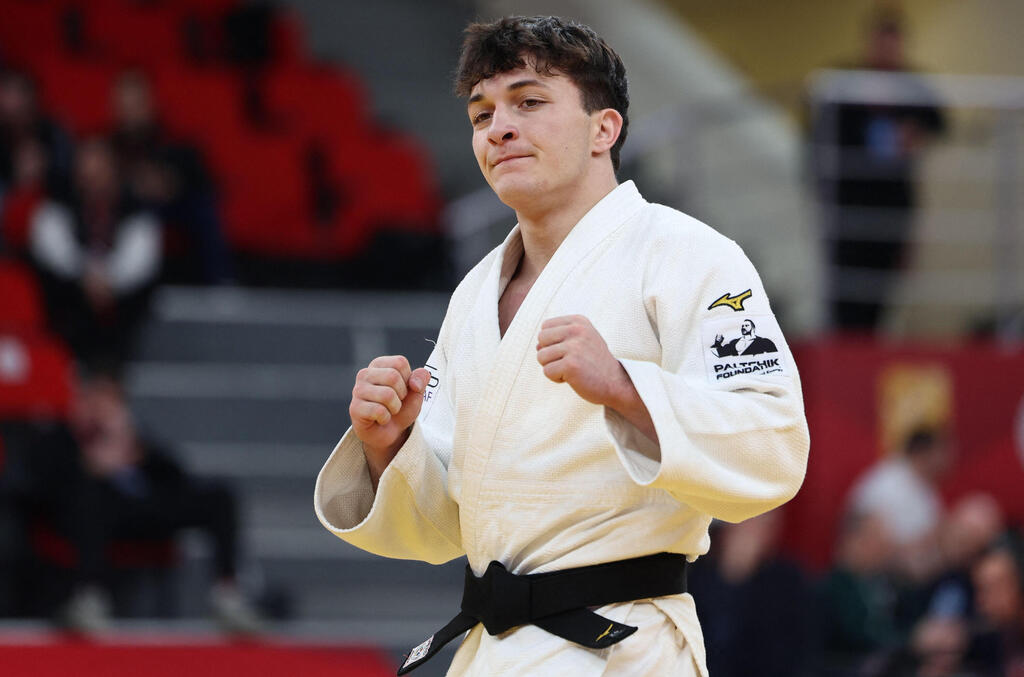
Izhak Ashpiz in Tblisi
(Photo: Giorgi Arjevanidze / AFP)
In April, Ashpiz returned to Tbilisi, this time for the European Championships, and added a bronze medal that made him the youngest Israeli judoka to reach the podium at the senior continental championships. In the quarterfinal, he beat France’s Romain Valadier-Picard, the world runner-up, providing further evidence that his Paris result was no fluke.
In June, he continued with bronze at the Grand Slam in Mongolia, and last month, in his final warm-up event before Baku, he won gold in Budapest after defeating France’s high-level Enzo Jean in the final.
The Japanese model
Alongside the run of success, there were also moments that served as reminders that he is still an athlete at the beginning of his career. The most notable came at the Qingdao Grand Prix in China, a lower-tier event than a Grand Slam, where he lost in his opening match to Mongolia’s Tumenjargal Tuvshintur.
It was a stumble that did not fit the consistency he showed throughout the year, especially compared with the level he reached in bigger competitions.
Overall, his four losses this year came against three opponents. Two were against Aghayev, the world No. 1, at the Paris Grand Slam and the Ulaanbaatar Grand Slam in Mongolia. The Azerbaijani remains an opponent Ashpiz has struggled to solve.
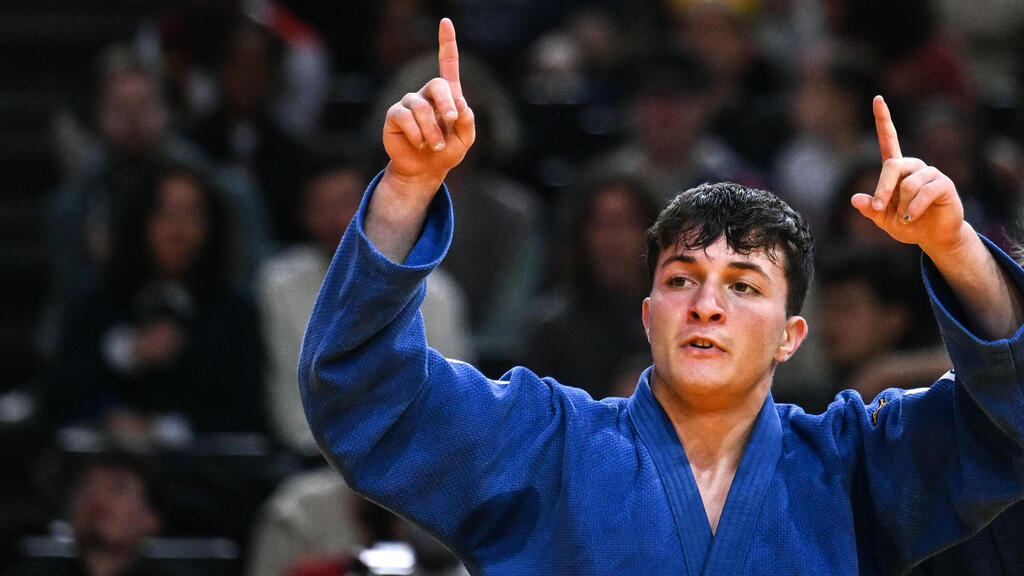
He's still an athlete at the beginning of his career
(Photo: Julie Sebadelha / AFP)
Another defeat came in the European Championship semifinal against Olympic silver medalist Luka Mkheidze, the Georgian-born Frenchman. Those are understandable losses against two elite judokas. The early exit in China was the less expected result.
That is why, when Japanese commentators place him among the candidates for gold in Baku, they are relying on an entire season. Nagayama, Valadier-Picard and Aghayev will all be among the top-ranked competitors at the championships, alongside Russia’s Ayub Bliev and Brazil’s Michel Augusto.
Ashpiz is already part of that group and, in some of those meetings, has shown he can beat them. Sunday morning, he will try to do it in the most important competition of his career so far.
His Japanese connection does not end with praise from commentators. Ashpiz’s role model is Hifumi Abe, a four-time world champion and two-time Olympic champion. Abe competes at under 66 kilograms, but the young Israeli has adopted his style: control of the fight and aggressiveness.
Ashpiz says he watches the Japanese star’s matches over and over to learn and draw inspiration.
The foundations were laid by Ido Romi, under whom Ashpiz began training in a country club class. Within a year, it was already clear how unusual he was on the mat, and the class later developed into a competitive program.
On the national team, he works with Golan Pollack, who has played a major role in his professional development. After Smadja’s departure, Pollack is also the man who will sit in the coach’s chair at the world championships and accompany him through his matches in Baku.
Romi says one of Ashpiz’s great advantages is how difficult it is for opponents to establish a comfortable grip on his judogi. Without that grip, it is harder for them to execute techniques, and Ashpiz is able to dictate the nature of the contest.
To illustrate the possibility of breaking through at a young age, the coach points to Italy’s Fabio Basile, who surprised with gold at the Rio Olympics. But he also stresses the difference in style: with Ashpiz, patience, confidence and modesty stand out. He is very young, yet conducts himself on the mat with the maturity of a veteran athlete.
Backed by Paltchik
But even this talent nearly stalled along the way. Romi himself speaks about the gap left by Ponte’s policy between the veteran medal-winning generation and those meant to succeed it.
According to him, Ashpiz did not even have an adequate national-team framework in which to train. After an unsuccessful period last year, he was also left off the association-funded competition tour in South America.
The person who helped him then was Peter Paltchik’s foundation, which provided financial support at a moment when he needed it.
The turning point came with a gold medal at the Grand Prix in Lima, Peru. It was not the most prominent event on the circuit, but for Ashpiz it opened the way to everything that came afterward. The opportunity to compete, win and build confidence proved highly significant in his development.
Off the mat as well, he is described as unusually mature for his age. Ashpiz is the oldest of three siblings, and his middle brother was born with Down syndrome. He was an outstanding student and even won the Rishon LeZion Bible Quiz.
From childhood, he developed mental resilience that is also reflected in the way he approaches competition: the draw and the names of his opponents do not change his objective. He steps onto the mat for every fight determined to win.
That approach connects with his professional abilities. His grip fighting, kumikata, is one of his standout strengths, alongside a tactical understanding not always found in athletes his age.
He knows how to make things difficult for an opponent, wear him down and force him into penalties, and he can win fights that way as well. Behind the attacking judo and attractive techniques is a great deal of patience and an ability to manage what is happening on the mat.
For all the praise, it is worth remembering that Ashpiz arrives at the senior world championships at just 18 years old. He is capable of producing a major performance on Sunday, but an early-round loss is also a possibility that has to be taken into account.
After a year in which he was seen as a rising force, he is now expected to win a medal. He will have to deal with that pressure as well.
Hershko’s hopes
Beyond Ashpiz, 10 other Israeli judokas will compete during the week at the championships. The strongest medal chance belongs to Raz Hershko, the world No. 1, who will compete in the over-78 kilogram category.
Gefen Primo will compete Sunday at under 52 kilograms. She enters as a seeded athlete and is improving, but in a talent-packed category it is still difficult to place her among the leading podium contenders. On a good day, she can certainly surprise, but to do so she will have to raise her level.
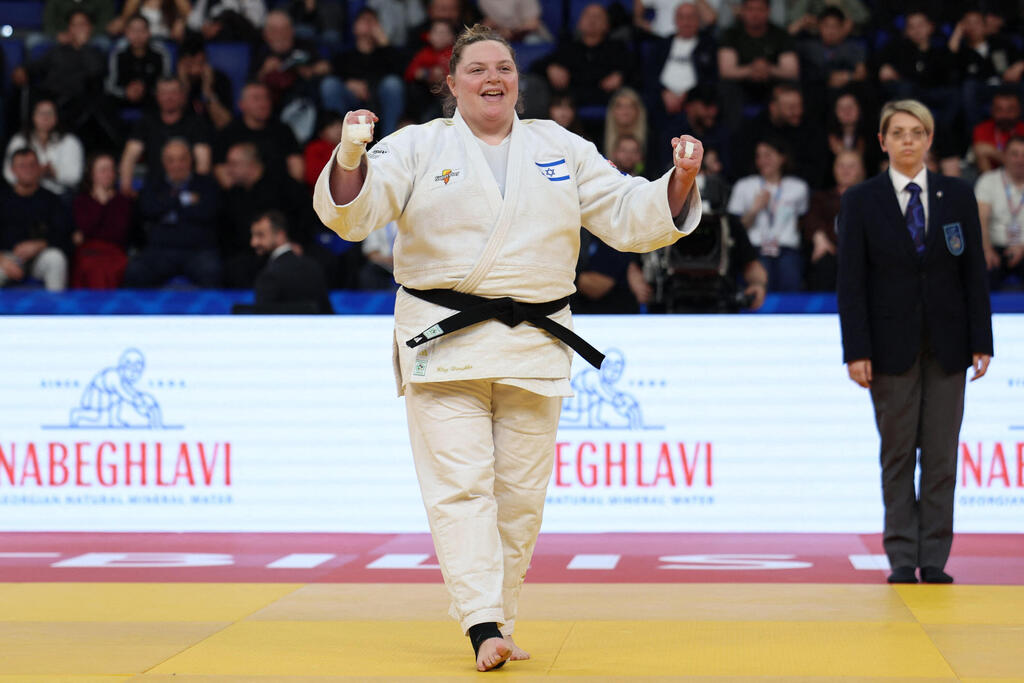
The strongest medal chance belongs to Raz Hershko, the world No. 1
(Photo: Giorgi Arjevanidze / AFP)
On Tuesday, veteran captain Timna Nelson-Levy will compete at under 57 kilograms and is capable of reaching the medal rounds. Inbal Shemesh, who moved down from the under-63 kilogram category, will also compete at that weight. On Wednesday, Kerem Primo, Gefen’s younger sister, will compete at under 63 kilograms, and on Thursday Maya Goshen will compete at under 70 kilograms.
Among the men, Yonatan Elbaz and Ohad Moritz will also compete at under 73 kilograms, Roy Sivan at under 90 kilograms and Iosif Simin at under 100 kilograms. None of them arrives with a realistic expectation of reaching the podium, and the gap between them and Ashpiz illustrates the state of the men’s team.
The women’s team also arrives with less strength than Israeli judo has become accustomed to. Only three of its representatives are among the top eight seeds in the competition: Hershko, Gefen Primo and Nelson-Levy. That is compounded by the absence of Olympic silver medalist Inbar Lanir, who is still recovering from shoulder surgery.
At these championships, much of Israel’s hopes are focused on the teenager competing Sunday morning.