

The 61st Venice Biennale, which opened this week and runs through Nov. 22, is unprecedented in several ways. The most dramatic is the death of Biennale curator Koyo Kouoh in May 2025, about six months after she received the role and just 10 days before she was due to present her vision publicly.
Biennale organizers had never before faced such a situation, with no time to appoint a new curator. In an unprecedented move, they decided to stage the Biennale according to Kouoh’s vision and spirit through five associate curators she personally selected, all of whom had worked with her on developing the exhibition before her sudden death from cancer.
The Bahamas pavilion at the Venice Biennale
(Video: Debby Luzia)


After her death, they shifted from collaborators to custodians of her intellectual legacy. The answer to the question of how to steer such a massive ship without a captain is now being revealed to the public.
Kouoh, the first black woman chosen to curate the Biennale’s central exhibition, was born in Cameroon in 1967 but developed her curatorial career in Dakar and later in South Africa, where she became a leading voice in promoting contemporary African art.
The title of her exhibition, “In Minor Keys,” encapsulates an idea that, at its core, stands in opposition to the chaos of today’s world. In her view, only one form of communication remains possible in the current moment: creating a listening zone tuned to a lower frequency — more intimate, welcoming and human, yet no less charismatic.
Gallery
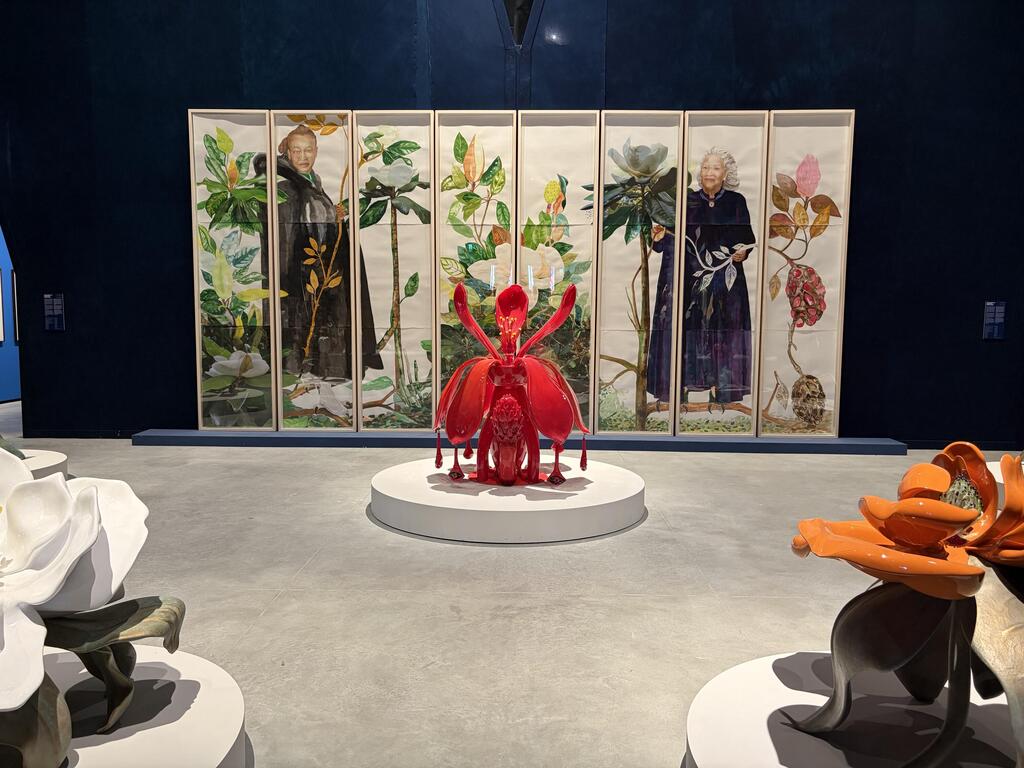
A tribute to curator Koyo Kouoh at the central exhibition of the Venice Biennale
(Photo: Debby Luzia)
Her vision was to keep politics outside the exhibition.
I must admit that Kouoh’s vision of minor-key gentleness and whisper-level frequencies initially made me somewhat apprehensive about the exhibition. But after visiting both parts of the central exhibition, I am happy to report that the result is magnificent. The exhibition is compelling and, as Kouoh intended, inspired by the concept of the Creole garden — different species coexist in harmony, though certainly not minimalistically. Despite the relatively small number of participants, the exhibition feels densely packed.
Can art really be separated from politics?
Despite Kouoh’s wishes, politics has overtaken this year’s Biennale more than ever. It is impossible to expect an event based on national representation to be neutral, but this year the political takeover reached new heights.
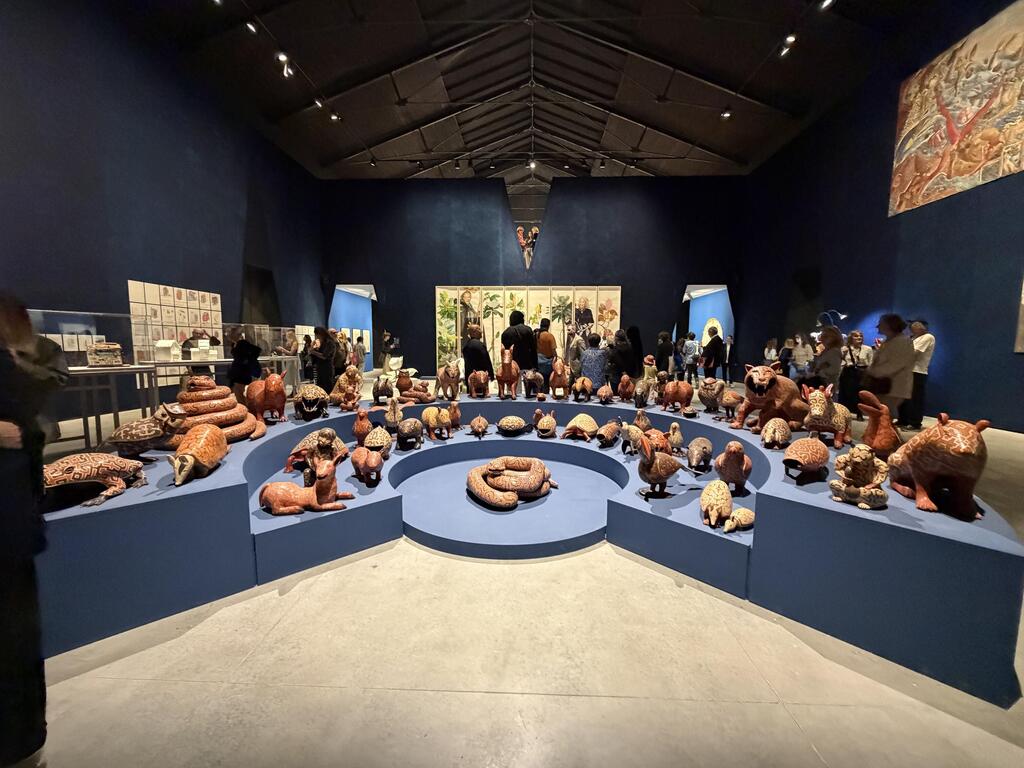
The central exhibition at the Venice Biennale
(Photo: Debby Luzia)
Biennale organizers came under heavy criticism after Russia announced it would participate this year following an absence of two Biennales. The European Union threatened to freeze 2.3 million euros in funding for the next Biennale. The compromise was that the Russian pavilion would open only during the preview days, leading to demonstrations outside the pavilion.
Israel, of course, was also a target. The word “genocide” dominates flyers and signs throughout Venice. In protest against what activists call the “genocide pavilion” — the Israeli pavilion — Austria, whose role in the murder of Europe’s Jews remains well remembered, decided to close its own pavilion for one day to express opposition to the Israeli presence.
There is no doubt that being Israeli in Venice during opening week was difficult. Fortunately, within a few days, the protesters disappeared — along with the media.
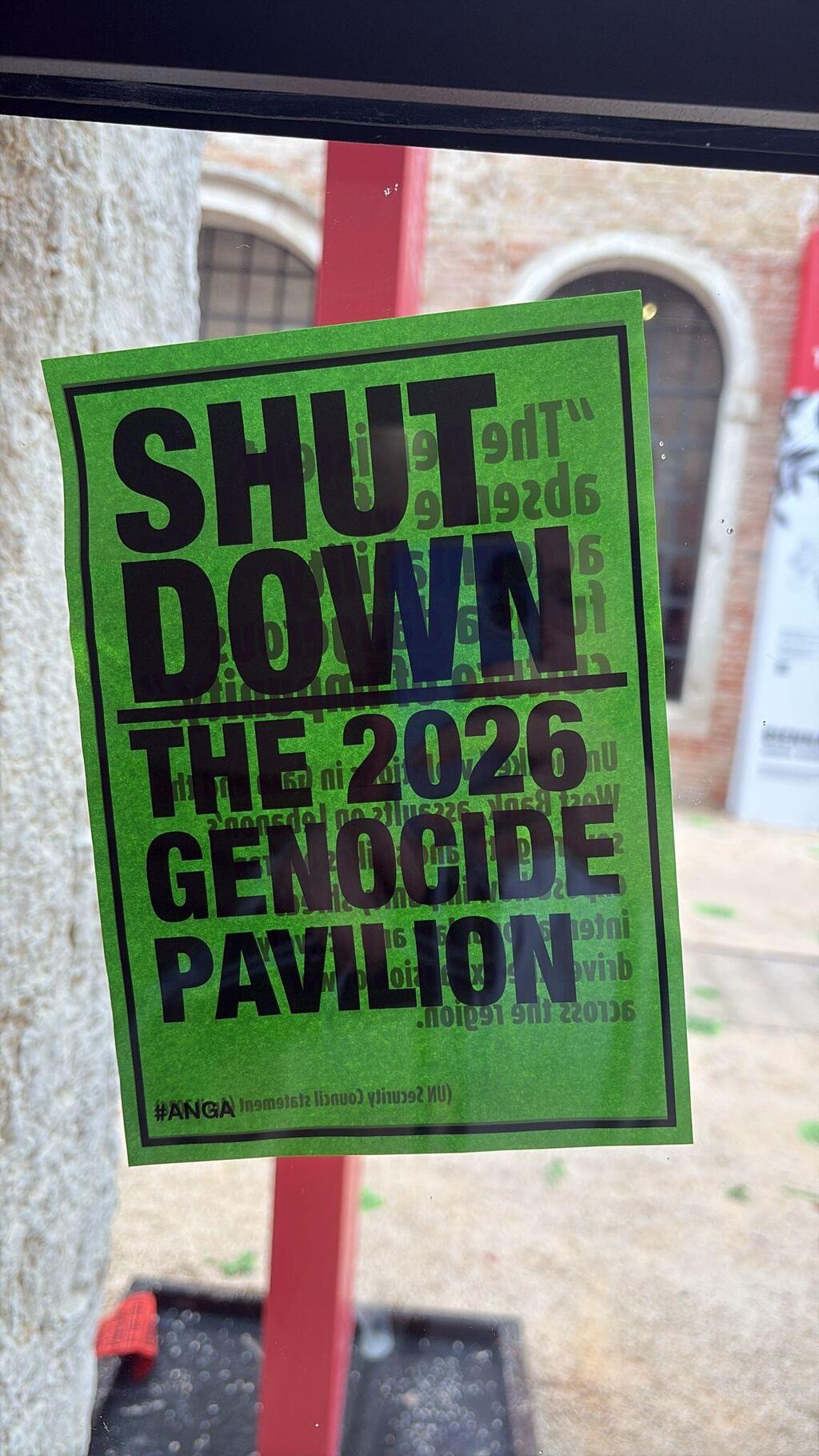
A protest outside the Israeli pavilion at the Venice Biennale
(Photo: Debby Luzia)
Israel’s representative, Belu-Simion Fainaru, argues that art and politics must be separated. But art is political by its very creation, and such a separation is impossible. It is important to say that the Israeli pavilion, housed in a temporary space at the Arsenale, is beautiful. Fainaru’s work, “Rose of Nothingness,” aligns closely with Kouoh’s meditative vision.
The central exhibition sets the tone for the Biennale, but the national pavilion representatives are not bound by the curatorial concept. This year’s Biennale includes a record 99 national pavilions. Some are located within the two main Biennale venues, while about half are scattered throughout the city.
The sheer number of exhibitions I saw over the past week is dizzying, and it is important to stress that this is only an initial impression, but it seems that the national pavilions are relatively weak this year.
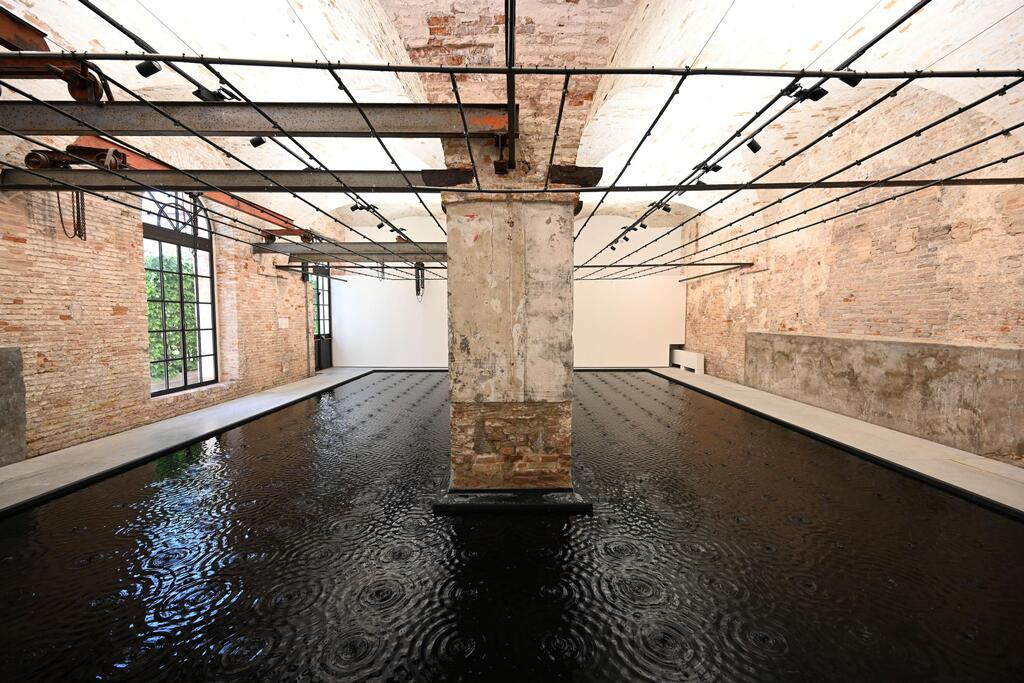
Rose of Nothingness, by Belu-Simion Fainaru, at the Venice Biennale
(Photo: Warhaftig Venezian)
There is considerable buzz around the nude performances in the Austrian pavilion, represented this year by performance artist Florentina Holzinger in a wild installation addressing the climate crisis through water and human urine.
People line up mainly to see the nude performers participating in the pieces, some of which are genuinely difficult to watch. But perhaps that is what is required today to attract attention amid all the surrounding noise.
If Holzinger’s goal was to draw attention, she undoubtedly succeeded. Whether people understand that it is connected to the climate crisis is another question.
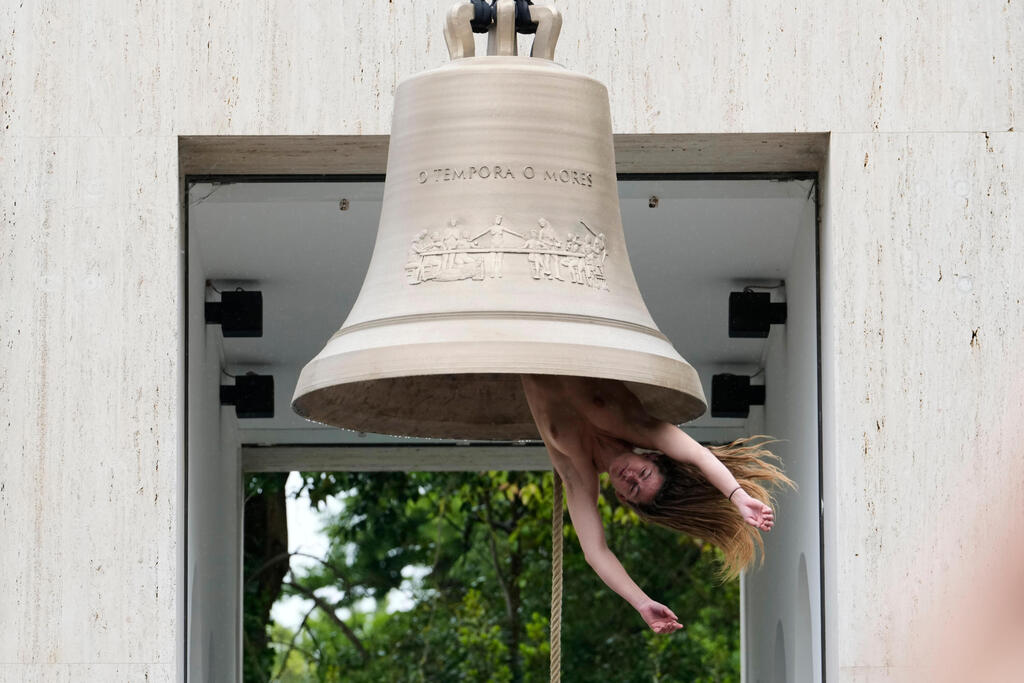
An installation at the Austrian pavilion by Arakawa and Gins at the Venice Biennale
(Photo: MARCO BERTORELLO / AFP)
The most interesting pavilions are those dealing with local subjects, broadening understanding and opening windows into unfamiliar worlds.
The excellent German pavilion, titled “Ruin,” hosts Henrike Naumann, who tragically died shortly before the opening, and Sung Tieu, who arrived in East Germany from Vietnam with her family as a child. The German pavilion itself, renovated in 1938 to suit Hitler’s fascist architectural style, has long posed a challenge for participating artists.
This year, Tieu transformed the pavilion’s threatening facade into a replica of the communist apartment building where she lived as a child, using 3 million mosaic stones.
The Indian pavilion at the Venice Biennale
(Video: Debby Luzia)
Another pavilion that impressed me was India’s, returning after a seven-year absence. In the group exhibition, artists present works that transform organic materials typical of India into emotionally charged explorations of land, memory, architecture and community. It is impossible not to be moved inside this beautiful installation.
The citywide pavilions are harder to reach, but the Bahamas pavilion is especially recommended. The Bahamas are much more than beaches and turquoise waters. Visitors can learn about Junkanoo, the Bahamas’ centuries-old parade festival, characterized by traditions of creating costumes from recycled materials as symbols of spiritual triumph even in times of slavery and economic hardship.
One of the experiences that best embodies Kouoh’s vision is found in the Vatican pavilion, located in the vegetable garden of a Carmelite monastery and offering a meditative and magical garden-walking experience in a space usually closed to the public. Each visitor receives headphones through which a soundtrack created specifically for the event is played. The soundtrack changes according to one’s location in the garden. The gravel path forces visitors to walk slowly, and the overall experience is one of introspection and surrender to music.
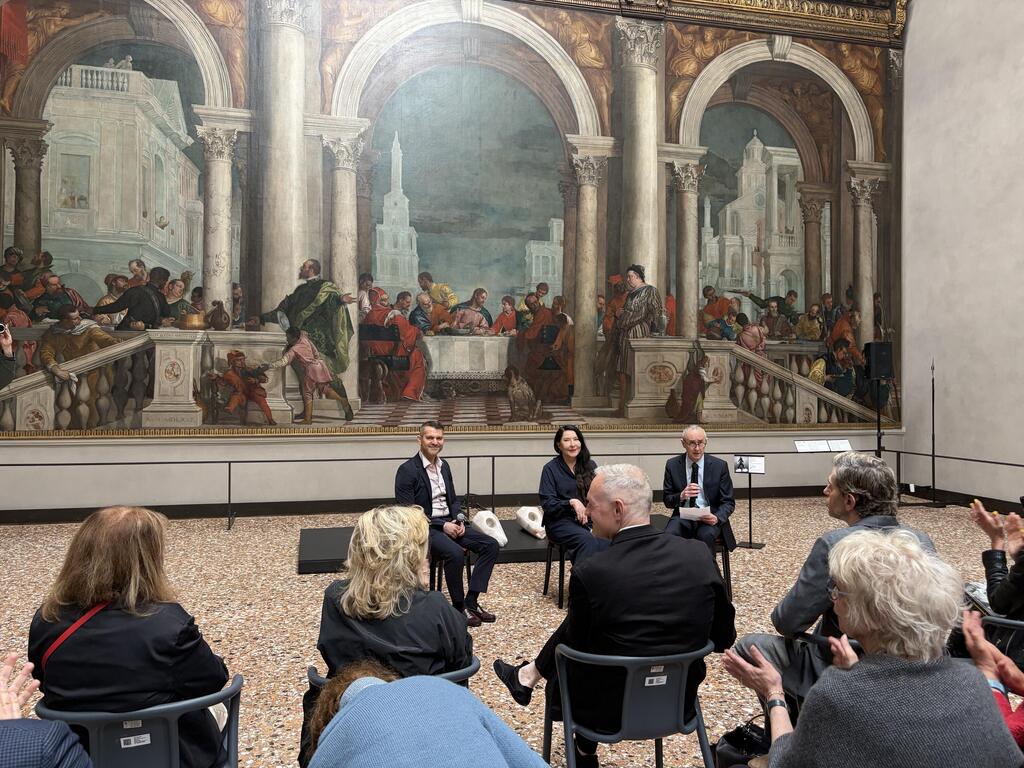
Marina Abramović at a news conference with Israeli curator Shai Baitel, left
(Photo: Debby Luzia)
Speaking of introspection, this is also the place to mention additional Venice exhibitions. Marina Abramović, one of the world’s best-known performance artists, has become the first woman to present a solo exhibition at the Accademia Gallery, founded 250 years ago.
Abramović offers an experience of energetic transformation, and here too visitors receive headphones — though these are meant only for noise cancellation, allowing surrender to the spiritual experience she seeks to create through crystals and other elements.
There is also an Israeli connection worth noting: the exhibition’s curator is Israeli curator Shai Baitel, whose role as artistic director of the Museum of Modern Art in Shanghai brought him together with Abramović. They are now working together in this prestigious Venice setting.
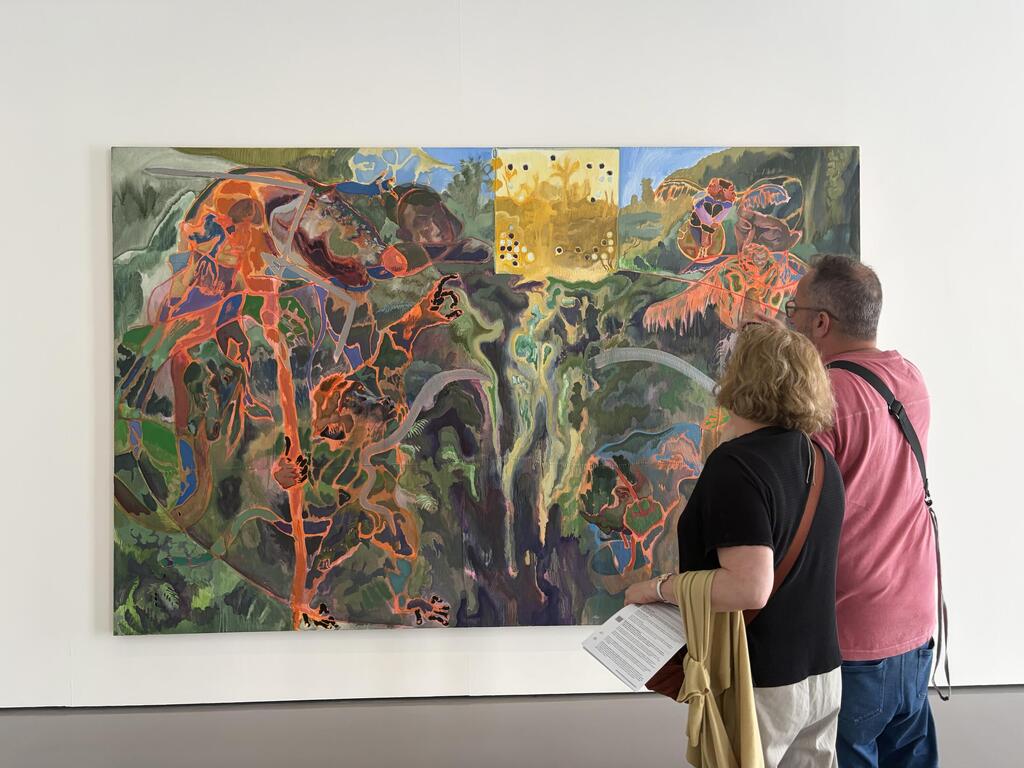
Michael Armitage exhibition
(Photo: Debby Luzia)
Two other excellent painting exhibitions currently on view are by Michael Armitage and Jenny Saville, two British artists proving that figurative painting has not lost its relevance, even in the city that gave the world Titian, Tintoretto and Canaletto.
Ultimately, people come to the Biennale to see art, and once the media noise fades, that is what remains. The opportunity to see art from around the world in one place, alongside major collateral exhibitions of the highest level, makes the Venice Biennale an unforgettable experience.
- Debby Luzia is a Venice Biennale tour guide.