

For six months after the October 7 war outbreak I did not go to the studio and did not work, like many other creators. As an artist, I experienced this period as an “inner death” that echoed the external danger and death around us. When I managed to return to the studio, I could not continue creating works on the subjects that had occupied me before the war. I experienced emptiness and uncertainty, both inner and external.
The change came one day when I was driving past a strawberry field near where I live. A huge pile of single-use irrigation pipes that had been discarded at the roadside, caught my eye. Presumably, I had passed by this pile dozens of times without noticing it, but this time a “miracle” happened and I saw it. It was immediately and intuitively clear to me that this is the material I would work with at this stage, and that it is connected inside me to the war. Understanding the connection came later, over a year and a half of working with this material.
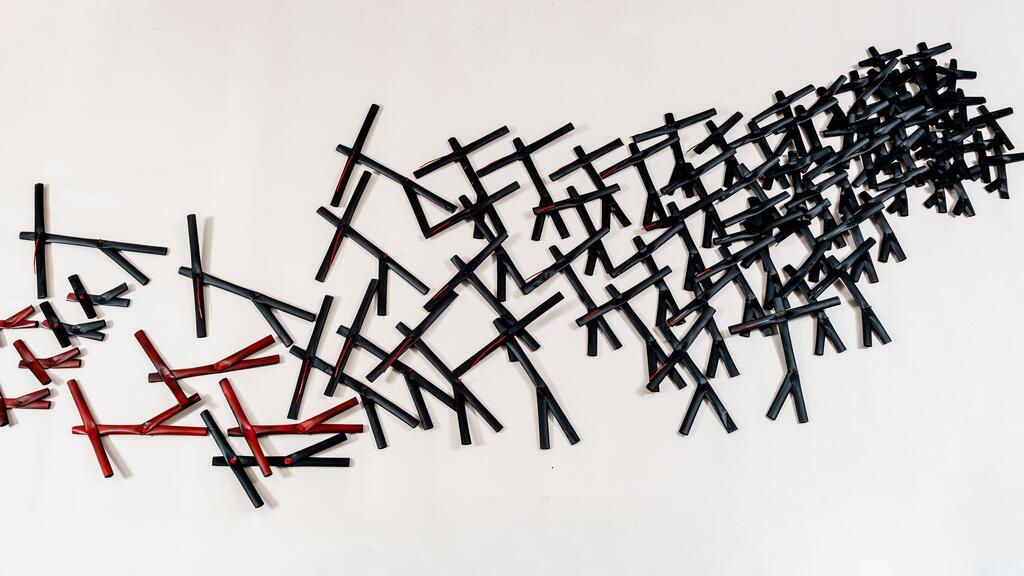
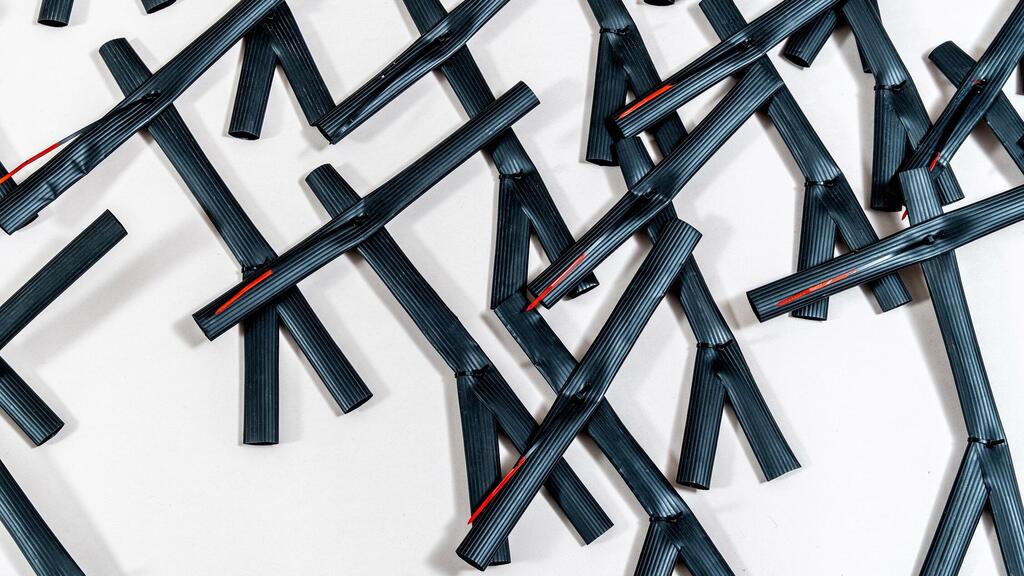
(Photo: Ilan Amichai)
The works were created using a weaving technique with irrigation pipes and auxiliary irrigation components: connectors, sprinklers, and cable ties. The pipes are rigid and required great force during the work, while the stubbornness of the material and my own stubbornness found the right balance in each piece.
Creating with irrigation pipes led to two solo exhibitions that are interconnected and grow out of one another. The first, “In thy Blood, Live” (Municipal Art Gallery, Gordon London House, Rishon LeZion, May-July 2025, curators: Efi Gen and Keren Weisshaus). In this exhibition I screamed the war through my human eyes:
Between black and red, between flow and tear, the exhibition tries to touch the war that was forced upon us. Elements and symbols of life and death, despair and hope, are gathered into a fabric that brings to the surface our being, both as individuals and as a people in the current era. The black color of the irrigation pipes for the life-giving fields has turned into the black of fire, death, and despair. The red color of the blooming of "Red South" was replaced by the "red color" of the alarms and the red of the blood shed.
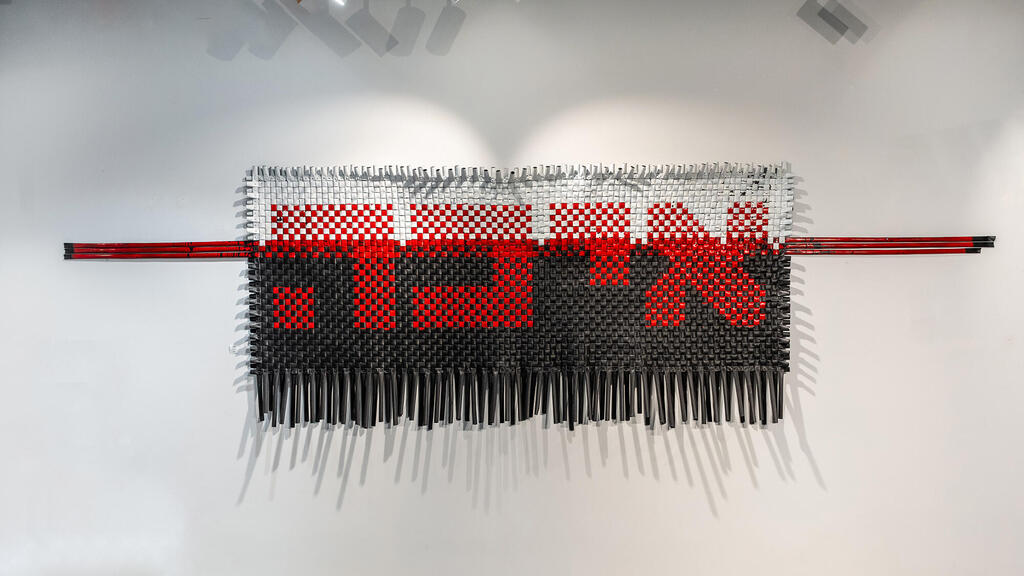
(Photo: Ilan Amichai)
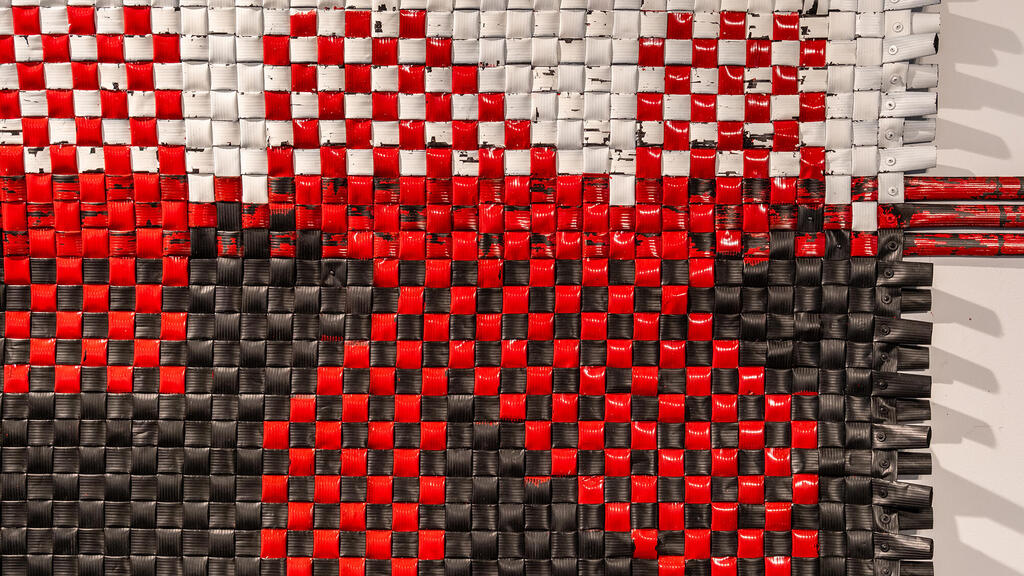
(Photo: Ilan Amichai)
The works in the exhibition moved between events and sensations from the beginning of the war, touching powerfully on the nerves of pain, grief, and trauma, alongside the possibility of gradual and cautious renewal.
The second exhibition, “Fields” (Mishkan HaKavana - House of Kabbalah Study, Yakum Industrial Park, September-November 2025, curator: Rabi Saphir Noyman Eyal). In this exhibition I tried to observe that period, in a whisper, through the eyes of a Kabbalah student, while within my heart a request to be able to agree that the Creator's intention is to bestow good upon his creates and a prayer that we would be given the permission to see it.
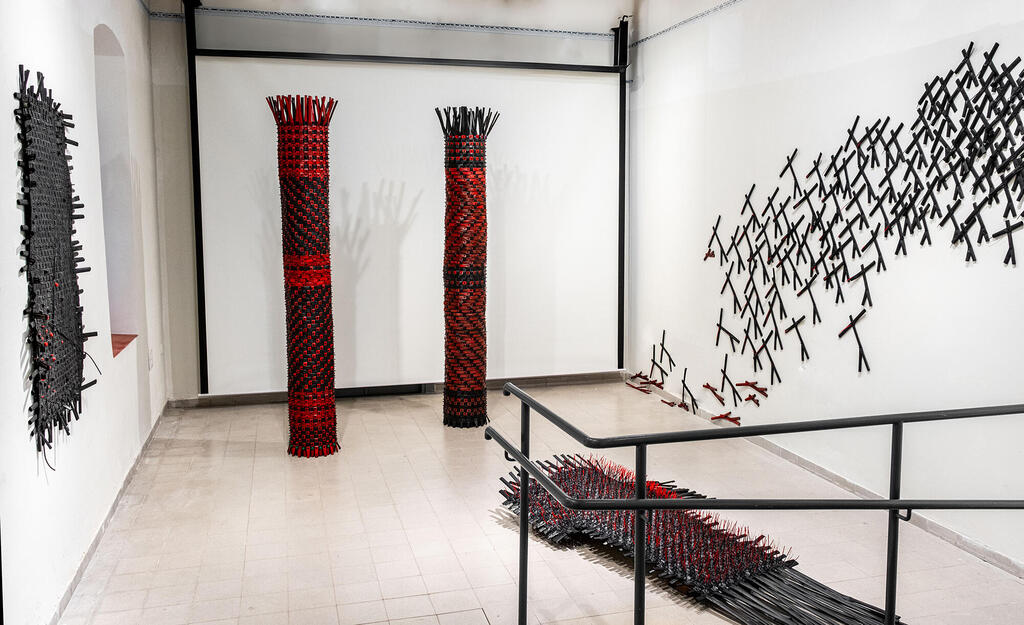
creation during war
(Photo: Ilan Amichai)
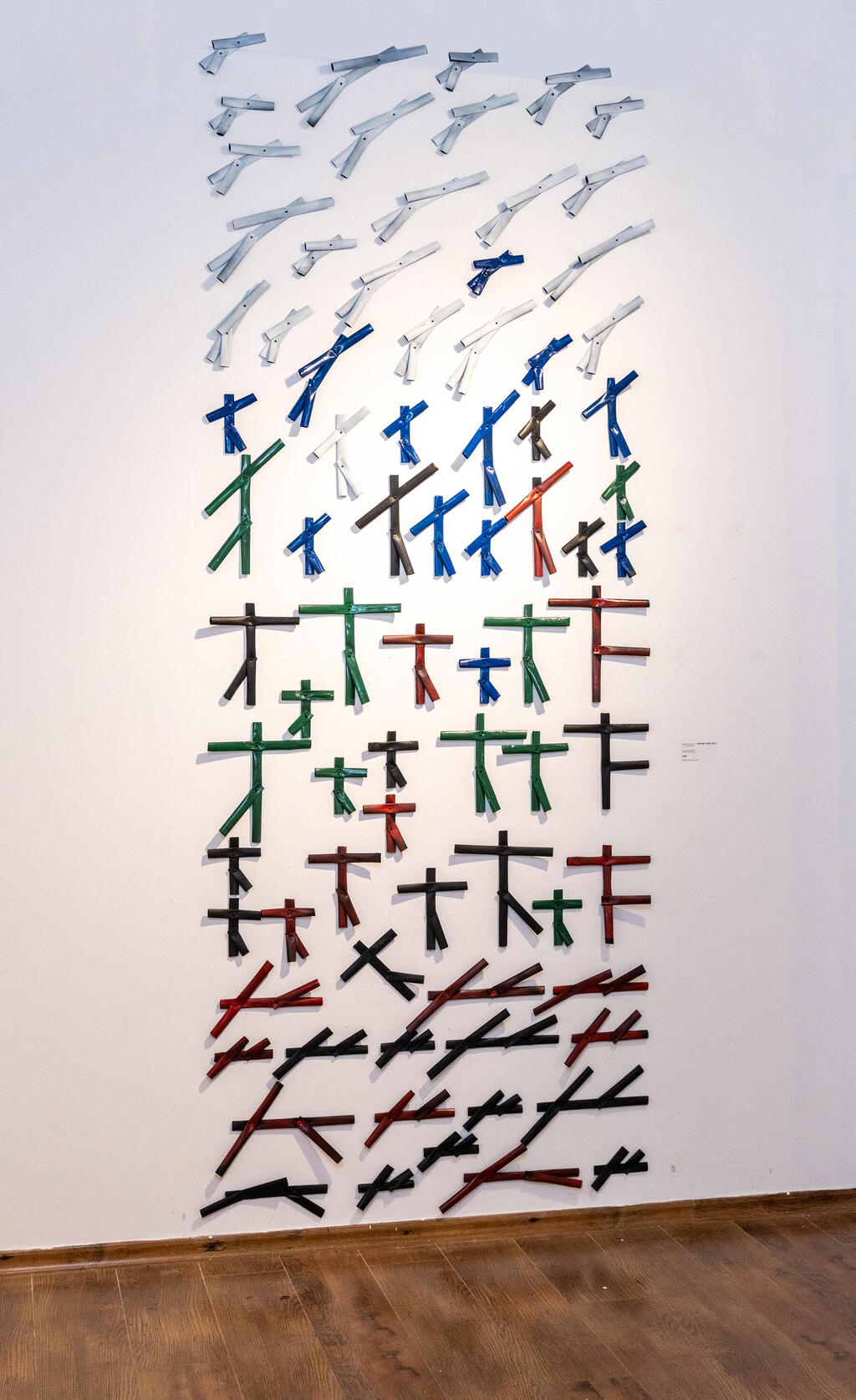
(Photo: Ilan Amichai)
Some works were transferred from the first exhibition to the second, while the different orientation of the exhibition necessarily led to renewed treatment of the works and their placement in the space. In addition, I created two new works for this exhibition, one of them “Ayecha,” which, for me, gathered the spirit of the study taking place in Mishkan HaKavana, as well as the spirit of the entire body of works presented there.
In “In Thy Blood, Live,” the colors black and red represented physical and emotional expressions. “Fields” brought to the surface black, red, and white, also as representations of three Spheres in the Kabbalistic system and the relationships between them.
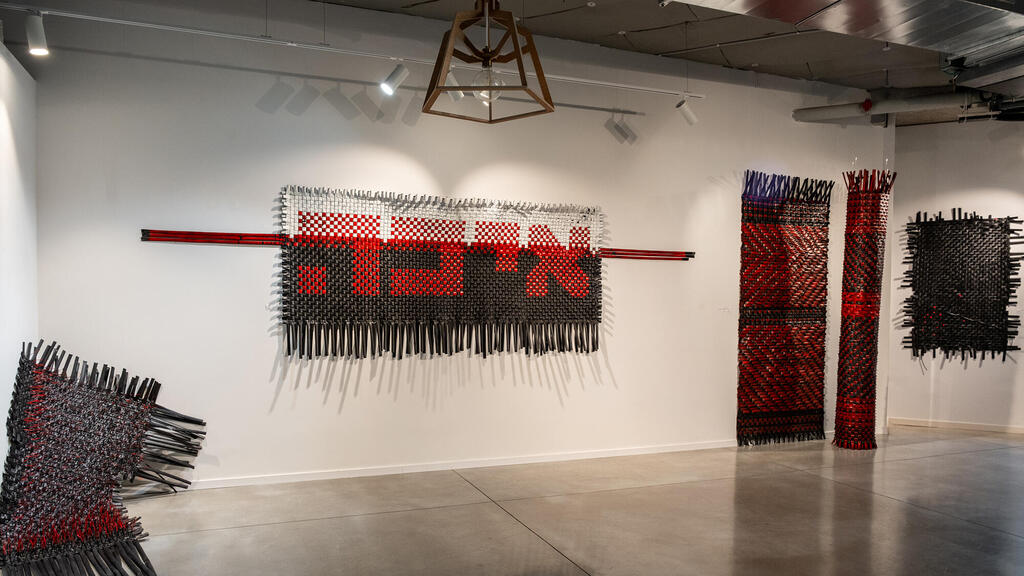
(Photo: Ilan Amichai)
The title “Fields” references the physical place where the war erupted and the dance of demons that took place, and still takes place, around us and within us. At the same time, spiritually, we seek to remember that a “field” is the place of our “work” as Kabbalah students: a place of encounter with the unknown and the struggle between “evil” and “good” within us.
Gila Miller Lapidot is an Israeli multidisciplinary artist working in sculpture, installation and weaving, drawing inspiration from current events, architecture and Jewish texts. A Shenkar College graduate, she teaches ceramics and artistic weaving, exhibits in Israel and internationally, and her works are held in museum and private collections.