

Titi Aynaw is not afraid of politics. While many celebrities prefer to avoid controversial subjects or hide behind carefully worded statements, the former Miss Israel speaks openly about her views on life in Israel, its political leadership and the country's social divisions. She made no secret of her support for Avigdor Liberman in the recent elections. But when an opportunity arose to enter politics herself, she decided it was a step too far.
"Yes, I was offered a chance to run for the Knesset," she reveals. "I won't say who approached me, but I was offered a place on a party list."
Gallery
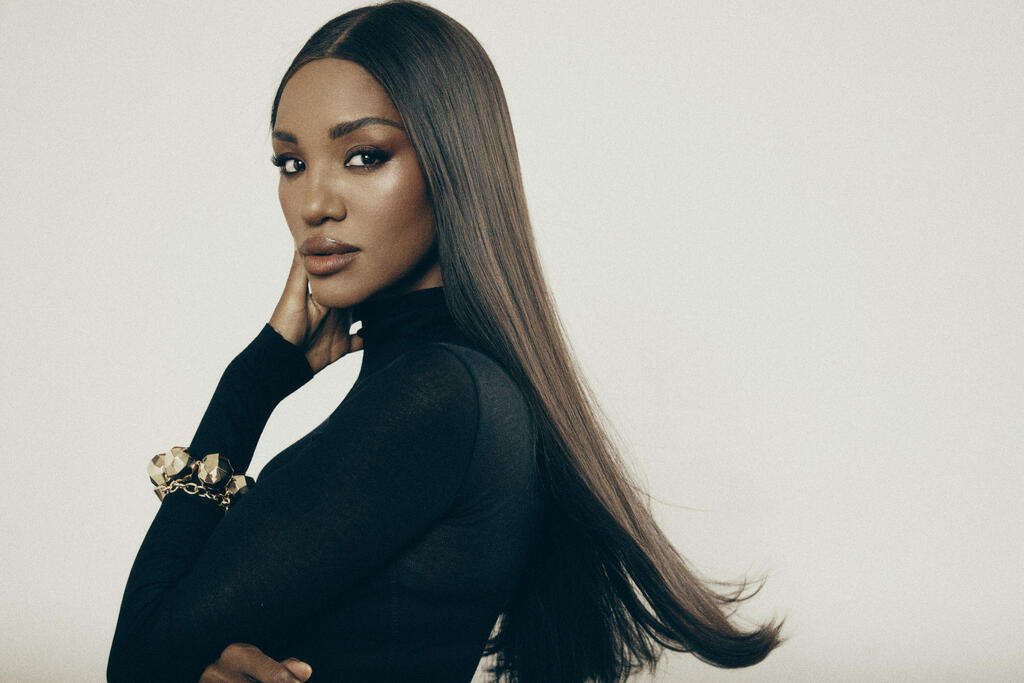
Titi Aynaw, the first Ethiopian-born woman to win the Miss Israel beauty pageant
(Photo: Shai Franco)
Were the people who approached you interested in your political views, or mainly in the fact that you're famous and of Ethiopian origin, which could attract votes?
"First of all, I don't have a captive audience of voters. What's interesting about me is my ability to work on social issues and public diplomacy. That's what stands out about me. I don't think the offer came because I'm Ethiopian. It came from people who had seen my work and my contribution."
And yet you turned it down.
"At the moment, politics isn't something I'm thinking of entering. But I do feel I need to become involved in representing Israel internationally. We live in our own bubble here and don't understand what people outside the country think about us or what they're being fed.
"I give talks about Israel around the world, and when I walk into a room, the first thing I say is: 'I'm Titi, and I'm from Israel. I have a life here and equal rights, and I don't have to sit at the back of the bus,' because that's what some people think happens here. When I tell them I was Miss Israel, an officer in the military, that I immigrated here as a child and built a life here, that's something you can't argue with."
‘I'm right-wing, but I'm also liberal’
You decided against entering politics yourself, but you openly supported Avigdor Liberman. Why him?
"I'm someone who loves this country very much. I'm right-wing in my views, and I'm not prepared to give up a single centimeter of it. At the same time, I'm a liberal person. I don't want religious coercion in this country, but I love religion and tradition.
"I connect with Yvette [Avigdor Liberman] on many levels. He offers an alternative that, for me, combines my right-wing views, my concern for the country and my love of Israel with defending the country and defeating Hamas."
Is there also a connection between his social positions and your own fight against discrimination?
"Of course. With Yvette, I can talk about the difficulties of immigration, racism and discrimination. He's someone who has experienced those things himself. He immigrated from Moldova, and I immigrated from Ethiopia. It's not the same story, but there's something similar about our experiences."
How do you feel about the election results?
"I stand by my choice. The election results have created a complicated political reality, and I hope we'll find a solution that brings stability to Israel. I believe the public wants to see a stable government dealing with our real challenges: security, the economy and our children's future. Ultimately, we all want to see our country move forward."
Aynaw, 35, is a model, businesswoman, television presenter and social activist. She was born in a village in Ethiopia's Gondar region and lost her father when she was just two years old. Her mother died when she was 10. Two years later, she immigrated to Israel with her older brother and went to live with their grandmother in Netanya.
In 2013, she made history by becoming the first Ethiopian-born woman to win the Miss Israel beauty pageant, an achievement that transformed her into a prominent figure in Israel's Ethiopian community. But she has since built a public identity that extends far beyond beauty pageants, with activism and international advocacy becoming central parts of her career.
‘Being Ethiopian is part of who I am’
Your connection to Israel's Ethiopian community is a major part of your public work. Was there ever a time when you felt people saw you only as a representative of that community rather than as Titi Aynaw?
"My connection to the community is part of who I am. It's not something I would ever consider separating myself from. It's true that there are many problems I don't personally experience in my life today, but when they affect my community, they still affect me. I'm proud to be Ethiopian and proud of my traditions. Those are the values I teach my son. I even share traditional Ethiopian recipes on Instagram. I'm not running away from that identity.
"At the same time, I'm my own person. I have my own opinions, feelings and beliefs, and I do things that aren't necessarily connected to the community. Ethiopian Israelis aren't the only thing I care about. I care about anything that's unfair or unjust in Israeli society. For example, I hosted a ceremony organized by the October Council, a group representing survivors and families affected by the October 7 attacks that is campaigning for an independent state commission of inquiry. I did that because I identify with their pain. My heart is with the families, and I believe a state commission of inquiry must be established."
Aynaw's determination to be fully Israeli without abandoning her Ethiopian roots began in childhood. She remembers quickly realizing that learning Hebrew, making Israeli friends and understanding local culture would be essential to building a life in her new country.
"I understood very quickly that if I wanted to integrate into society, I needed to adopt the language, speak like an Israeli and make Israeli friends," she says. "It's not that I didn't have Ethiopian friends, but I made a real effort to have white Israeli friends too, people who could teach me about the culture. I'm glad I didn't stay closed off in my own world, even though that would have been easier and more comfortable. I broadened my horizons. For example, Noa, the good friend who entered me in the Miss Israel competition, isn't Ethiopian."
The missing girl who became her personal mission
One of the issues closest to Aynaw's heart is the disappearance of Haimanot Kassau, a nine-year-old Ethiopian Israeli girl who vanished from an immigrant absorption center in Safed, northern Israel, on February 25, 2024. Despite an extensive police investigation, her whereabouts remain unknown.
Aynaw has become a prominent supporter of the family's campaign for answers. She has repeatedly criticized the authorities' handling of the case and has joined calls for the Shin Bet, Israel's domestic security agency, to take over the investigation from the police. She also believes the response would have been different had the missing child come from a wealthy, predominantly white Israeli community.
"I joined the fight for Haimanot as a parent raising children in Israel," she says. "I don't think we can ignore a child being abducted here. We must not normalize a reality in which a girl is kidnapped and never found. It could happen to any child in Israel, and we could end up like America in that respect."
What do you know about how the investigation is being handled today?
"The case is with Lahav 433 [the Israel Police's national serious crimes investigation unit], and they say they're investigating. Over the past three months, with the help of a strategic consulting firm called Critical Impact, led by Doron Hadar, we've developed a new strategy. We met with all the party leaders ahead of the elections to hear what they intend to do and what they can do for Haimanot. Eventually, we also secured a meeting with Shin Bet director David Zini.
"Our demand is that the Shin Bet take charge of the investigation. We don't want them simply to provide tools and assistance. We want them to run it. Both the family and those of us supporting them feel this is the agency best suited to investigating Haimanot's disappearance. Every minute that passes puts her in danger."
The Shin Bet has already become involved in assisting the police investigation, but Aynaw and the family are seeking a more direct operational role for the agency.
How much difference does your involvement make?
"It helps. I see the impact, for example, when I approach members of the Knesset. It takes up a lot of my time, but I know I have to be there. I feel needed."
Do you really believe the response would have been different if Haimanot were a white child?
"I'm certain that if this girl had disappeared from Ramat Hasharon, Tel Aviv or Herzliya, the response would have been different. When you look at how the police handled things from the beginning, in the first 24 hours after she disappeared, the way they looked at the family, the dismissive attitude, you just shake your head in disbelief. You have no choice but to ask yourself why it's happening.
"In my personal life, I don't walk around all day feeling sorry for myself or claiming everyone is against me. But when I see Haimanot's case, it's hard not to wonder."
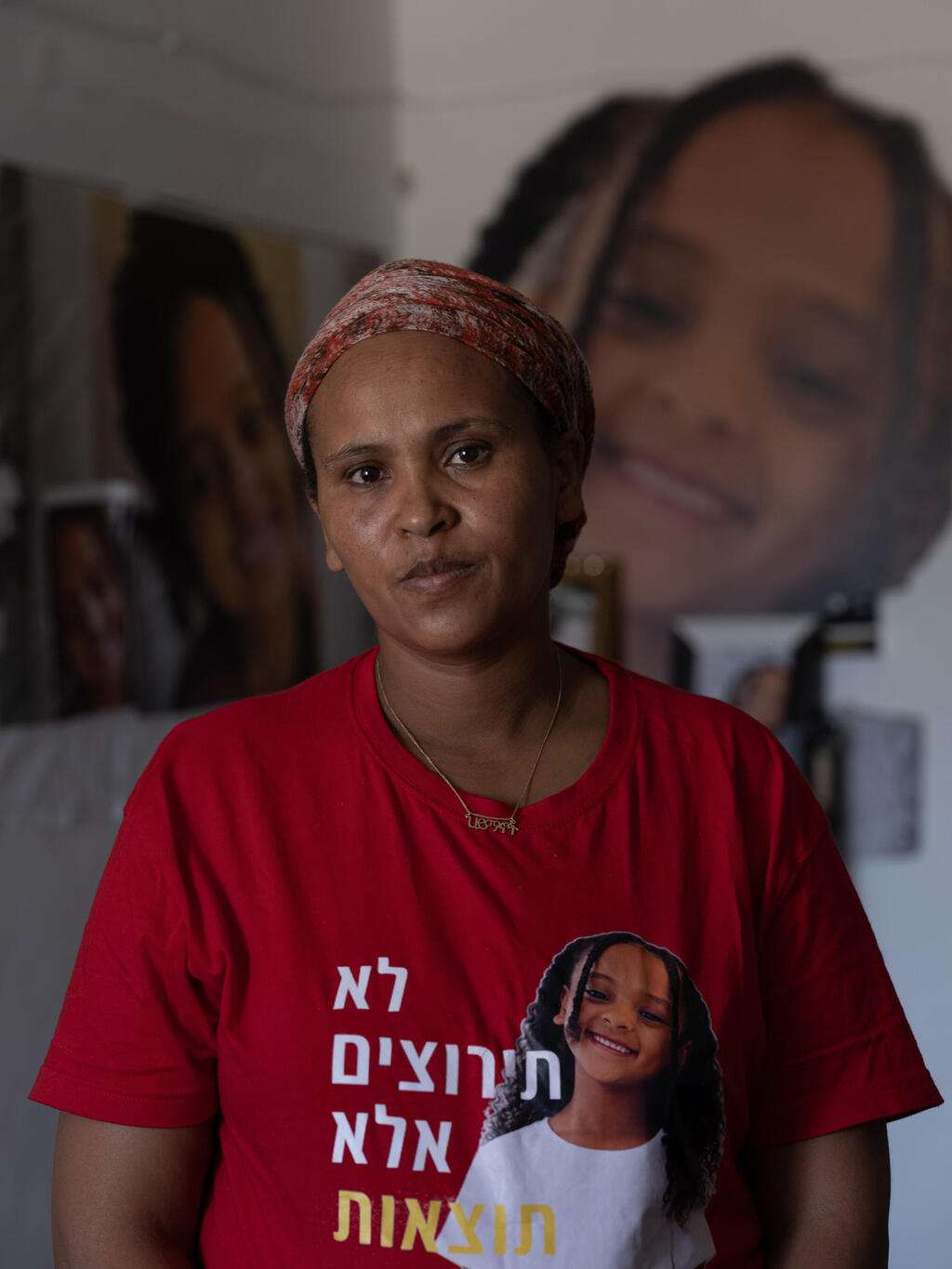
Benchi Kassau holds a photograph of her missing daughter, Haimanot, who disappeared from an immigrant absorption center in Safed in February 2024
(Photo: Yuval Chen)
Has anyone personally disappointed you during this campaign?
"I haven't met the prime minister personally, but he met with the family, and that was disappointing. Ultimately, it takes a decision by one person to instruct the Shin Bet to take over, and he isn't doing it."
The investigation has not established that Haimanot was abducted. Are you convinced she was kidnapped?
"Yes. The police have to work on evidence, and until they have evidence, they can't say for certain whether it was a kidnapping. The surveillance footage shows her entering the absorption center and handing out flyers, but it doesn't show her leaving. I've been there. It's a circular, enclosed building. Whoever took her knew where to enter and where to leave. She was definitely kidnapped. There's no other explanation."
Aynaw's certainty goes beyond what investigators have publicly established. The police have not determined whether Haimanot was abducted, and the circumstances surrounding her disappearance remain unresolved.
Doesn't it trouble you to express such a definite opinion when the full circumstances are still unknown?
"Then where did she go? Give me another theory and I'll say, 'You know what, maybe I'm wrong and you're right.' Where can a nine-year-old girl disappear to for two years? Is she hiding under the living room couch? Where is she?"
You've also criticized celebrities who haven't done enough to support the search.
"I'm not going to start attacking people personally. I feel we're a deeply traumatized nation. Because of everything we've been through in recent years, because of the horrors we've seen and experienced, our senses have become somewhat numb. I would have expected something like this to mobilize every citizen, the entire country, but that didn't happen. Social involvement needs to be one of our priorities here."
‘I criticize Israel at home, but I defend it abroad’
Alongside her criticism of Israeli society and the authorities, Aynaw has taken on another public role: representing Israel overseas. Over the past five years, she has spoken at 69 universities across the United States, most of them on behalf of the Jewish National Fund (JNF), an organization involved in supporting projects and communities in Israel. Her presentations draw on her personal journey from an Ethiopian village to becoming Miss Israel and an officer in the IDF.
You defend Israel against accusations of apartheid, yet you also speak openly about racism within Israeli society. How do you reconcile the two?
"There's a difference between criticizing my country from within and representing it abroad. I separate my desire for us to live well here from the way we're perceived as Israelis around the world. There's racism in the United States too, and in many other places. I love my country, and I'll represent it abroad in the best way I can, with enormous pride. But I don't hide the challenges either.
"We don't have another country. I live here, I'm raising my children here, and I want them to have a good future."
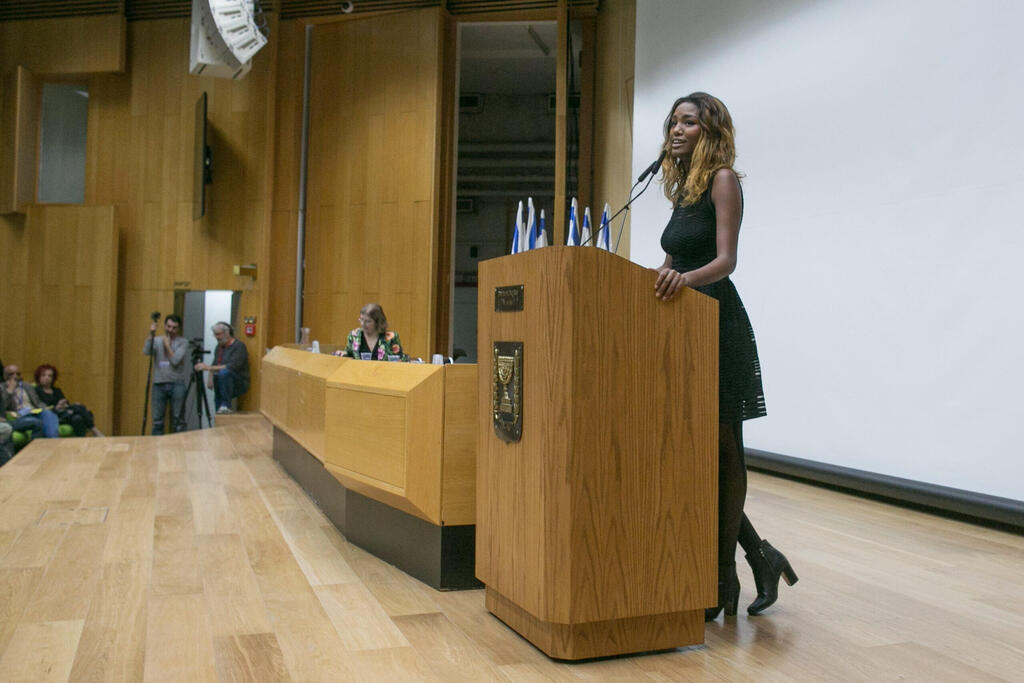
Titi Aynaw at a ceremony marking 30 years since the immigration of Ethiopian Jews to Israel
(Photo: Ohad Zwigenberg)
So you're saying Israel's dirty laundry should be washed at home, not abroad?
"There's room for internal criticism in Israel. If something bothers us here, we can protest, we can change things, and we can deal with our problems. At the same time, especially now, I'm not going to criticize Israel from outside. We already have enough critics abroad. I believe we need to defend our home, our country. It's too precious. We also need to show the good things about it."
What particularly worries you about the battle for international public opinion?
"The younger generation on TikTok. We've lost them. They think we took the Palestinians' country and that we're committing genocide in Gaza. They genuinely believe it. Qatari money has reached everywhere. They're trying to connect the Palestinian struggle with oppression, racism and what African Americans went through."
How do you feel when you travel abroad today?
"I'm afraid, genuinely. If I'm with the children and someone asks where we're from, my husband immediately says we're from Israel. Then I ask him, 'Why? We're here with the children.' Sometimes I say I'm from Ethiopia."
‘They looked at me like a piece of meat’
Long before she became involved in social activism and public diplomacy, Aynaw was trying to build a career in the highly competitive modeling industry, first in Israel and then internationally. Although winning Miss Israel opened doors, she discovered that the fashion industry's standards were often considerably narrower than the public image of glamour suggested.
You've spoken before about failing to get booked for fashion shows in Paris because you weren't thin enough.
"I haven't been back to Paris since. That was a period when I was extremely thin. Everyone thinks modeling is glamorous and exciting, but it really isn't. Walking on the runway with your hair and makeup done, that's the glamorous part. There's so much work behind the scenes. Standing in long casting lines, running from audition to audition, not eating properly.
"You walk into a room, they look at you for two seconds, ask you to walk in front of them and examine you like a piece of meat. When I was in Paris, I was at my thinnest. I couldn't possibly have been thinner, but I still wasn't considered thin enough."
What does that feel like after being crowned Miss Israel, only to arrive in Paris and face rejection?
"It felt like failure. I went abroad to develop my career and take it to an international level, and then I got there and they told me no. Simply because I had a bit of a butt and a bit of a chest. My body was too curvy for them. I wasn't a walking coat hanger.
"You get this feeling that maybe you're not good enough. I don't think I felt unattractive, but I felt that I didn't fit."
Aynaw also tried to establish herself in the United States after signing with international modeling agency IMG, alongside her Israeli representation at Yuli. But she eventually returned to Israel to care for her brother when he became ill, interrupting her career for more than two years.
"The industry in Israel isn't that big, and it isn't diverse enough," she says. "Look at the faces representing the major Israeli fashion brands today. There's nothing that represents my skin color. They're all blond with green eyes. That's a shame, because there's a community here and there are people who deserve representation."
Does that lack of diversity also limit opportunities in acting?
"When a casting director is looking for someone to play a lawyer, she won't cast an Ethiopian woman. An Ethiopian police officer, yes. So right from the beginning, you barely have a chance. Every community needs representation, especially in a country where people come from so many different backgrounds and have so many different skin colors.
"That diversity is actually our advantage. We have the opportunity to represent everyone, yet we're still quite rigid in our thinking."
Was there a specific occasion when you felt you weren't cast because of your Ethiopian background?
"There weren't specific incidents. And I don't like taking the approach of saying, 'They didn't cast me because I'm Ethiopian.' What I'm saying is something different: We need more diversity from the outset.
"I'm appealing to Israeli cinema, to people in the industry, to producers, and saying: Don't categorize people by their skin color. Judge them by their talent. Anyone can play any role."
Motherhood, breastfeeding and an unexpected backlash
In recent years, Aynaw has fulfilled what she describes as her greatest dream: building a family. She and her husband, businessman Tzachi Frenkel, have two sons. Their eldest, Dorian, was born in 2022, while their younger son, Oz, joined the family about a year ago.
Several months ago, Aynaw sparked a heated online debate after posting a video on Instagram showing herself breastfeeding Oz in a supermarket and at a bus stop. The accompanying message encouraged women to feel comfortable breastfeeding wherever they wanted. While the video received widespread support, it also attracted criticism, including racist comments referring to her African background.
Were you surprised by the reactions to the video?
"Yes, I was very surprised. I knew there would be people who didn't like it, but wow. I even received messages from breastfeeding women who wrote that they weren't comfortable seeing breasts. My entire childhood was filled with women breastfeeding in public. That was the culture I grew up in. I didn't know anything else.
"I don't take it personally, but I was amazed by the hatred and ignorance."
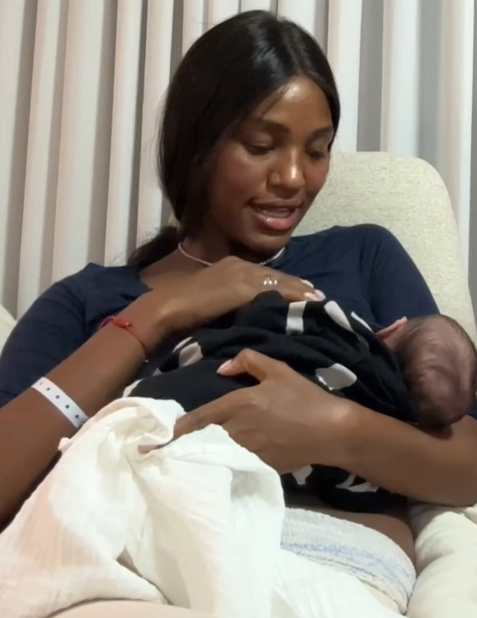
Titi Aynaw with her younger son, Oz
(Photo: Instagram)
Challenging social conventions seems important to you.
"I put breastfeeding front and center to encourage it, not to annoy people. I wanted breastfeeding women to feel comfortable. There were supportive responses too, of course. So many women shared the video and told me, 'You have no idea what you've done for us,' or 'This is amazing,' and 'Thank you, it's so important for people to see this side too.'
"It gave them strength. And that was the goal. That's where I was coming from."
What kind of mother are you?
"I'm a very involved mother who loves her children. It's important to me to teach them love for this country, love for Israel and values. I take them on lots of trips, and I care about them eating properly. I'm a very present mother."
Do you feel motherhood limits your career?
"Today women are expected to have careers and also be mothers who take care of their children. A lot of that burden falls on women. If a woman stays home to raise and care for her children, people say she isn't building a career. If she focuses only on her career, she's criticized for that too.
"If you don't put your baby in daycare before the age of one, you can often lose your job. So yes, it does limit you to some extent. I know I can't simply forget everything else and stay home for six months or a year."
‘I wish my mother could have met my children’
For Aynaw, motherhood carries an emotional weight shaped by her own childhood. She lost her father at the age of two and her mother at 10, growing up without the parental presence she now works so hard to provide for her sons.
You lost your mother when you were very young. Do you feel the absence of someone to turn to for guidance as a mother yourself?
"Yes, it's always present in my life. I miss my mother everywhere, all the time. For example, when I'm not sure what to give a child who's sick and I wish I could ask her about home remedies. At birthdays when she isn't there, during my pregnancies and after giving birth. My aunts come to help, but I miss my mother terribly."
Are there things you make a special effort to give your children because you didn't have them growing up?
"Yes. My presence. I really try to be there because I didn't have a mother. Yesterday I was at a photo shoot and was away from home all day, and it made me feel bad. I came straight back for bath time and dinner so I could be with them. I try very hard to make sure neither of them feels he hasn't had enough time with me."
Do you think losing your mother has made you a more anxious parent?
"That's something I'm working on. When you're a parent, you don't only worry about your child. Sometimes I have thoughts like, God forbid, what would happen if something happened to me? But I try very hard not to let those fears take over."
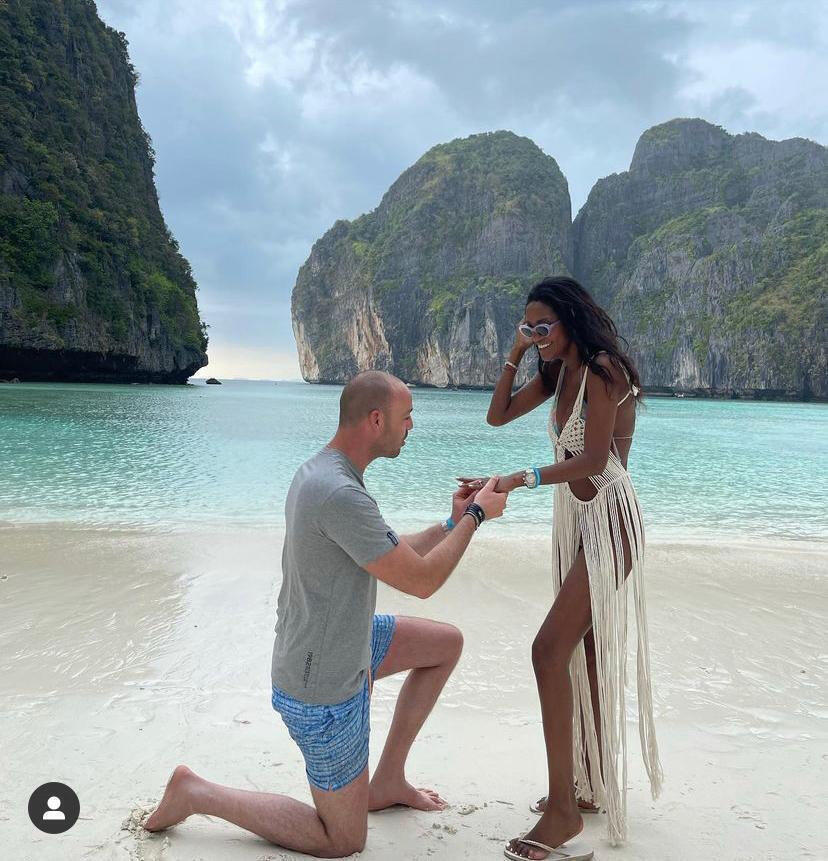
Titi Aynaw with her husband, businessman Tzachi Frenkel, during his marriage proposal
(Photo: Instagram)
You've spoken in the past about dreaming of having a home, a family and a traditional Friday night Shabbat dinner. Do you feel you've achieved that dream?
"Yes. It's a dream come true. Friday night dinners and Kiddush [the blessing over wine welcoming the Sabbath] are things I place enormous importance on. If I'm abroad, my son asks, 'Who's going to say the blessing for me? Who's going to make Kiddush on Friday?' So I call my brother and ask him to come and do it.
"It's not just that the dream has come true. These traditions are already deeply rooted in my child, and it's wonderful to see. There are always more dreams and a desire to develop and do more, but my home is the most important thing in the world to me."
If your mother could see you today, what would you most want to tell her?
"I would want her to meet my children. I talk about her a lot, so Dorian really knows who she is. Sometimes we're going somewhere and he says to me, 'Mommy, your mommy can't come because she's in heaven.' I've explained to him that she's up in heaven, but she's always, always watching over us."