

At first glance, Tom’s work looks digital. Clean lines, sharp contrast, faces that emerge from a distance. Only when you step closer does the illusion break. Every pixel is a Rubik’s Cube. Every color is rotated into place by hand. What appears to be a photograph is, in fact, the culmination of hundreds of small decisions made in silence.
Tom, 28, is a medical student and self-taught artist who transforms logic puzzles into large-scale portrait art. His work lives somewhere between mathematics and emotion, discipline and intuition.
From solving to creating
Tom encountered his first Rubik’s Cube at age 15. What began as casual problem-solving quickly deepened. He learned to solve cubes blindfolded, then moved on to increasingly complex variants. At around 20, art entered the picture. Two and a half years ago, he connected the two worlds. Instead of seeing a cube as a puzzle, he began seeing it as a pixel.
Alongside his artistic practice, Tom is in his sixth year of medical school. Much of his studying happens online, through YouTube, reinforcing a mindset of self-directed learning that defines both his academic and creative paths.
A finished portrait may appear in a short video, but behind it lie hours of preparation. Tom starts by choosing a photograph with strong contrast between light and shadow. Using digital tools, he converts the image into a grid that translates tones into the cube’s limited color palette: red, blue, orange, yellow, white and sometimes black, created by removing stickers entirely.
Gallery
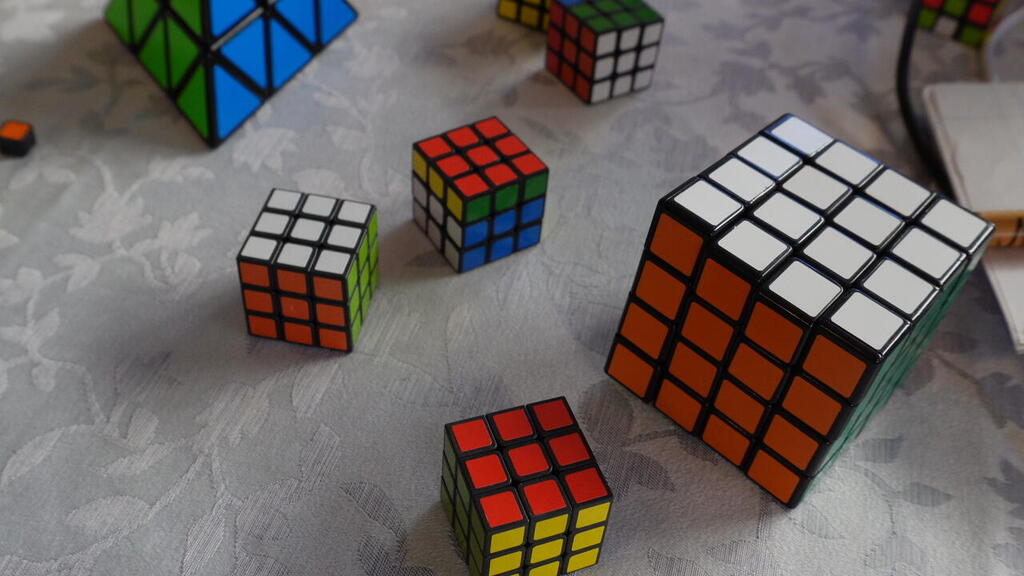
Various Rubik’s Cubes, including classic 3x3, 4x4 and pyramid variants, are scattered across a table at artist Tom’s home studio, where he creates large-scale portrait art by arranging and rotating each cube by hand to form pixelated images
(Photo: Bar Gindy)
Software helps, but it is never enough. Tom manually corrects details, especially around the eyes, where recognition lives. Only then does the physical work begin.
An average portrait requires between 600 and 700 cubes. Larger works reach 1,200. To manage costs, Tom uses inexpensive Chinese-made cubes, each costing a few shekels, instead of original Rubik’s brand cubes that would make the work financially impossible.
Over time, Tom has created portraits of well-known figures, including Ninet Tayeb, Ivri Lider, Yuval Noah Harari, Salvador Dalí and Albert Einstein.
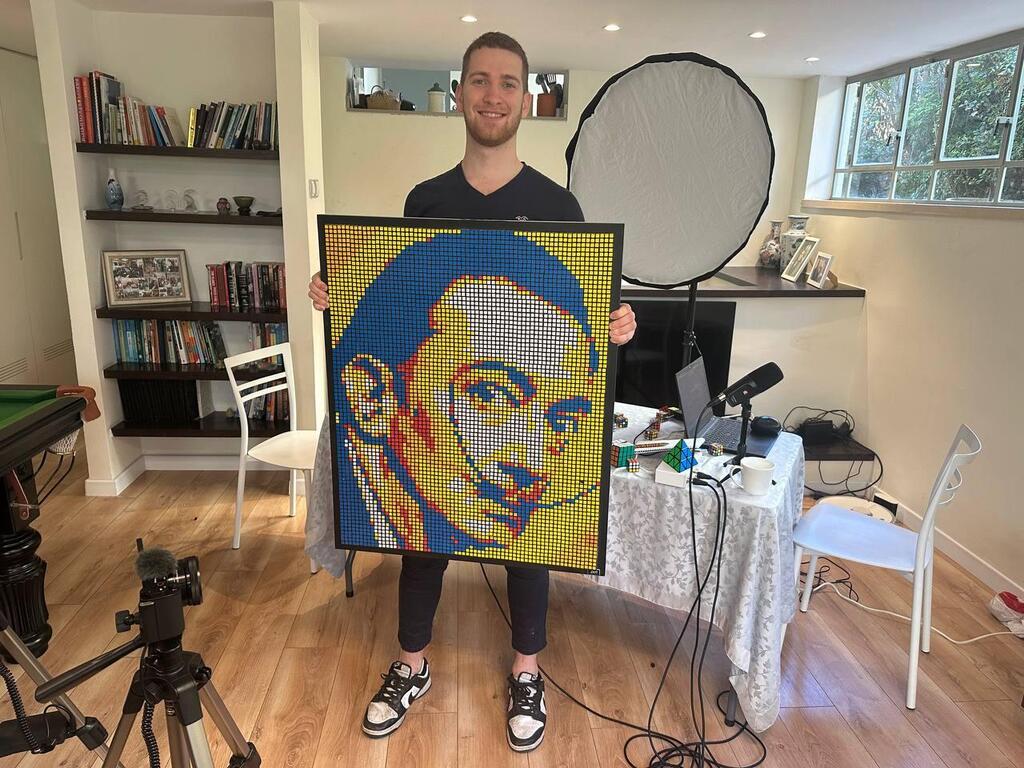
Rubik’s Cube artist Tom poses with a completed portrait of Salvador Dalí made entirely of rotated cubes in his home studio. Each work uses hundreds of cubes to recreate iconic faces, blending mathematical precision with artistic expression
(Photo: Bar Gindy)
A standard portrait sells for around 3,500 shekels. Larger pieces have reached nearly 5,000. For broader accessibility, Tom also offers canvas prints of the digital pixel designs at lower prices.
The science of solving
Tom insists that anyone can learn to solve a Rubik’s Cube in about six hours using online tutorials. Speed, however, is another story. Solving in seconds requires memorizing roughly 200 algorithms and mastering pattern recognition.
During demonstrations, he solves complex cubes like the 4x4 and introduces shape-shifting puzzles and pyramid cubes. The key, he explains, is learning to recognize patterns rather than thinking linearly.
Last summer, Tom participated in a major exhibition of Rubik’s Cube art, where monumental works were displayed, including recreations built from thousands of cubes.
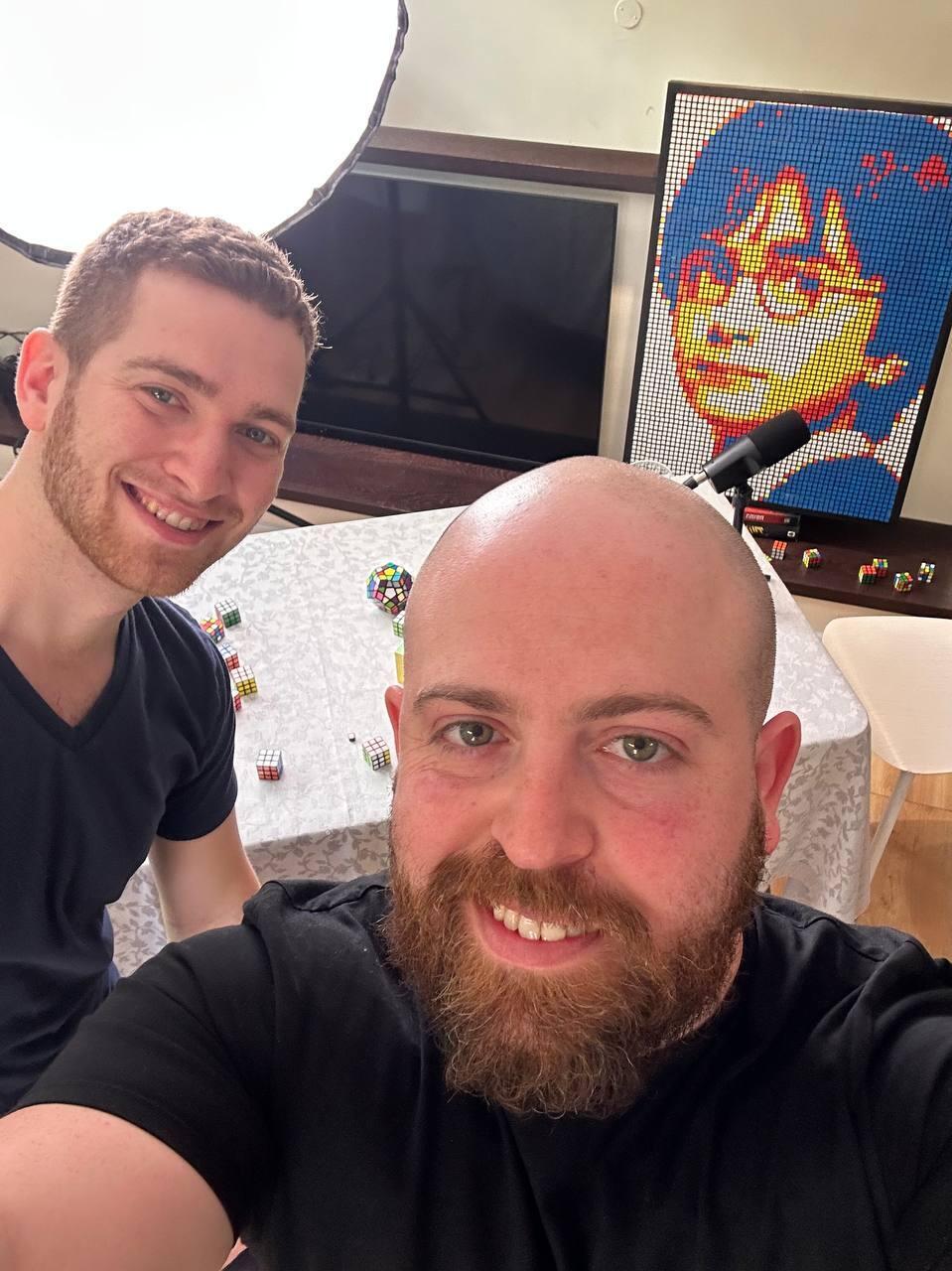
Tom, left, and Bar Gindy, host of the People & Collectors podcast, take a selfie in Tom’s home studio during a recording session. Behind them is a finished cube portrait built from hundreds of hand-arranged Rubik’s Cubes
(Photo: Bar Gindy)
Since the war, his work has taken on a social role. He creates digital portraits for families of hostages to raise awareness and planned a live build in Hostages Square for the family of Alon “Lulu” Shamriz. For Tom, the cubes are not just a medium. They are a platform.
Tom describes himself as an autodidact who enjoys breaking systems apart. He has taught himself juggling, tightrope walking and even experimented with breaking glass using his voice.
His long-term dream is to create a massive Rubik’s Cube portrait for Elon Musk, whom he admires for attempting to push humanity forward.
Tom’s process resembles a self-built puzzle. Each cube must be oriented perfectly. Each small success enables the next. Only from a distance does the full image come into focus.
- For more stories from Tom and other collectors, check out the People and Collectors podcast. The full interview is available with subtitles in English and 50 other languages.