

You know that awkwardness: You have already said goodbye, parted ways, shed a tear and suddenly it turns out that, whoever it is, they are actually staying. The third season of “Ted Lasso,” which returned Tuesday night to Apple TV+ for another season, was almost forced to dig into the guts of its hero’s endless generosity. Lasso, played by Jason Sudeikis, was revealed to be using it as a defense mechanism and a way to avoid friction with real life — in his case, dealing with grief over his father, the collapse of his marriage and his fear of his relationship with his young son, Henry. His “toxic positivity,” it turned out, carried a psychological price and was not just endless altruism. In that sense, the creators of “Ted Lasso” risked an own goal when they failed to fully part with the sweetness that characterized the plot and to balance Lasso’s approach to life with his emotional abysses.
'Ted Lasso' Season 4 trailer
(Video: Courtesy of Apple TV+)


On another level, the creative freedom those same creators received following the series’ phenomenal success and its classification as one of Apple TV’s flagship shows did not necessarily do them any good — for example, in the unrestrained editing and secondary plotlines that spun out of control and received precious and unreasonable screen time without dramatic justification. The cute COVID-era tranquilizer, which began as an expansion of an American commercial, tried to become a panoramic HBO-style drama. The result was a drama that wants to be mature, but presses a little too hard on the pedal of educational messages.

Now, three years later, Sudeikis and the other creators are trying to start fresh and return Lasso to his innocent, warm starting point by changing the setting from Richmond’s men’s soccer team to the women’s team. The trick is the same trick, the pony is the same pony, the world is no longer the same world — but our Ted is still optimistic, humane and impossible to anger. Is he still repressed? Probably, but from the looks of it, he will have to discover everything all over again.
In interviews over the past week, the creators swore that the idea of returning did not stem from a desire to pile another season onto a successful brand, but because they felt there was a new story worth telling. During filming of the third season, they were in England during the 2022 Women’s Euro and saw up close how the country fell in love with the women’s national team.

Same show, this time with a girls' team
(Photo: Courtesy of Apple TV+)
Brett Goldstein, who also plays Roy Kent — take a lozenge, man, that hoarseness is not healthy — stressed that they felt they were “watching a cultural shift in real time,” reason enough to drag Ted Lasso across continents again. They even planted a moment in the third season finale in which Rebecca and Keeley talk about forming a women’s team, just to be safe.
The first of 10 episodes in the current season is meant to settle viewers’ minds on the critical question, or rather two questions. The first is how the good guy who left a promising career and a lot of money to be a good father to his young son, and swapped coaching a Premier League soccer team in England for a job at a supermarket in Kansas, returns once again to the English pitches.

Ted Lasso returns once again to the English soccer pitch
(Photo: Courtesy of Apple TV+)
Even the most skilled suspender of disbelief will need a good reason to believe that Lasso is still the good guy when he chooses soccer over his family for the second time. Even when Rebecca (Hannah Waddingham), Higgins (Jeremy Swift) and Keeley (Juno Temple) appear on his doorstep in America with the job offer, Rebecca emphasizes that this time she wants to recruit him for the right reasons. “Are we supposed to sabotage this team?” wonders an experienced Lasso.
So what are the right reasons? It is unclear. At the moment, it is simply Lasso’s longing for the fields, and perhaps Apple’s longing for its successful feel-good series.
The second question is whether there is justification for bringing Lasso back to the screen. There are not many television meals that can be served twice while expecting the same enthusiasm. “Ted Lasso” arrives with 11 Emmy Awards and the title of the most-watched original streaming series of 2023, but we are in 2026: angrier, more sober, less inclined to surrender.
“Ted Lasso” is refreshed with new crew members, and alongside the familiar faces, the ensemble is joined by the excellent Tanya Reynolds (“Sex Education”), who plays Alice Chilton, the assistant coach who grumbles on the outside but is, of course, soft on the inside, as well as Tracey Ullman as Rebecca’s mentor.
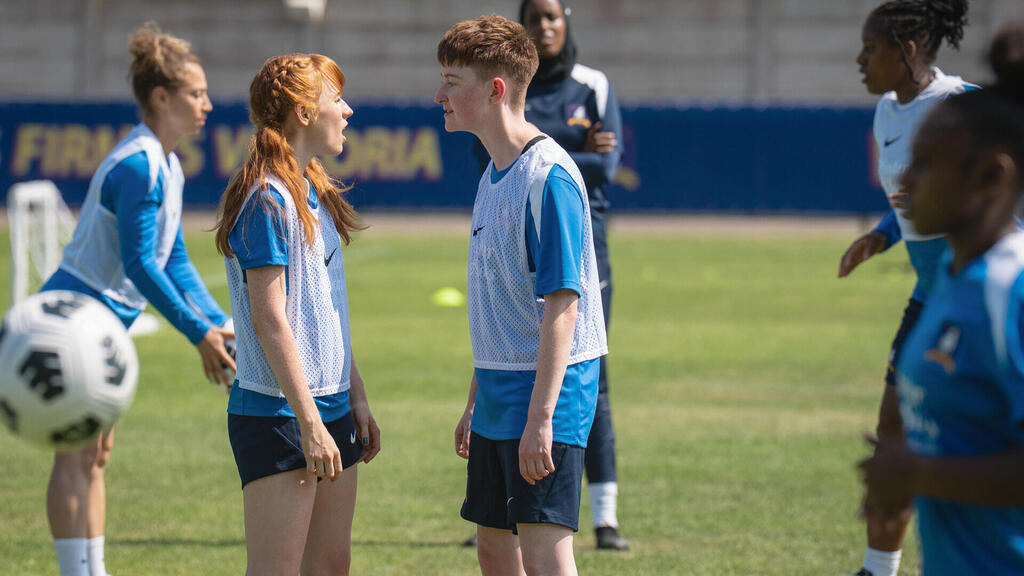
This time its a girls' soccer team
(Photo: Courtesy of Apple TV+)
If this season succeeds, it will not be because Ted Lasso has changed, but because the series finds a new way to examine his philosophy. Women’s soccer has been given a difficult task: to recharge the way of life that is Ted Lasso with meaning, with the kind help of issues such as gender discrimination and budgets, pregnancy and motherhood. Its challenge will be to succeed without being swept into an overdose of agenda — in the second episode, Rebecca turns the world upside down to prove she is a feminist, once she figures out what that means, for heaven’s sake — and without falling into the jaws of the perception of a man rescuing a group of women.
Does “Ted Lasso” really reinvent itself? Based on the five episodes released for review, probably not. But the goods the series offered us were never plot originality. It sold us humanity. The new season does not tell a new story, but it reminds us why we loved the people who told it to us in the first place.
What set “Ted Lasso” apart was the chemistry between the characters, the dialogue, the jokes, the transitions between humor and emotion and the choice not to brood over cynicism as a symptom of sophistication. All of that still exists in it. It may not be as thrilling as it was at the first meeting, but its comforting magic, especially for those who celebrate it, is still there.