

Shoshan Haran was abducted from her home in Kibbutz Be’eri together with her daughter Adi, her young grandchildren Naveh and Yahel, her sister-in-law Sharon and Sharon’s daughter Noam. Her son-in-law, Tal Shoham, was also kidnapped and held separately. Her husband, Avshalom, her sister Lilach and her husband, Evyatar, as well as her caregiver Paul, were all murdered.
Haran was held with her relatives in Hamas safe houses, guarded day and night by the terrorist group’s gunmen, until their release after 50 days as part of the first hostage deal. Returning to Israel did not bring healing or rehabilitation, but rather a renewed struggle for the return of her son-in-law Tal, who was brought back to Israel in February last year after 505 days in captivity.
Gallery
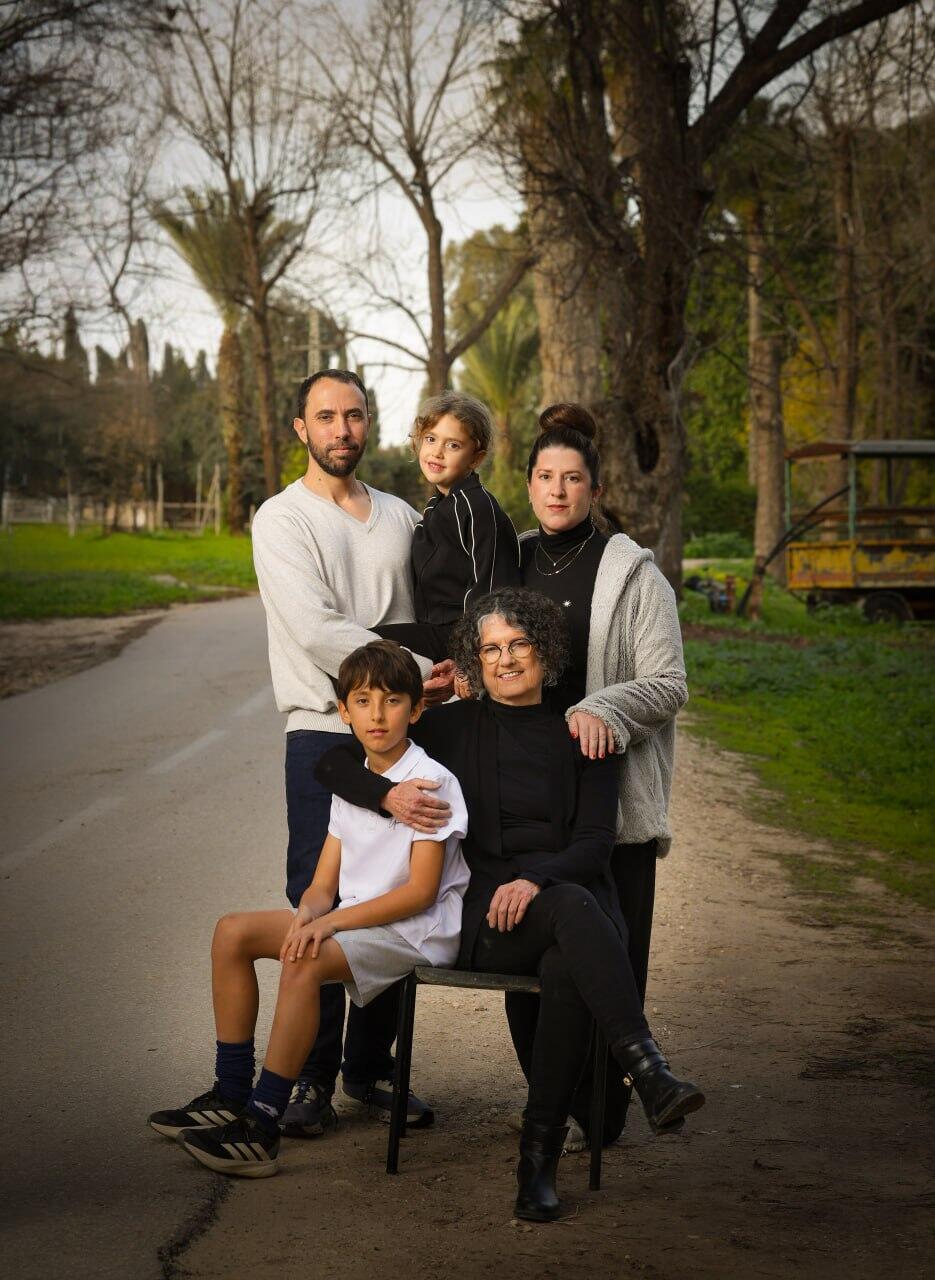
Shoshan Haran with her daughter Adi, son-in-law Tal and grandchildren Naveh and Yahel
(Photo: Avigail Uzi)
During her captivity, Haran had no information about her husband’s fate, and only gradually learned of the scale of the massacre. She was given no time to process the news or to grieve. Each day was a relentless effort to preserve both body and mind and to protect the children.
She describes the terror of nightly Israeli airstrikes and the unrestrained joy of her captors as rockets were fired from Gaza at Israeli population centers; the need to impose a daily routine amid constant uncertainty; the attempt to mediate reality for a child and a toddler through conversation and play in a world where crying was forbidden; the shortage of food; and her efforts to speak with her captors, encounters that sometimes revealed surprising and fragile moments of humanity.
How does one describe horror? What words can convey the unimaginable, let alone make it comprehensible? Haran chooses simple words and clear language, telling her story chronologically, beginning with her life among family and loved ones in Kibbutz Be’eri, where she was born and built her life. She moves through the massacre, the abduction, the captivity and the life that followed, because her journey did not end with her release, but with the freedom of all the hostages and of her son-in-law Tal. The chapter devoted to his captivity is the book’s most harrowing.
"Captive on a Mission" is not solely a book about massacre and captivity. First and foremost, it is a book about life, partnership and giving. Wisely, Haran opens with the days before October 7. She writes of her love for the landscapes and people of the western Negev; of her trip to the Dead Sea region for joint activity by Israeli and Palestinian women as part of the Women Wage Peace movement; and of preparations for a flight to the Netherlands, scheduled for the end of Simchat Torah, intended to advance humanitarian agricultural projects in some of Africa’s poorest regions. These details matter because they define Haran not only by what she endured, but by who she is.
An act of testimony
Since the publication in 1944 of "A Book of Testimony" by Jacob Kurtz, the first Holocaust testimony written by a survivor, Hebrew literature has been filled with accounts of witness. Over time, and with historical distance, the genre faded. After the October 7 massacre, testimony, as a literary genre, has reclaimed a central place in Hebrew literature.
"Captive on a Mission" is an essential work not only because of the story it tells, but because of its ethical stance. The hostages were torn from their private lives and turned into bargaining chips by Hamas murderers, while public pressure for their return transformed them, against their will, into public figures.
The book’s heartbreaking struggle for every moment of humanity, from conversations with armed captors to attempts to create a daily routine for toddler grandchildren, basic hygiene and mental survival, is vital not only as testimony, but also for giving voice to what was not allowed to be spoken and for restoring a human gaze to those stripped of their humanity.
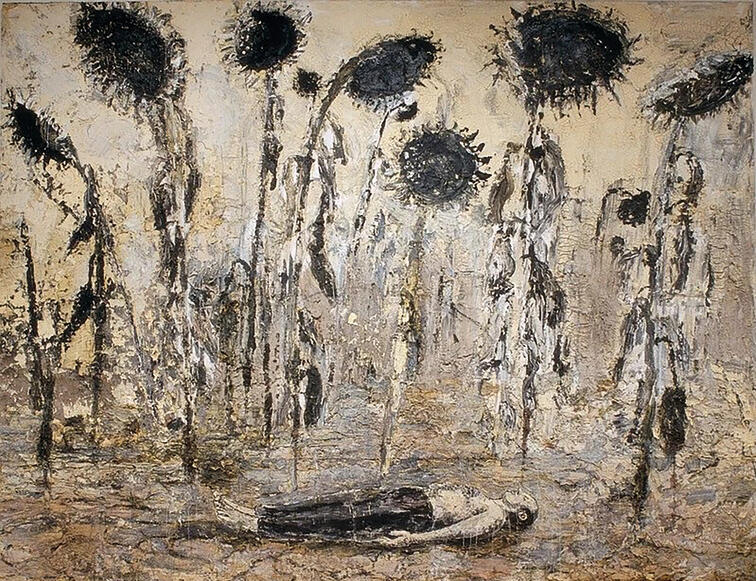
A plowed field, a painting by Anselm Kiefer
Haran references the Jewish-Austrian author Stefan Zweig, particularly his final book, "The World of Yesterday", a masterpiece depicting a culture in its death throes. Zweig describes the Europe he loved, where people forged deep intellectual and emotional bonds and moved freely across borders, a continent that failed to resist violence and fascism until its destruction. He wrote the book in exile as a persecuted Jew during the Holocaust, unable to find refuge. His final intellectual act before taking his own life was writing as testimony.
“To give witness of this tense, dramatic life of ours, filled with the unexpected, seems to me a duty,” Zweig wrote in his preface. “Everyone was a witness of this gigantic transformation, everyone was forced to be a witness. There was no escape for our generation, no standing aside as in times past. Thanks to our new organization of simultaneity we were constantly drawn into our time.”
Haran’s book should be read in that same spirit, as an act of testimony. She was captured not only by terrorists, but by time, history and years of criminal neglect by Israeli governments. Her story is the testimony of one woman, a mother and grandmother fighting for her life and her family’s lives during captivity and afterward. It is also a struggle over the future of society and culture.
The power of the book lies not only in what it records, but in the conclusions it draws. Haran examines not just her inner life, but the forces that led to disaster. She confronts Israel’s military and social policy of containment, which for years accepted rocket fire on Gaza border communities as minor incidents and normalized the presence of a murderous organization beyond the fence.
She describes Hamas’ dual strategy of terror and propaganda. Already on October 7, as the massacre was still underway and being broadcast, Hamas deployed a massive pre-prepared army of bots to flood media and social networks with claims that "Israel was committing genocide in Gaza."
The easiest simplification in war is to portray one side as purely moral and the other as wholly evil. Yet Haran’s humanity shines throughout the book. She is the founder of Fair Planet, an organization that supports farmers in Africa by providing high-quality seeds and basic agricultural knowledge in the world’s poorest regions, offering food security and dignity.
The contrast between an agronomy PhD dedicating her expertise to access to food and knowledge, and Gazans whose existence under Hamas is defined by murder and destruction, cries out from the pages. Throughout the book, Haran describes the full awareness of Hamas terrorists of their actions and their declared goal: the destruction of the State of Israel.
In every home hung images of Israel in flames, a vision realized in the Gaza border communities. Her captors asked whether she held another citizenship, urging her to use it and emigrate. Even the most gentle and humane among them told her that there was no difference between him and the murderers who carried out the massacre and rapes. “We are the same,” he said.
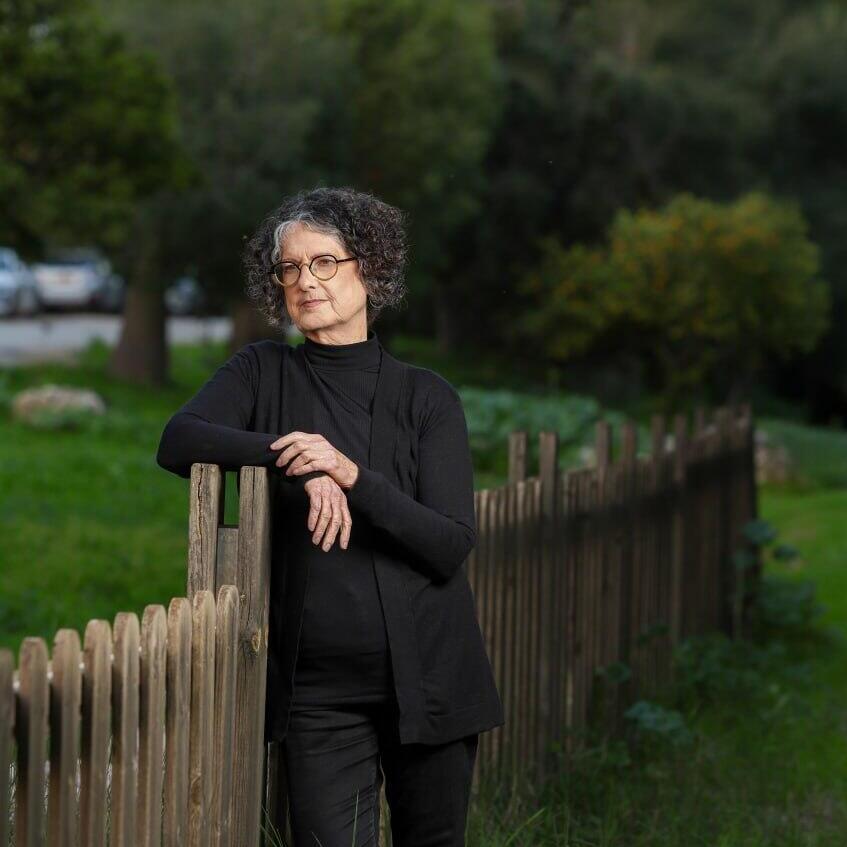
Shoshan Haran
(Photo: Avigail Uzi)
This is where the difference between Israel and Hamas lies. While Israelis often view Gaza residents who support Hamas as people like themselves, human beings seeking safety and peace, Hamas and its supporters identify fully and absolutely with the goal of Israel’s destruction.
Two and a half years after the war began, it is too early to assess the full trauma of October 7. As these words are written, there are no Israeli hostages or bodies held in Gaza, a reality that would have seemed unimaginable over the past 12 years. Yet despite this achievement, Gaza remains under the rule of a murderous terrorist organization committed to Israel’s annihilation.
The struggle to bring the hostages home has ended. The struggle to heal and rebuild Israeli society has only begun. Shoshan Haran’s testimony, with its depiction of an unfathomable reality, its moral implications and its choice of humanity as an ethical stance, is a first step in that process.