

The U.S. premiere of the Israeli documentary “NAZA” at the prestigious New York Film Festival drew a pro-Israel protest outside Lincoln Center on Saturday, even as the controversial film received an audience award and a public show of support at Spain’s San Sebastián Film Festival.
The New York screening, attended by filmmakers Yuval Abraham and Rachel Szor, had prompted opposition from the Israeli Consulate in the city and local activists over the documentary’s portrayal of Israeli military policy in Gaza. The Israeli-American Council, or IAC, issued an urgent call for supporters to demonstrate outside Lincoln Center during the screening.
Pro-Israel protest outside a screening of ‘NAZA’ in New York
(Video: Amir Bogen)


Inside Alice Tully Hall, which seats more than 1,000 people, the screening was sold out. Across the street, about 30 demonstrators, most of them Israelis living in New York, gathered with Israeli and U.S. flags and signs reading “Am Yisrael Chai,” or “The people of Israel live.”
Speakers included IAC representatives and Nova festival survivor Shalev Biton, who has been traveling on an advocacy tour with Younes al-Krenawi, a Bedouin Israeli who rescued him during the Oct. 7 Hamas attack.
Two trucks hired as part of an initiative by the Israeli Consulate repeatedly drove past the venue carrying electronic screens showing victims of the Oct. 7 massacre alongside the slogan: “Context is not censorship. It’s responsibility.”
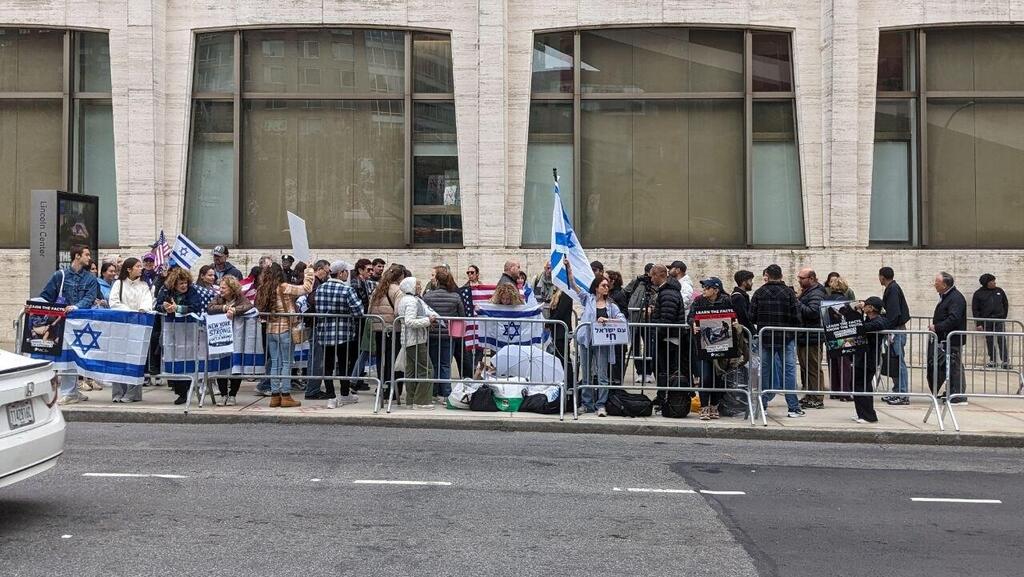
With the exception of one Israeli speaker who called Abraham and Szor antisemitic and compared them to Jews who betrayed fellow Jews during the Holocaust, speakers largely focused on what they described as the filmmakers’ responsibility to provide greater context.
They said they were not seeking to stop the screening and stressed that freedom of speech is a fundamental American value. Their demand, they said, was that the filmmakers make clear that the Oct. 7 attack was the event that triggered Israel’s military campaign in Gaza.
None of the demonstrators had seen “NAZA.” The film itself begins with the Oct. 7 atrocities and examines both the reaction within Israeli society and what Abraham and Szor portray as a subsequent loosening of restraints in the conduct of the war in Gaza.
“NAZA” seeks to expose what its creators describe as the inner workings of Israel’s security establishment during the Gaza war. Twenty-four intelligence personnel and combat soldiers appear anonymously, their faces obscured, and discuss what they say was a shift in policy regarding civilian casualties.
According to the documentary, civilian deaths increasingly came to be treated as acceptable collateral damage calculated with the assistance of artificial intelligence systems. The film also examines the use of intelligence involving relatives and associates to locate targets.
The testimony is framed throughout against the backdrop of Oct. 7. Several interviewees describe the anger and desire for revenge they felt after the Hamas attack and discuss the belief that “there are no innocents in Gaza,” which Abraham and Szor argue contributed to a broader disregard for Palestinian civilian life.
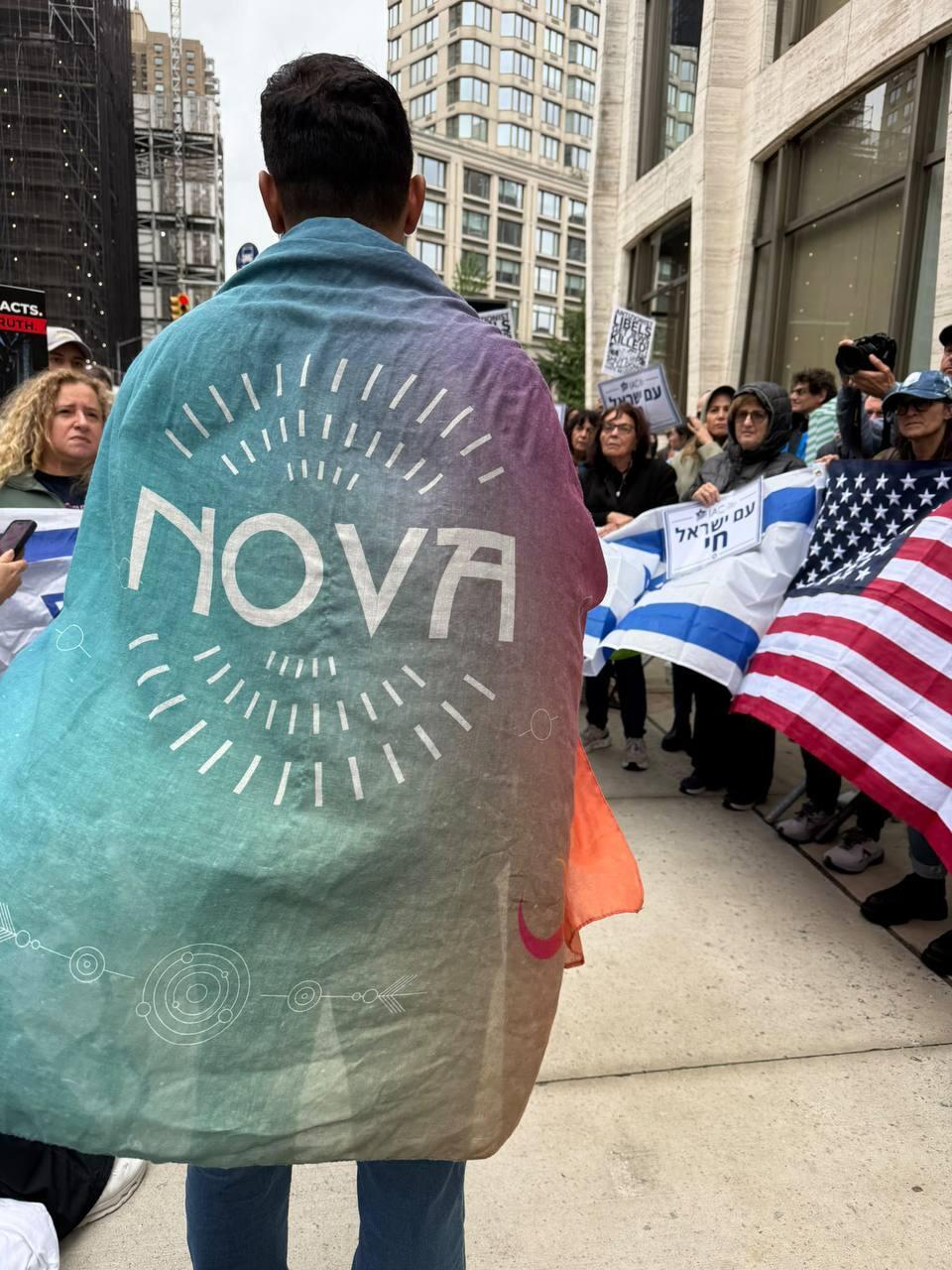
(Photo: IAC)
While the small group of protesters spoke outside Lincoln Center in Manhattan, a very different scene unfolded across the Atlantic at the awards ceremony of the San Sebastián Film Festival in Spain.
“NAZA” won the festival’s audience award. Spanish producer Enrique Costa accepted the prize on behalf of Abraham and Szor from actress Paz Vega.
Costa and Vega held signs featuring images of the two Israeli filmmakers and the words “We are NAZA too.” Many members of the audience responded by raising similar signs as well as Palestinian flags.
The display followed earlier demonstrations in the Basque city supporting Abraham and Szor amid the backlash they have faced in Israel.
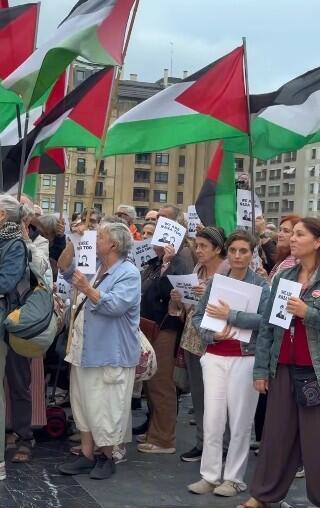
Support rally for ‘NAZA’ in San Sebastián
“It is an honor to receive this award from the audience in San Sebastián, which has received the film so warmly since its premiere,” Costa said on behalf of the filmmakers. “It is a shame we could not be there, but we saw the footage of what happened that night, and we are forever grateful.”
He added that Abraham and Szor hoped the film would “continue to raise awareness of what is shown in the film, and of what the Israeli government is doing in killing Palestinians in Gaza.”
The festival’s top prize, meanwhile, went to Mike Leigh’s “Tender Loving Care.” The veteran British director’s film is not expected to be screened in Israel because of Leigh’s boycott of the country in protest of Israeli government policy over the past two decades.
First published: 01:40, 09.27.26