


"10:30. Piazza del Popolo. Under the Obelisk." That was Erri De Luca's entire email.
I thought the Obelisk was the name of a café. It wasn't. It was the ancient obelisk standing in the middle of the piazza, exposed on all sides.
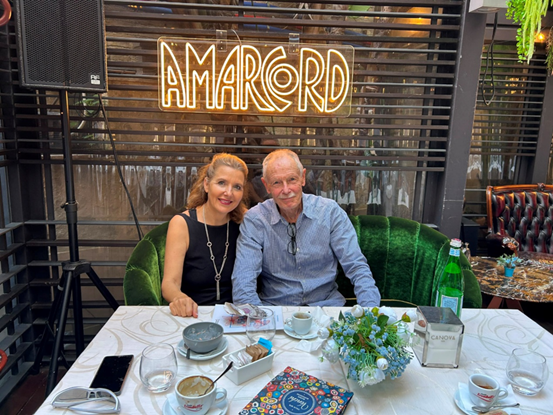
Hadar Galron and Erri De Luca
(Photo: Courtesy)
We had never met before. I was with my daughter, Na'ama, who is studying in Italy and speaks fluent Italian, which is useful for an awkward, "Excuse me... are you Erri De Luca?" I'd seen photographs of him, but I didn't know his height or the way he walked. From which direction would he come? Maybe I should retreat to one of the cafés and email him that I was there? He doesn't text. Only email.
There was a man sitting on the steps who vaguely resembled the photograph I remembered, but somehow it didn't seem like De Luca's style. Besides, Piazza del Popolo in July is one of the most crowded places in Rome. Tourists were flowing through the square from every direction.
How would I recognize him?
As it turned out, there was no need to worry.
He crossed the square with steady strides, tall and upright, a cap shading his face. Yet I knew instantly it was him. There was no performance in the way he carried himself, only a rare kind of modesty. He walked like someone with a mission, like a hiker.
Then he smiled.
It was one of those smiles that begins in the eyes. Honest, kind, curious eyes, yet sharp enough not to miss a thing. Our eyes met. He, apparently, had never doubted that we would recognize each other.
Without hesitation, he led us into a nearby café. He exchanged a few words with the waiter, who smiled knowingly and guided us through the bustling front room into a beautiful hidden garden at the back, completely sheltered from the noise of the street. The walls were decorated with the titles of great Italian films. We found ourselves sitting beneath Fellini's Amarcord. It felt like the only possible place for the conversation that followed.
We had come to speak about bringing Montedidio to the stage. And we did. But the conversation soon wandered effortlessly to Hebrew and Yiddish, to Kohelet (Ecclesiastes), to age, to Israel, and to the enduring power of words.
Later, I asked his permission to share his words as an interview for ynet.
"Why not?" he replied.
What follows is an edited version of a conversation that began under the Roman sun and wandered far beyond the play we had come to discuss. It is also a portrait of a man who, well into his seventies, remains profoundly curious about the world and fully alive to it.
Montedidio seems to connect Naples and Jerusalem. Did you always feel that kinship, or did the novel reveal it to you?
"I felt kinship between Yiddish and Neapolitan in a physical, material way. The overcrowded places produce shortcut languages, the ability to act always in a mix of market and stage. Places that produce emigrations."
You're not Jewish, yet you devoted decades to studying and translating Hebrew texts, Exodus, Jonah, Kohelet and Ruth. What drew you to a language that wasn't yours?
"It became my intimacy through each early morning of mine. It became manna, bread of the sky, for my brain. It became the tree of knowledge of good and evil, with the effect of opening my eyes wide and making me feel naked."
There are formal translations of the Old Testament. Why did you feel the need to translate it again?
"The formal translations miss a lot of the meaning. In Kohelet, for example, hevel havalim is translated as 'vanity of vanities,' not only in Italian, but in all the languages."
And how did you translate it?
"Who was Hevel? He was the first man murdered in the Bible, by his brother. So I translated Hevel as spreco, waste. From the first life lost and wasted.
"Kohelet is not a wise old man elaborating philosophical thoughts. He is King Solomon, a rich adult obsessed with the waste of all his deeds. He is in conflict with his own life. He accuses himself and everybody else."
I admitted that I had never connected Hevel the man to the expression "hevel havalim."
And you also learned Yiddish.
"Yiddish comes from my century. I was born after the destruction of the worst war of mankind. I have been emotionally affected by it. I am a splinter of it.
"Learning Yiddish was the only available action for one who came after: to move the lips of Yiddish, to read, to sing, to translate. I didn't want death to have the last word."
Does Kohelet read differently to you today than it did when you first translated it?
"Its spectacular list of opposite verbs is a dance, a waltz around life. I like Pete Seeger for the music added to the verbs. Do you know Turn! Turn! Turn!?
"Personally, I don't detect seasons in life, apart from meteorology. I am now an old man, but these are the best years of my life. I even wrote a book about it, L'età sperimentale ('The Experimental Age')."
At this point, Na'ama, my daughter, suddenly sits upright. She had seen the film during her psychology studies at the University of Padua and had been convinced that the man climbing mountains with the ease of a goat could not possibly be Erri De Luca himself. Surely, she thought, it must be a stuntman or a professional climber standing in for him.
She turns to him, genuinely surprised.
"That was you?" Na'ama asked.
Erri laughs. "Of course it's me. Who else?"
So in the book and film, you explore age as something experimental, something still to be discovered. Yet Kohelet says there is nothing new under the sun.
"I disagree. At my age, I find everything new inside me, and I discover around me new realities of people, animals and flowers.
"My connection with my body has grown to such an extent that I instantly know where every ache or pain comes from. I'm a hiker, but as I get older, I take fewer precautions and trust my body."
You've called yourself a Zionist despite the cost of that word today. What do you wish people understood?
"I don't care about the effects of my words. I defend them, and they, the words, defend me."
Finally, if these really are the best years of your life, what still lies ahead?
"At my age, every day has the right to be the last. So I deal with it. I treat it as penultimate. No projects for tomorrow."
As we stood up, Erri insisted on paying for our ridiculously overpriced Roman coffees and a cornettino. I protested, but he wouldn't hear of it.
"You can pay for my coffee," he said, smiling again with those eyes that smile first, "when I come to Tel Aviv."
I'm looking forward to keeping that promise.