

On a Saturday afternoon at St Mary’s Stadium, pop singer Noa Kirel joined tens of thousands of Southampton fans singing Doris Day’s Que Sera, Sera — a classic that has become a staple of English soccer. In that moment, even one of Israel’s biggest stars understood she was witnessing the peak of her husband’s career — the man in the green vest, the hero of a sensational 2–1 win over Arsenal, on the way to an FA Cup semifinal against Manchester City. For three years she has stood by him, supporting him through difficult moments — and only she knows how many there were.
Even before the frenzy surrounding his standout performance against the title-chasing Gunners, Daniel Peretz had become one of the most talked-about goalkeepers in England. The new leader who took a struggling team from 16th place in the Championship and turned it into a serious contender for Premier League promotion.
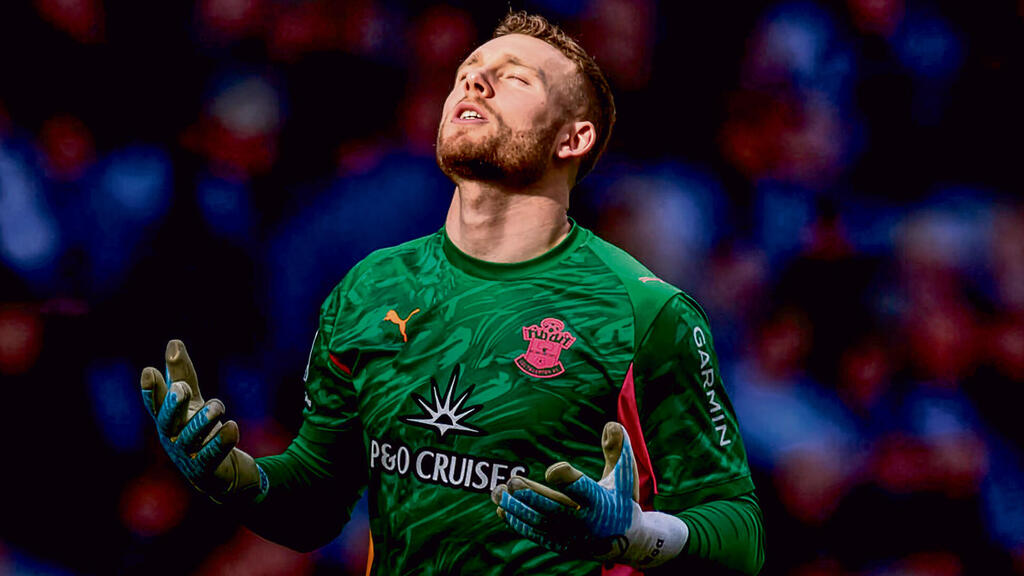
“I am proud and excited to be in this position. My country and my people are at war, so for me it’s a huge source of pride to be Israeli and Jewish and to represent all of us this way,” said Peretz, who has been dubbed “Iron Dome” in England, in a wide-ranging interview with Yedioth Ahronoth and ynet. “When I went out to the match against Arsenal, I thought about what’s happening back home — a combination of holiday and war — and it was important for me to make as many people happy as possible.”
Is this the peak moment of your career?
“There’s a chance this is the biggest achievement of my career. You can see the impact of this win on our fans — in England, in Israel and across Europe. It only gives you a taste for more and increases the hunger for what we’re capable of.”
What’s it like facing the best players in the world?
“It was fun and challenging. To see where you stand at that level, to test yourself against the best players in the world — those are the most enjoyable matches. We felt we were really there. We proved it against Fulham and Arsenal, and with God’s help we’ll prove it in the semifinal against Manchester City. I came very prepared. For me, whether it’s a lower league or the champions of England — the level of preparation is the same.”
Describe the atmosphere at the final whistle.
“The atmosphere was crazy, the best since I arrived at Southampton. From the start of the match, we felt the magic — the fans were with us in every action, every tackle and every pass. At the final whistle, it was a shared moment of joy for the entire stadium. Noa and her parents were in the stands, and there was so much energy.”
Can you get past City?
“Everything is possible. I want to return to Wembley twice after this match — for the FA Cup final and the promotion playoff final.”
'Building myself as a starting goalkeeper'
Peretz, 25, made headlines when he signed for Bayern Munich about two and a half years ago. He admits the experience was mainly a “school” for goalkeeping and professionalism, but now it is time for practical application. After an unsuccessful spell at Hamburg, he is finally getting a real opportunity — and showing why he was once considered one of Europe’s most promising goalkeepers.
Some top goalkeepers accept being backups at big clubs. Did you consider that?
“Right now I’m building myself as a starting goalkeeper. I know that’s what I want. Everyone makes their own decisions at different points in their career. I want to play — it’s good not just for my career but for my life. To be dominant, to feel truly sad after a loss and truly happy after a win, and to be fully connected to the team. If you’re not on the pitch, you don’t feel that 100%.”
Did knowing someone like Manuel Neuer was ahead of you make it easier?
“Even if you know who’s ahead of you, you still see the pitch and the atmosphere and want to play. That’s why you chose this profession. I enjoy playing soccer, and of course there were and will be difficulties. During those two years, every time I faced challenges I reminded myself why I’m doing this and what it will give me in the future.”
Who helped you acclimatize at Bayern?
“First of all, the goalkeeping coach. He’s amazing — professionally and personally. He always knew how to handle the situation and help me develop. In the dressing room, everyone is a top person and a top athlete. You talk to many players with a lot of experience. I have a great relationship with Neuer — I consult with him about everything, even before moving to Hamburg or Southampton. I had an amazing connection with Thomas Müller too — we still talk a lot. He sent me ‘mazal tov’ for my performances in England — a very humble person, someone I care about a lot.”
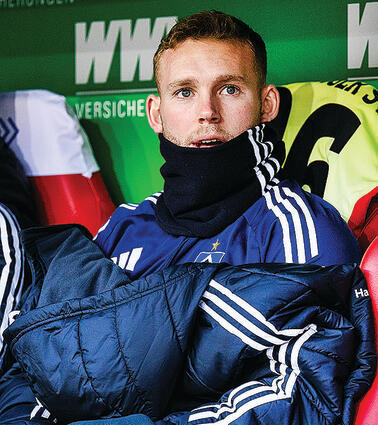
Peretz made headlines when he signed for Bayern Munich about two and a half years ago
(Photo: picture alliance/dpa via Getty)
When did you decide to leave the golden cage of Bayern?
“It was a mutual decision. I had a period where I played, from December to January 2025, and I felt amazing. Then came that bizarre kidney injury — I could write a book about it. I took a hit, thought it was my ribs, but tests were fine. I was in a lot of pain, and after the national team break something felt off. I went to the hospital and they found internal bleeding. I had severe pain and was hospitalized for three days.”
'It was very, very hard at Hamburg'
Despite signing with PSV Eindhoven initially, a failed negotiation led him to Hamburg instead. There too, Peretz faced setbacks.
“I don’t break. It’s frustrating, of course, and I was very disappointed because I wanted to play, but I knew it would pass. I always have a choice — to break down and complain, or to accept the situation and use it in the best way possible. If I had played the victim, I would have been the first to suffer.”
“It was very, very hard. You feel you can help the team, but you don’t get the opportunity. You train well, feel great — but can’t show it. It’s frustrating.”
How did you cope?
“My habits. The way I approached every day, not allowing myself to be a victim. Improving every day, giving not 100%t but 200%, staying committed to myself. I’m only 25 — my career isn’t over. So if I don’t play for six months, I’ll get through it.”
Then you come to the national team and have two weak games, against Norway and Italy.
"Against Norway I had a bad game even though I started well and took penalties. Against Italy, the goals were in very difficult situations. Even when I sat down and analyzed the game against Italy, there were very small details that if you had done better I could have saved. And when you concede five goals it looks bad, but it's not like Norway, where we made mistakes. I'm a person with high self-criticism, so obviously after those games I was disappointed. And you're not playing in Hamburg either – so this is your last game. But that's the job, I'll have more bad games in my career."
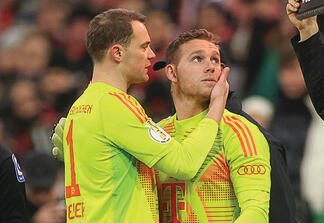
Peretz turned to Manuel Neuer for support
(Photo: Alex Grimm/Getty Images)
Your wife Noa Kirel liked your criticism less.
"I understand the media, and as a goalkeeper I can have a bad game. I understand the expectations and I also understand that my name is convenient for the headlines. So just as I get the credit in good times, when they were less good, I'm the first to take the credit. There's no player in history who doesn't have a bad game or two, especially when I'm not playing regularly, and people haven't seen me before. After those games I received criticism - I don't think the media hurt me as much as the messages I received on WhatsApp with curses from fans. After all, I'm a person who would die for the national team, so those messages were tough and difficult for me. It pinched my heart. I decided to completely disconnect. I wasn't exposed to the media.
What does that mean?
“I deleted all apps. The only criticism I accept is from my coaches. Journalists are doing their job, but they don’t know what you go through. If you’re exposed to that, it affects you. I think it’s a must for any athlete.”
'We will make the Euros'
Still, the national team recorded a disappointing campaign. Your defense became one of the weakest in Europe, and you defeated only two of the continent’s weaker sides — Moldova and Estonia.
“We have room to improve, especially in defense — we conceded a lot of goals, and that’s no secret. We’re aware of it. It was a very tough draw, especially with the current Norway side. We know the real goal was the Euros. At one point we could even have gotten past Italy. The World Cup is a much tougher task. We matched Italy in both games, and we also won away against Estonia and Moldova. We will make the Euros.”
As someone who has gone through setbacks, what advice would you give Oscar Gloukh regarding his situation at Ajax?
“Oscar is very strong. He missed a couple of games, and soccer is very fluid, especially in his position. Waves come and go, and these periods pass. Oscar is a top player, and he has a winner’s mentality. It’s not even really a ‘period.’ He’ll be very significant for Ajax and for our national team, I’m sure.”
How did you decide to move from the Bundesliga to a team that was then 15th in England’s second division?
“There’s no ego here. I do what’s best for me, and I don’t care what people think or say, because I live with myself. I look at every situation only from my own perspective. Maybe a lot of people raised an eyebrow — I don’t know — but I did what was right for me, and thank God it paid off. Southampton is a big club. When I arrived, I understood even more the human strength here, the level of professionalism — it’s unbelievable. I made the decision because I wanted to play, and this club gave me confidence — this time through actions, not words. They saw my two cup matches at Hamburg and my national team games — they believed in my abilities.”
'The goal — only the Premier League'
You spoke about reaching a peak in your career, but it’s not just about soccer — it’s also about leadership and your connection with Southampton’s fans.
“It’s a young team, so you’re relatively experienced — one of the veterans. We have a leadership group of four, and I’m one of them. It’s very natural for me, because that’s my character — to influence, to be involved, and to come from a genuine desire to help.”
You’ve climbed to sixth place — what’s the goal?
“Only promotion. Right now, we’re the best team in the league — we beat the leaders Coventry and Fulham from the Premier League in the cup. It’s still a tough league, and I absolutely love it. Choosing Southampton was spot on, partly because of the number of matches — every three or four days there’s a game, it’s like a full season.”
Your connection with the club is strong, but promotion matters — and in any case, you’re set to return to Bayern. What are your plans for the summer?
“We’ll have to see what the situation is. I’m really enjoying it here. The Premier League is a dream, and the place itself is great — an hour and a half from London, a fun port city, the best weather in England. I feel like a Premier League goalkeeper in every sense, and ready for the top leagues in Europe.”
As a player abroad, what’s the hardest part of adjusting to a new country — Germany and then England?
“Being away from Noa, from family and friends — honestly, that’s the hardest part.”
You’re in developed Western countries, but still new cultures.
“Before I moved, I learned everything about them — cultures, habits. The adjustment at Bayern was harder — it was my first time abroad, but it helped toughen me up. In Hamburg and Southampton it was much easier, especially since people speak English here.”
So how did you communicate in Germany?
“I speak German at a high level. The club immediately arranged a teacher, I learned the language, and it helped me a lot communicating with players. It’s very important to be part of the dressing room, the local culture and the fans.”
Tell us about a special experience in Munich outside of soccer.
“Oktoberfest — it’s an incredible event. Wearing their traditional outfits, which they’re very proud of, is part of the culture, and I really enjoyed it. You arrive, you wear the outfit, and everyone is in a good mood. For a whole month they sing the same songs — it’s fun and contagious. In general, it’s an amazing place. When you’re in Munich, you’re in the heart of Europe, and on a day off you feel like you’re in paradise. There are so many lakes nearby, and you’re close to Austria, Switzerland and Italy. You can disconnect — go out without your phone, just you and your wife in nature.”
And in Southampton?
“To be honest, we play so much — there’s a game every few days — so I don’t really go out, just stay at home and take care of myself and my body. It’s a great city with amazing people, there are restaurants and everything.”
What’s it like being an Israeli playing in Europe today?
“When I played in Germany, I felt support from the fans, the club — everyone. In England too, I really feel that people care. They just want me to focus on soccer, do my job, be good — I don’t feel that being Israeli carries any extra weight.”
What about in the dressing room, especially during a war with Iran?
“They’re interested, they ask, they care. Because I’m with them in the dressing room, I make them pay much more attention to the news. I really feel like a kind of national explainer — at Bayern, Hamburg and now in England. It’s very important to me. I went through October 7 and the past two and a half years, and now there’s also a sense of identification among the English themselves. After all, Iran also attacked a British base in Cyprus.”
'Noa takes care of everything'
Beyond soccer, Peretz spoke about his relationship with his wife, Noa Kirel. “It’s very hard, because Noa is truly my center. There’s nothing better than coming home after a match and being with her — that’s when you really disconnect.”
Does she give you advice?
“A lot. We both talk about staying focused, about consistency. After a good game, stay grounded; after a bad one, remind yourself you’re not as bad as you think.”
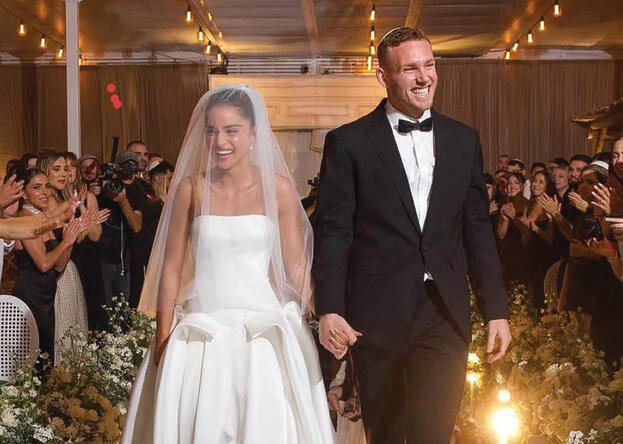
Daniel Peretz and Noa Kirel were married in November 2025
Is she a mentor?
“We’re there for each other. It helps that she understands this world. Without her career, she wouldn’t understand the battles I face.”
Does she give you space?
"You don't understand how much. She takes care of everything for me. When we moved to Southampton, within two days I had a game. Noa and my mother were with me, I didn't do anything except soccer. They did everything – and that's the greatest support possible, because she understands my need. I need to disconnect and have a good game, so I don't think about the apartment, not about the move, not about a hotel, I don't think about anything – everything is packed and organized."
She arrived in Germany and England as an international star.
"Noa is a star, and in England she is really well-known, because the Eurovision Song Contest she starred in was in Liverpool – she gave the show of a lifetime there."
First published: 17:54, 04.14.26