

Over the course of five decades as a writer, Salman Rushdie has published more than 20 books and established himself as one of the most daring and inventive literary voices of his generation. Yet two acts of violence have come to define the most turbulent chapters of his life.
The first occurred in 1989, when Iran’s Ayatollah Ruhollah Khomeini issued a fatwa calling for Rushdie’s death following the publication of his novel “The Satanic Verses.” The decree sparked violent protests across the Muslim world and forced Rushdie into years of hiding under constant threat.
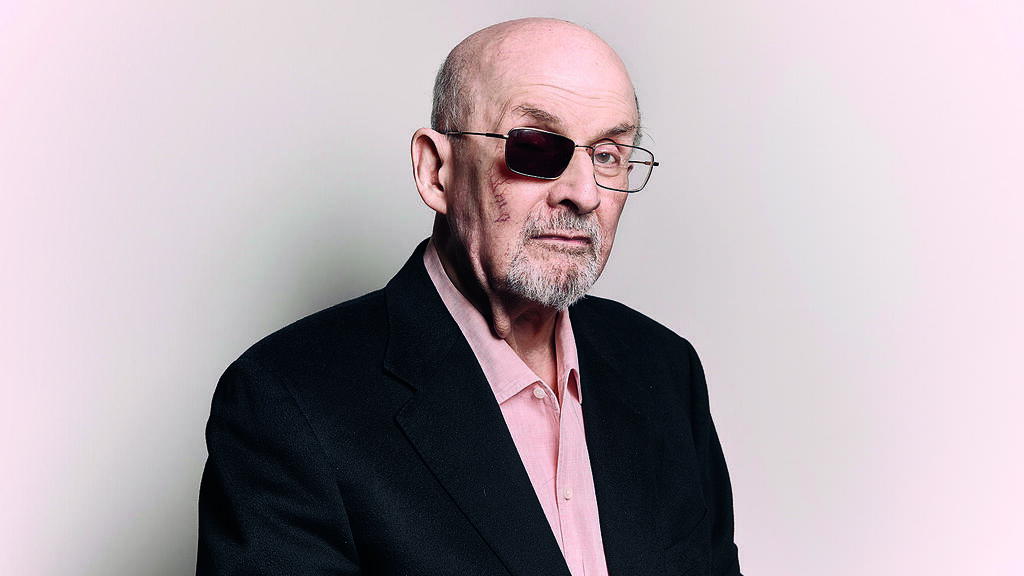
Stabbed the name of Allah, Salman Rushdie
(Photo: andreas kudacki, AP)
The second came in August 2022, when Hadi Matar, a Muslim man from New Jersey, attacked Rushdie with a knife during a public lecture in Chautauqua, New York, stabbing him repeatedly in the name of Allah. Rushdie survived but suffered severe injuries, including the loss of sight in his right eye.
The attack did not silence him. Instead, it propelled Rushdie to write “Knife,” a memoir that confronts the trauma of the assault while weaving together reflections on fear, survival and the enduring impulse to write. The book has now been adapted into a documentary film, “Knife: The Attempted Murder of Salman Rushdie,” directed by Oscar-winning filmmaker Alex Gibney.
The film premiered at the Sundance Film Festival, combining Rushdie’s own reflections, intimate footage from his hospital recovery and previously unseen archival material from the day of the attack. Following the screening in Park City, Utah, Gibney appeared on stage alongside Rushdie and Rushdie’s wife, photographer Rachel Eliza Griffiths, who documented his recovery from the ICU through rehabilitation.
Salman Rushdie at Sundance
(Amir Bogen)


In a conversation moderated by Sundance Film Festival director Eugene Hernandez, the trio spoke about the making of the film, the personal cost of extremist violence and the broader cultural and political implications of Rushdie’s story.
Rushdie, born in 1947 in Mumbai, said the most difficult aspect of participating in the film was not revisiting images from his hospitalization or confronting the physical damage to his body. Instead, he feared reigniting attention around the original fatwa and its long echo through extremist groups such as al-Qaida and Hezbollah. In the film, Rushdie recounts years spent living underground in London before eventually moving to New York and choosing a different approach, embracing public visibility rather than hiding from threats.
'For the authoritarian, culture is the enemy' Salman Rushdie at Sundance
(Amir Bogen)
“The question mark for me was going all the way back to 1989,” Rushdie told the audience, which gave him a standing ovation. “It was so long ago, and many people watching the film do not really have a clear memory of what happened then. If you do not understand what happened, you do not understand what happened now.”
Gibney, 72, said the archival research surprised even him. “When we were looking through the archive, we were astounded because we had already forgotten just how vast the reaction was,” he said. Known for documentaries examining authoritarian power and political abuse, Gibney drew parallels between the Rushdie affair and the current political climate in the United States, alluding to unrest under President Donald Trump. “Frankly, it connects to our present moment,” he said. “You see how violence unleashed by an irresponsible political leader can spread out of control.”
Rushdie said the film’s completion coincided eerily with global events. “You make the film, and then the world does what it does,” he said. “Maybe all of us are now feeling that danger is just around the corner. Maybe this experience can help people think about these larger things.”
Salman Rushdie at Sundance
(Amir Bogen)
Asked how his life reflects the anxiety produced by authoritarianism, Rushdie said the story extends far beyond him. “Violence is the thing,” he said. “Violence unleashed by the unscrupulous, using the ignorant to attack us. For the authoritarian, culture is the enemy. Journalism, universities, music, writing. The uncultured and tyrannical do not like it, and they act against it every day.”
Gibney, who recently produced “The Bibi Files,” a documentary by Alexis Bloom examining Israeli Prime Minister Benjamin Netanyahu’s legal troubles, said the film arrives at a moment of heightened relevance. “Salman’s story intersects with what is happening all around us in a powerful way,” he said.
He also pointed to Rushdie’s recovery as a source of hope. “The story moves from an act of hate toward a place of love,” Gibney said. “Salman never loses his principles or his sense of righteousness. At a time of growing authoritarianism, it is essential that we hold on to our humanity, our intimacy and our capacity to love.”