

Peter Max, the pop artist whose vivid colors, cosmic landscapes and psychedelic imagery became part of the visual language of the 1960s, died Monday at a Manhattan hospital after a long illness. He was 88.
Max’s work was nearly inescapable at the height of the counterculture era. His posters and paintings featured starbursts, floating peace signs, butterflies, clouds and surreal cosmic scenes, while his portraits included some of the era’s biggest musical stars, among them the Beatles, Jimi Hendrix and Mick Jagger. A 1967 Village Voice review described him as “a visionary fascinated by time, space and evolution.”
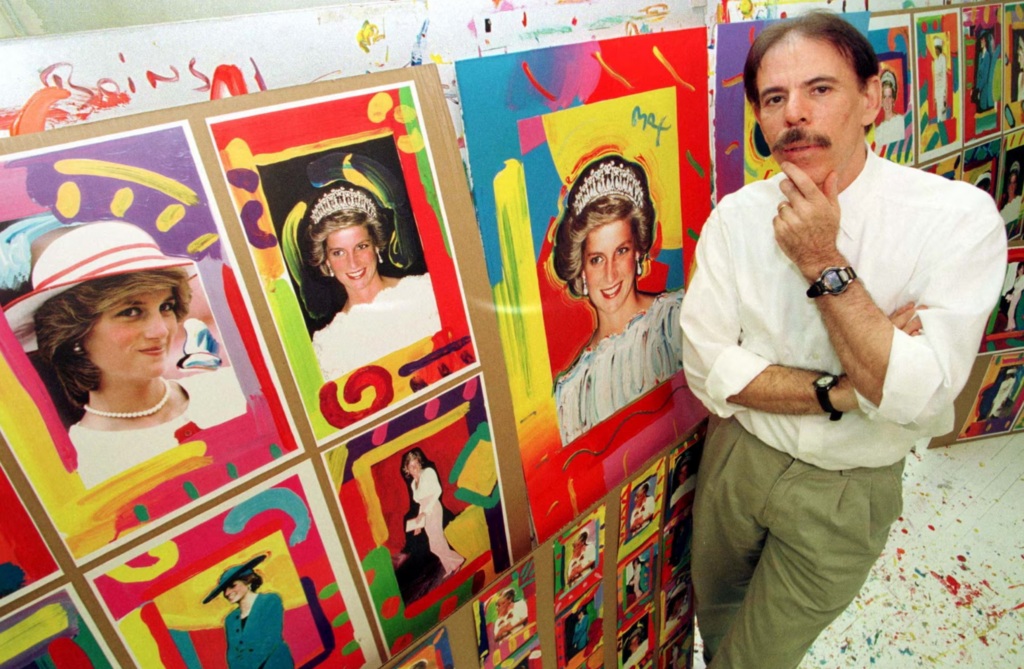
Peter Max
(Photo: Reuters)
His art also attracted prominent admirers. Former President Ronald Reagan was a fan, and Max donated a painting of the Statue of Liberty to the Reagan Presidential Library. Bill Clinton later told Max that his posters had hung on the walls of his college dorm room; decades later, portraits of Clinton by Max were displayed at the Clinton Presidential Library.
Max is survived by his daughter, Libra, and son, Adam. “My father was my best friend,” Libra said in a statement. “I feel incredibly blessed to have been so deeply loved and to be his daughter. I hope that alongside his remarkable artistic legacy, people will remember his kindness, his gentleness, and how much he genuinely cherished putting joy into the world.”
Art, commerce and a cultural phenomenon
At the height of his fame, Max embraced commercial success on a scale few artists of his generation matched. He licensed his work for roughly 70 products, placing his designs on everything from airplanes and cruise ships to bedsheets, eyeglasses, swimsuits and chessboards.
“Such an explosion was monumental,” Max told Reuters in 2007. “I could have never gotten that kind of explosion just being in galleries.” Critics accused him of selling out, but Max rejected the idea that commercial success compromised artistic integrity. “In our era, if an artist is not seen in the media, he doesn't exist,” he told The New York Times. “The myth that an artist is not pure if he makes money is the wrong myth... What have I got to apologize for? I make art people can afford. And that makes them happy.”
Max largely withdrew from public life as the 1960s ended, focusing on private work and travel. He returned with a New York gallery show in 1987 and soon rebuilt his business into another major commercial operation. His later work became more impressionistic, while his subjects expanded to include presidents, world leaders and major sporting events.
He was named official artist for five Super Bowls, the 1994 World Cup, the 2000 Kentucky Derby and the U.S. team at the 2006 Winter Olympics. His designs also appeared on a Continental Airlines Boeing 777, a Norwegian Cruise Line ship and a NASCAR race car driven by Dale Earnhardt. By the 2000s, his New York studio employed more than 100 people and generated annual sales estimated at $80 million to $100 million, according to The New York Times.
From Berlin to China, Israel and New York
Peter Max Finkelstein was born in Berlin on Oct. 19, 1937. His family later lived in China and Israel before eventually settling in New York City. He trained in realism at art school, although little of that style would remain visible in the psychedelic work that made him famous, and began his career in an award-winning design studio before striking out on his own.
His career also included controversy. In 1997, Max pleaded guilty to tax evasion after being accused of concealing $1.1 million in art sales. He was sentenced to two months in a halfway house and community service, including work helping children with art projects.
In 2019, The New York Times reported that Max had been diagnosed with symptoms of Alzheimer’s disease and had advanced dementia. By then, the newspaper said, he had not painted seriously in four years. Max, a longtime vegan and yoga devotee, was married twice.