

George Clooney warns that artificial intelligence is rapidly advancing in ways that could destabilize Hollywood, blur the line between fact and fabrication, and challenge the very idea of stardom.
In an online roundtable interview ahead of the global release of “Jay Kelly,” his new Netflix-backed film directed by Noah Baumbach, Clooney said the public should be alarmed by how easily AI can mimic real people — including him.
“It’s kind of terrifying because they’ve done videos that are me,” he said. “It’s me saying things that I’ve never said, but it’s me. It doesn’t look fake. It looks very real.”
Clooney said the technology has already outpaced some of the basic safeguards the industry hoped to rely on. “They can watch the watermarks now,” he said, noting that even small digital identifiers can be wiped. “Some of the only ways they’re able to discern AI from reality is from the aspect ratio.”
He said that what was once a hypothetical risk is now headed toward geopolitical consequences. “We’re going to have Putin saying he’s launched the first missile strike against the United States, and we’re going to have to decide,” Clooney said. “It’s complicated.”
Hollywood attempts to lock down image rights
Clooney said the industry is moving quickly to establish legal ownership over actors’ likenesses — a direct response to the growing ability of tech companies and content farms to generate photorealistic replicas.
“We’re working on and trying to protect ourselves by owning your image,” he said. He added with characteristic humor: “I’d really like to not be in a tampon commercial 20 years after I’m dead.”
He said he expects AI-generated characters to appear in mainstream films and advertising regardless of Hollywood’s efforts. “They’re going to create characters and we’re going to see it,” he said. He pointed to sports broadcasts already experimenting with AI-enhanced appearances. “It’s perfect, and you go, oh my God.”
The actor said the problem is not only ethical or economic — it touches the core of what makes films compelling. “How do you make a star?” Clooney asked. “You look at somebody and go, that’s a better actor, but that’s the bigger star. You don’t know why… AI’s going to have that same exact problem.”
He predicted that high-budget action franchises, such as superhero films, will face the earliest and most significant disruptions, while smaller, character-centered stories — the kinds he gravitates toward — will still depend on human identity and presence.
A film that forced him to confront aging
“Jay Kelly” follows a fading movie star grappling with family fractures and shifting relevance. The film screened in competition at the Venice Film Festival and begins its theatrical release in select territories ahead of its Dec. 5 debut on Netflix.
Clooney said he was startled by Baumbach’s decision to include a montage of his actual film career in the finale.
“I had no idea,” he said. “I thought they were just gonna play it sort of abstract and they’d play it on my face. I didn’t think it was gonna be an actual montage of my actual film.”
Watching decades of images flash in front of a live audience unnerved him. “I was just sitting there going, holy shit,” he said. “None of it’s good news. The first part is bad haircuts and mullets and bad acting. And then you just get grayer and older.”
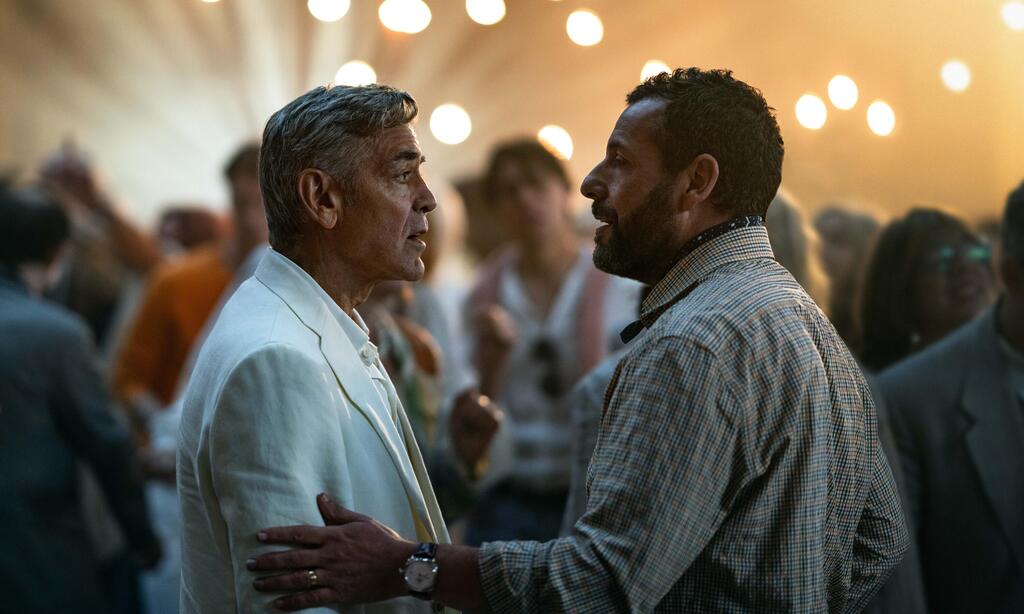
“I looked at Adam,” Clooney said of co-star Adam Sandler. “I literally grabbed his hand. I was like, oh my god. I’m old.”
Why insecurity is part of the job
Clooney said insecurity is a near-universal condition among performers. “I would be very hard to find actors that are actually fully secure,” he said. “If you’re that secure, you’re probably not very good at your job.”
After directing many films, he said he is cautious about overindulging in repeated takes. “I would hate for these directors to be in an editing room for hours watching 15, 30 takes of me trying to figure things out.”
Asked whether his real life resembles that of Jay Kelly, Clooney rejected the comparison. “I didn’t read it like, oh shit, this is me,” he said. He noted the character is consumed by remorse. “He’s a character that lives with regret, deep regret. And regret’s a toxic thing.”
(Photo: Netflix)
Clooney said his own perspective is shaped by a long road toward stardom. “I didn’t get successful in my industry until I was in my mid-30s,” he said. “I’d failed an awful lot.”
Repeated setbacks, he said, helped him understand that success is often beyond any actor’s control. “A lot of this has very little to do with you.”
Hollywood’s schedule and the pressure on families
Clooney said the demands of filmmaking create pressures on family life that many outside the industry underestimate. “We’re sort of a band of gypsies that go away for three months to shoot something,” he said. “It can make it harder to maybe stay in touch with family.”
But, he said, this is not unique to celebrities. “This is the same dilemma that every single working person has to balance. Very few of us get it right.”
He said his 8-year-old twins “still like me,” adding wryly, “They’ll end up in therapy anyway.”
Politics, art and public battles
Clooney, who has a long record of political involvement, said he recently participated in a Broadway play that created tensions with the current U.S. administration. “It got me in a lot of trouble,” he said.
He said he sometimes wishes for a break from the constant intrusion of politics into daily life. “It permeates all of our society right now,” he said. “I just want to be entertained.”
Still, Clooney said he is willing to take public positions when he feels compelled. “If I’ve been given an opportunity to pick a fight, I believe that it’s a good thing to do,” he said. “When they stop being successful, I go away.”
He said he grew up admiring artists who treated cinema as a record of the social moment. “People that I greatly admired… looked at films and storytelling as a reflection back onto us of who we are at a moment in time.”
A renewed appetite for acting
Recent years have seen Clooney focus heavily on directing, except for a handful of high-profile roles. He said “Jay Kelly” reignited his interest in performing. “The spark came back,” he said. “There’s a certain vulnerability that’s interesting to explore, especially as you get older.”
Clooney said staying active keeps him rooted. “My dad is 92 and still writes for the newspaper,” he said. “It’s important to stay connected as you get older.”
A quieter period after Oct. 7
In the months following Hamas’ Oct. 7 attack, Clooney maintained a lower public profile. He defended his wife, Amal Clooney — a human rights lawyer — after she was criticized for her involvement in recommending that the International Criminal Court pursue arrest warrants for Israeli officials. According to public reporting at the time, Clooney contacted the White House to object to comments made by President Joe Biden about the court’s intentions.
(Photo: Gareth Cattermole / Staff, Getty Images)
Clooney did not join Hollywood figures who signed petitions calling for cultural boycotts of Israel, and he agreed to speak with the Israeli outlet conducting this interview.
An absent press conference and a warm festival reception
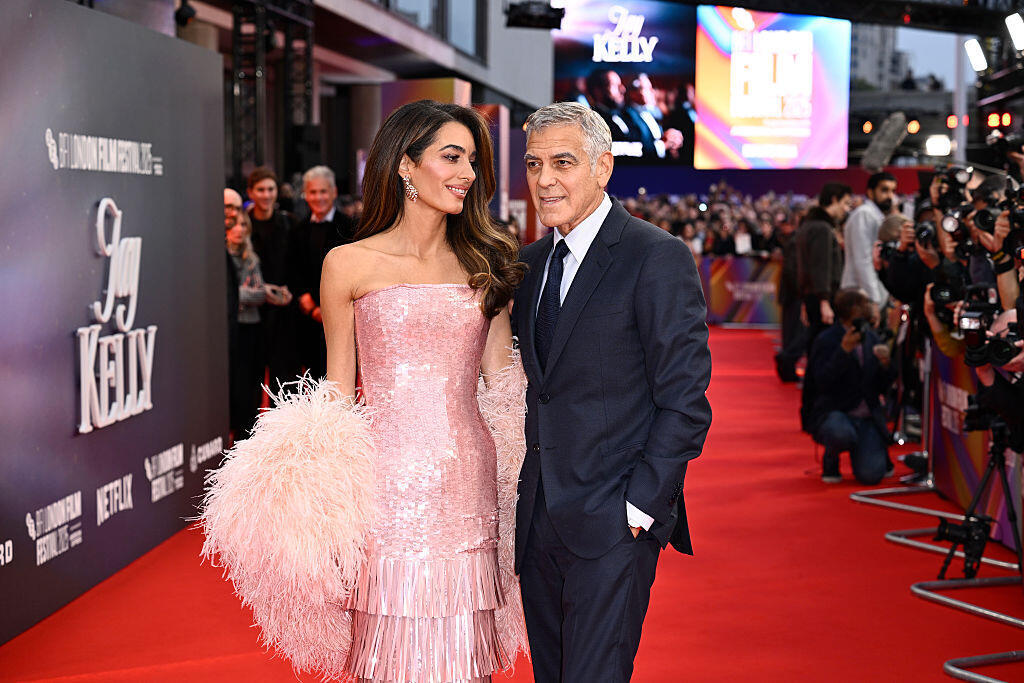
Clooney missed the “Jay Kelly” press conference at the Venice Film Festival due to illness, according to Netflix representatives, and he also canceled several other scheduled appearances. He did attend the premiere alongside Amal Clooney, where he and Sandler received a lengthy ovation.
“Jay Kelly” participated in the festival’s main competition and is rolling out worldwide. The film is set to open in Israeli theaters next week before arriving on Netflix on Dec. 5.