


The name Israel gave its military campaign in Iran — Operation Roaring Lion — echoes both Jewish and Persian history. In both cultures the lion has held a place of honor. Flags bearing the lion-and-sun emblem, associated with Iran before the Islamic Revolution, are now being waved at demonstrations by Iranian exiles and opponents of the ayatollahs’ regime.
Today lions can no longer be found in Israel or Iran outside of zoos, but in the past they were part of the natural landscape in both the Land of Israel and Persia. In both places they disappeared because of human-related factors: hunting, shrinking habitats and competition with humans over prey. The lion native to the region was the Asiatic lion, which has a shorter mane than the African lion and tends to live in smaller groups.
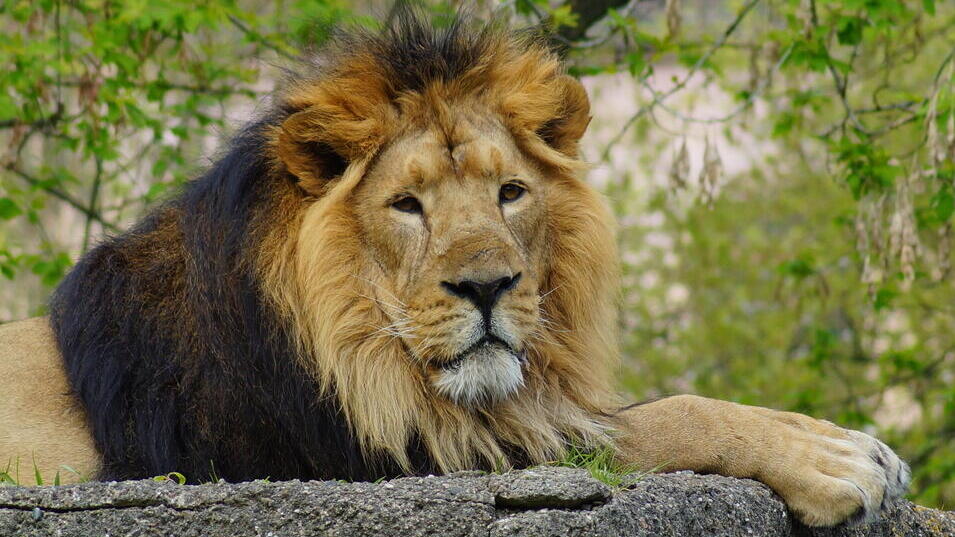
“While there are about 20,000 lions in Africa, only a few hundred Asiatic lions survive in the wild, all in a single reserve in India,” says bioarchaeologist Prof. Guy Bar-Oz of the School of Archaeology and Maritime Cultures at the University of Haifa. According to him, “the Hebrew language was born and developed in a place where people knew lions and saw quite a few of them around. At the Nesher Ramla quarry, they even found lion bones dating back 250,000 years.”
From the tribe of Judah to Trumpeldor
The Bible contains many names for lions. Alongside aryeh and ari, other terms include lavi, layish, shachal, shachatz and kfir, meaning a lion cub. In Jacob’s blessing to his son Judah in the Book of Genesis it is written: “Judah is a lion’s cub… He crouches and lies down like a lion — who dares rouse him?” It is no coincidence that the emblem of Jerusalem — the capital of Israel and once the capital of the Kingdom of Judah — is a lion.
Lion cubs at the Biblical Zoo in 2022
(Credit: Moshe Zinger)


In Moses’ blessing in the Book of Deuteronomy, the tribe of Dan is also compared to a lion: “Dan is a lion’s cub, leaping from Bashan.” In the prophecy of Balaam appears the verse that gave a previous operation against Iran its name: “A people rises like a lioness and lifts itself like a lion.” In the Book of Amos appears the line “The lion has roared — who will not fear?” — a verse that inspired the well-known song by Israeli singer Avihu Medina, “Yaakov Hatamim” (“Do Not Fear, Israel”).
Lions also appear in several memorable biblical stories. In the Book of Judges, Samson tears apart a lion with his bare hands as a demonstration of his strength. In the Book of Daniel, the hero is thrown into a den of lions but miraculously survives. According to one tradition, Daniel is buried in ancient Susa — today’s Shush in Iran.
Over time, the region’s lion population dwindled. “The frequency of lions declined with the rise of agriculture, which created conflict between humans and nature,” Bar-Oz explains. “That’s when competition began with shepherds, who didn’t want lions preying on their flocks. From the stories we know lions existed in the biblical world, and archaeological research has also uncovered lion bones. Sometimes they find a lion tooth that likely had a ritual purpose, and sometimes more than that.”
When did lions disappear from the Land of Israel?
“From an archaeozoological perspective, the latest lion bone discovered in Israel comes from a Crusader site dating to the 12th century,” says Bar-Oz. “Lions became rare, reflecting the intensity of agriculture, development and human settlement, which created competition with wildlife — and the lion symbolically represented the king of wild animals. Bears, for example, also became rare at that stage.”
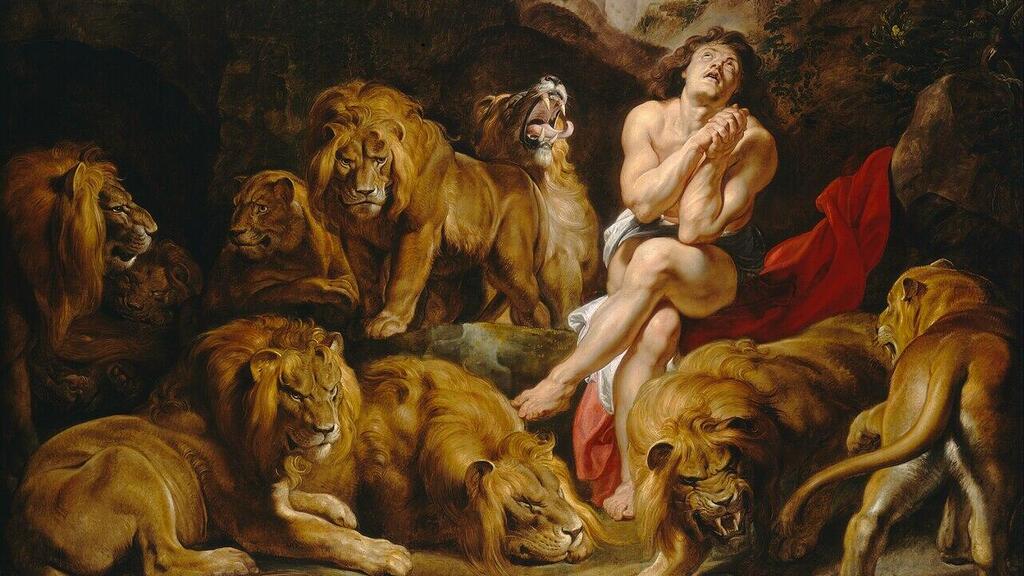
Daniel in the lions’ den — a 17th-century painting by Peter Paul Rubens
Historical reports suggest lions were still seen in parts of the Golan Heights as late as the 16th century. In Anatolia, in modern-day Turkey, lions survived until the 19th century.
Although lions have not existed in the wild in the Land of Israel for centuries, they remained highly present in local culture — not only in the famous children’s book by Tirza Atar, The Lion Who Loved Strawberries. The lion has long symbolized bravery. One example is the statue of the “Roaring Lion” at the cemetery of Kibbutz Kfar Giladi near Tel Hai, which has recently returned to the headlines in connection with Operation Roaring Lion.
The campaign in Iran began on the 11th day of the Hebrew month of Adar — Tel Hai Day — marking the anniversary of the 1920 battle at the Tel Hai courtyard in northern Israel between Jewish defenders and Arab attackers. Eight Jewish pioneers were killed in the battle, including Joseph Trumpeldor. The Roaring Lion statue created by sculptor Avraham Melnikov was erected there in their memory.
Prime Minister Benjamin Netanyahu, who referred to Israelis as “a nation of lions” in a filmed statement at the start of the operation, also noted the symbolism of the date.
“It is deeply symbolic that today is the 11th of Adar — the day when, 106 years ago, the national hero Joseph Trumpeldor fell at the battle of Tel Hai,” Netanyahu said. “His legacy and bravery live within us. At the monument in the Galilee where he fell with his seven comrades stands the statue of the ‘Roaring Lion.’ Many times in my life I visited that site. When I looked at the statue, that is how I always saw us — the people of Israel. With God’s help, the roar of our soldiers, our pilots and our citizens is now being heard around the world.”
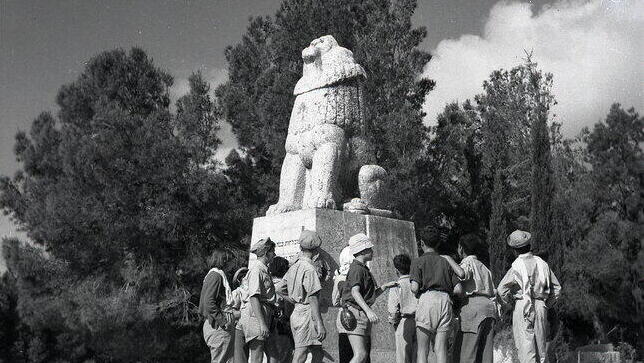
The Roaring Lion statue in 1953
(Photo: Beno Rothenberg, from the Meitar Collection, the Pritzker Family National Photography Collection, the National Library of Israel)
According to Bar-Oz, lions were also prominent in other ancient cultures of the region during biblical times, such as Assyria. “In palaces in Nineveh there are scenes depicting the king fighting a lion,” he says. “It resembles the Maasai in Africa, where in one initiation ritual young men would hunt a lion, and also the gladiators who fought lions in the Colosseum in Rome.”
Not only Jews viewed the lion as a symbol of courage and power. Other rulers who controlled the region also adopted the symbol. One example is the Lions’ Gate in Jerusalem, through which Israeli paratroopers entered the Old City during the Six-Day War — although some argue the carvings there actually depict leopards mistakenly identified as lions. According to historical accounts, the lion was also the emblem of the 13th-century Mamluk sultan Baybars — though here too some scholars believe the image may in fact represent a leopard.
A symbol of longing for another Iran
In the Persian sphere, lions survived until the 1940s. “The last lion in the region was hunted in Iran in the 1940s,” Bar-Oz says.
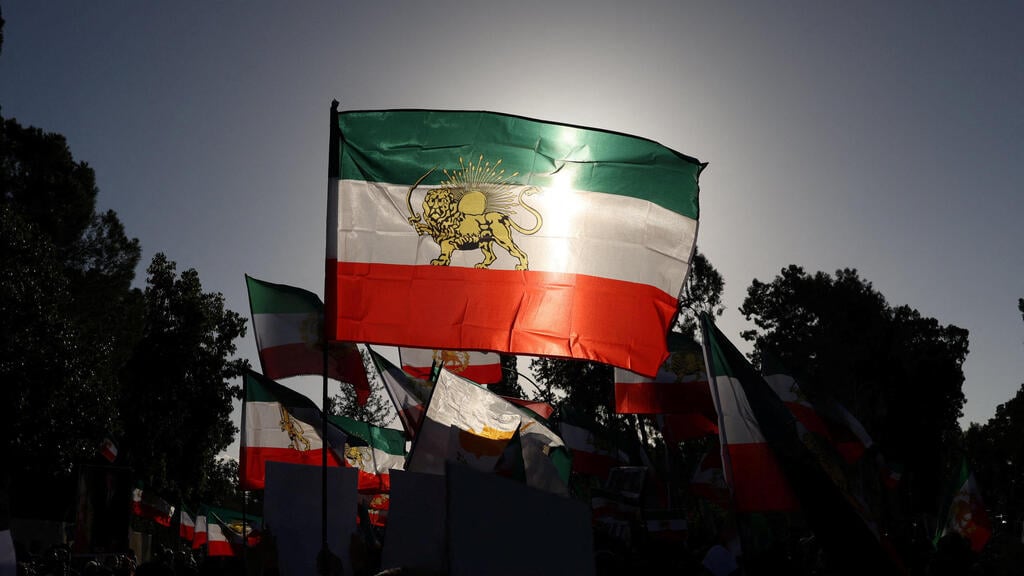
Lion-and-sun flag at a rally in support of the Iranian people in Nicosia, Cyprus
(Photo: REUTERS/Yiannis Kourtoglou)
At protests against the Iranian regime around the world, demonstrators frequently wave the lion-and-sun flag — the flag of Iran before the 1979 Islamic Revolution. The lion-and-sun emblem was closely associated with the shah and had long been tied to various dynasties that ruled Persia, undergoing minor changes over time as rulers changed. In the version associated with the Pahlavi dynasty — Iran’s last royal dynasty before the 1979 revolution — the emblem shows a lion holding a curved sword with a rising sun behind it.
“The lion has always symbolized power, courage and royalty. Lions were carved in Iran on royal tomb walls and palace walls as symbols of strength, kingship and the victory of light over darkness,” says Iran scholar Dr. Thamar Eilam Gindin.
“In our culture the lion is the king of animals, and in Persian it is the sultan of animals,” she adds. “In the Shahnameh (‘The Book of Kings’), the great Persian epic written in the early 11th century by Ferdowsi, ‘shir’ (lion) is one of the epithets used for great heroes such as Rostam. Even today brave fighters — including the revolutionaries of 1979 and those protesting now — are described as ‘shir-mard’ and ‘shir-zan,’ meaning lion-man and lion-woman, or with other expressions using the word lion, all associated with strength and courage.”
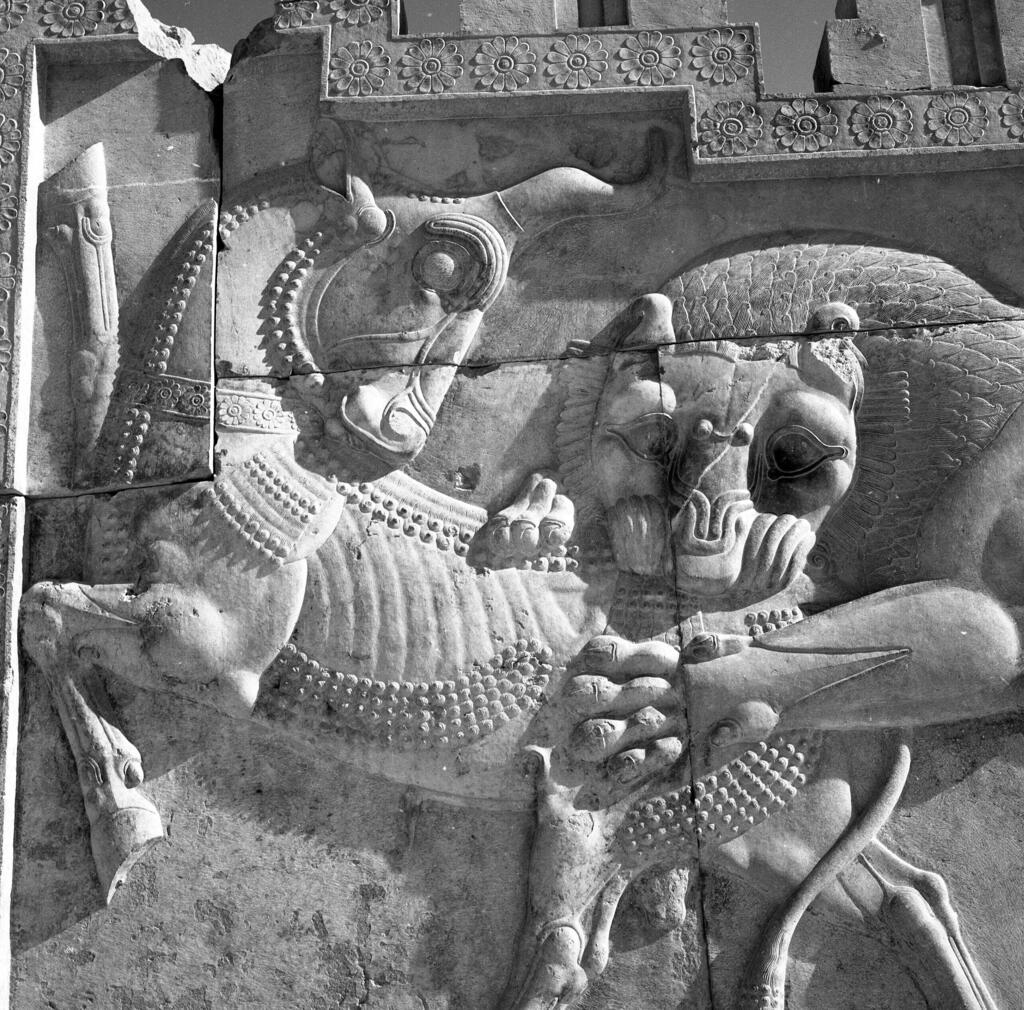
Ancient relief of a lion attacking a bull in the ruins of Persepolis
(Photo: Beno Rothenberg, from the Meitar Collection, the Pritzker Family National Photography Collection, the National Library of Israel)
The symbol’s ancient origins may lie in the Zoroastrian religion, which was the official religion of the Persian Empire before the Muslim conquest. Bar-Oz also links the imagery to Nowruz, the Persian New Year and spring festival marking the transition from the cold season to the warm one.
“In Zoroastrian culture winter is represented by the bull and the moon, while summer is represented by the lion and the sun,” he notes.
According to Eilam Gindin, “the lion and sun on the shah’s flag symbolize power and light, which are central in Zoroastrianism, the religion of pre-Islamic Persia. The protest movement that began in December — which has faded from the streets but remains alive on balconies and in people’s hearts — is called by Iranians the ‘Lion and Sun Revolution,’ after that symbol.”
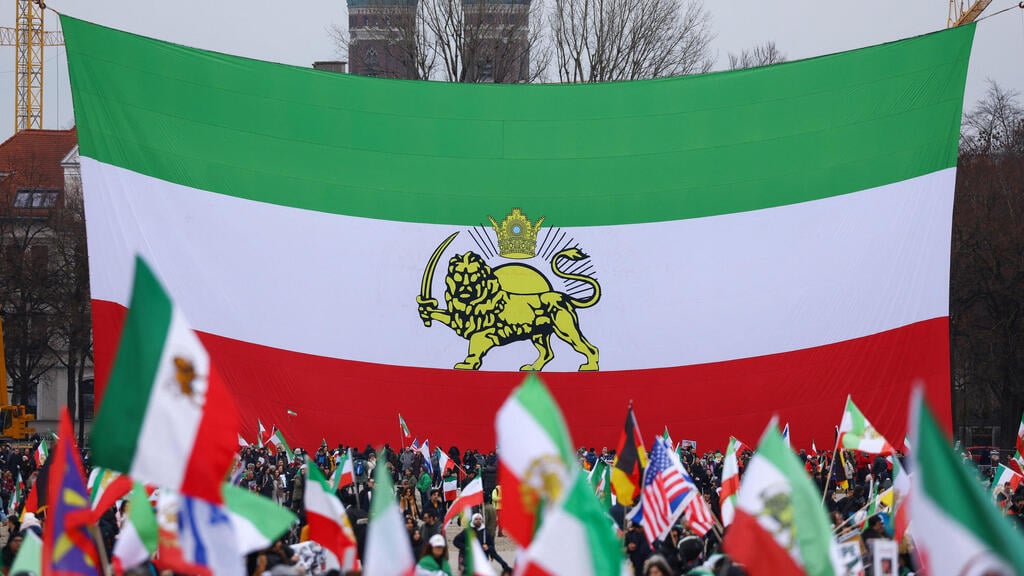
Lion-and-sun flag at a rally in support of the Iranian people in Munich, Germany
(Photo: REUTERS/Thilo Schmuelgen)
Iran’s current flag, adopted after the Islamic Revolution, features in its center a stylized sword surrounded by four crescents that together form the word “Allah.” Along the edges of the flag appears the takbir — the phrase “Allahu Akbar” (“God is greatest”) — repeated 22 times, 11 along the top and 11 along the bottom.
The adoption of this flag symbolized Iran’s transformation into a Shiite Islamic theocracy. Nostalgia for the lion-and-sun emblem reflects a longing for a different Iran — one not ruled by an extreme fundamentalist regime that constantly threatens its neighbors.