

In Daliyat al-Karmel, a quiet Druze village on the Carmel ridge in northern Israel, there is a house that refuses to behave like real estate.
It is not “a renovated childhood home.” It is not “a quirky attraction.” It is a living, breathing environmental sculpture that looks like a paint explosion learned how to tell a family story.
The man behind it is Sam Halaby, known online as “the Color Hunter.” He did not give himself that moniker, he says. It was coined by curator Doron Polak, and the name stuck.
But Halaby’s real title is simpler: painter. Not a decorator. Not a graffiti guy. A painter with an unusual canvas: an entire four-floor home, every room, wall, object and memory.
A museum born from grief, built in secret
Halaby’s “House of Colors” began as a private act of survival — his mother died at 50, when he was 22. Soon after, his father remarried, and the home began to change. Items were moved, replaced, thrown away, as families do when they try to “reset” the past. Halaby did the opposite. He started collecting the objects connected to his mother and turning them into art, piece by piece: a red jar, kitchen items, fragments of a life he refused to lose.
At first, it was therapy. Then it became a method. Paint dripped onto floors. Splashes hit walls. Furniture stopped being furniture. The house became a record of emotion, not design.
For years, the project lived like a secret second life. The family knew Sam had a studio upstairs, but they did not realize the entire home was becoming a single artwork. Only later, after the house emptied and the story surfaced, did his sisters see what he had built: not a renovation, but a monument.
Gallery
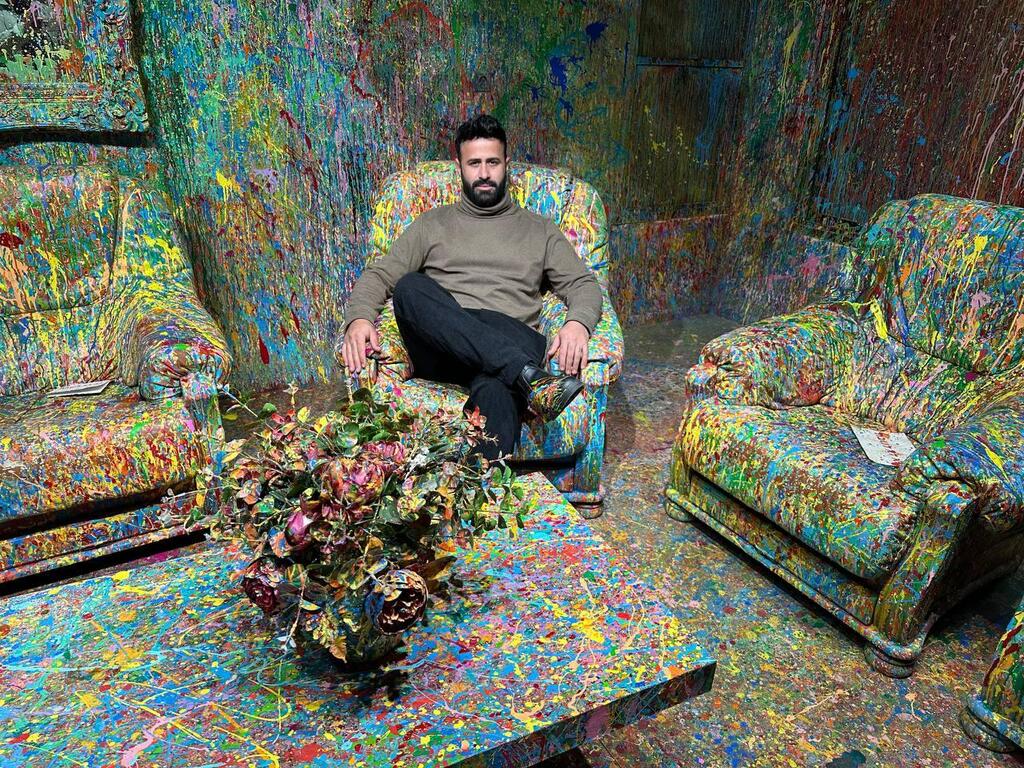
Artist Sam Halaby sits inside his House of Colors in Daliyat al-Karmel, northern Israel
(Photo: Bar Gindy)
Halaby did not plan to turn his home into an attraction. Then people started coming. He describes something close to disbelief: crowds arriving without an invitation, drawn by color, curiosity and the feeling that this place is the opposite of the gray feed we scroll through every day.
Today, the House of Colors is widely covered as a major cultural phenomenon: a childhood home transformed into a full-scale artwork that has captivated social media and visitors.
Even during a national moment defined by stress and loss, Halaby says the house became a kind of emotional charging station. Families, soldiers, people displaced by war and the general public walked in and left with a different face. Not because the pain disappeared, but because the nervous system finally got permission to breathe.
Viral by accident, then by craft
Here’s the twist: Halaby’s explosion online came after a decade of creating with almost no documentation.
Only recently did he start posting consistently, and one simple video of him washing dishes inside the saturated, candy-colored interior blew up to nearly 90 million views on Instagram — record-breaking numbers for an Israeli artist.
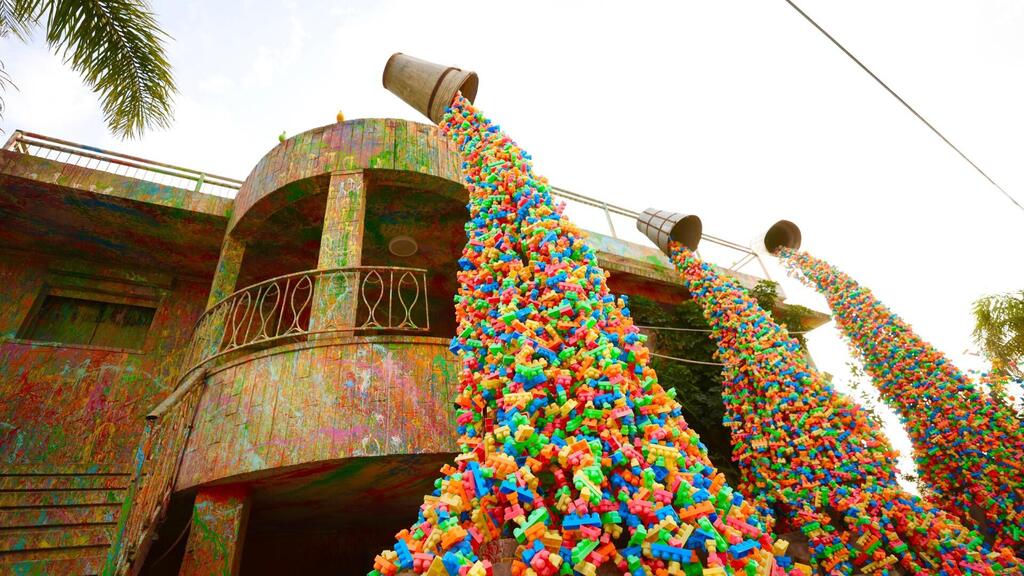
Colorful funnel installation
(Photo: Sion Ynon, Eastside Studio )
He is honest about the mechanics: he learned what works, what resonates, what audiences respond to. But the engine is not editing tricks. It is the collision between the ordinary and the impossible: a man doing daily chores inside a house that looks like joy became architecture.
Halaby’s work does not stay still. He describes painting a Mercedes electric SUV as part of a collaboration, not as product placement, but as a statement: art can sit on top of status and turn it into play.
He also created a moving sculpture from a 2002 Fiat Panda, a car worth almost nothing on paper, then transformed into a rolling artwork crowned with flowers and dripping color. People do not just notice it. They chase it, photograph it, tag it. It turns traffic into a parade.
And in Tel Aviv, he built a pop-up installation in a mall: a forest of olive branches hung with LEGO and small toys, with “autumn leaves” on the floor and thousands of pieces inviting visitors to touch, build and play. Museums say “do not touch.” Halaby’s instinct is the opposite: if it heals, let people put their hands in it.
At some point, every artist who gains value meets the collector dilemma — Halaby recognizes two kinds of buyers: those who want to live with the work, and those who want to own it like a future asset, stored away like a bottle of wine. He does not judge the market, but he refuses to flood it. Scarcity is not a sales tactic for him; it is emotional truth. He paints slowly now, and some works never leave because they carry a chapter of his life he is not ready to sell.
In his eyes, the House of Colors is the clearest answer to the whole conversation: the most valuable thing he has made is the one he will not trade for anything, because it is not a product. It is his history, in color.
- For more stories from Sam and other collectors, check out the People and Collectors podcast. The full interview is available with subtitles in English and 50 other languages.
First published: 12:52, 03.23.26