

Japanese avant-garde artist Yayoi Kusama, whose hypnotic polka dots and immersive mirrored rooms made her one of the most recognizable figures in contemporary art, has died at the age of 97.
Kusama died at a hospital in Tokyo on August 14, her studio announced Thursday. No cause of death was given. The Yayoi Kusama Museum and Yayoi Kusama Foundation said she continued painting until her final days and “never put down her paintbrush.” Her death and the date were confirmed in official statements released Thursday.
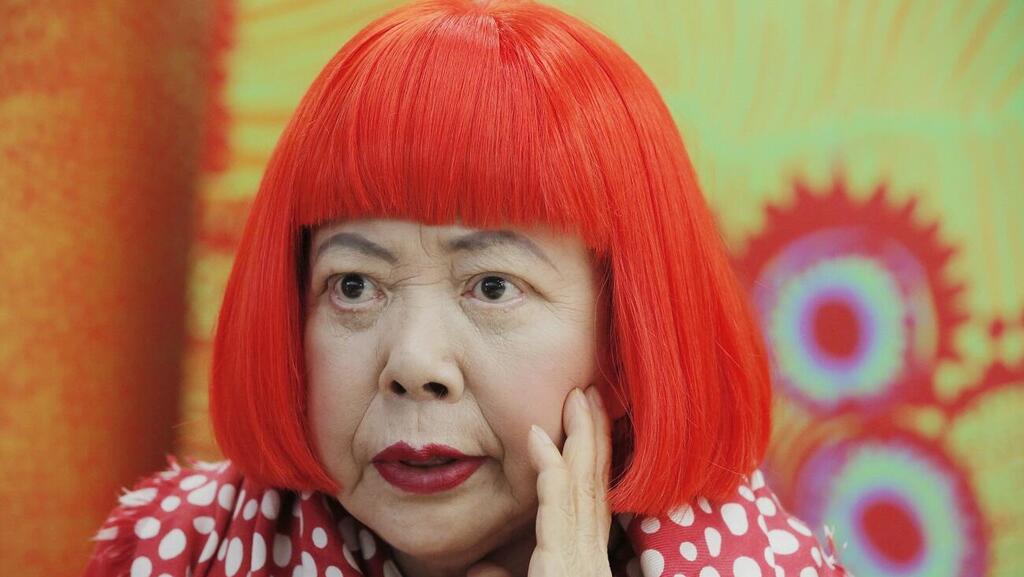
Born in Matsumoto, Japan, in 1929, Kusama began painting as a child and drew inspiration from hallucinations of flashing lights, flowers and fields of dots that she said had followed her from an early age. She transformed those visions into a distinctive visual language of repeated patterns, nets and polka dots, later adding the pumpkins and dazzling Infinity Mirror Rooms that became among her best-known works.
Kusama left Japan for the United States in 1957, seeking greater artistic freedom than she felt was available to her in the conservative society of postwar Japan. In New York, she emerged as a distinctive figure in the city's experimental art scene, working across painting, sculpture and performance and staging provocative anti-war happenings during the Vietnam War era. She also wrote novels and poetry.
After returning to Japan in the 1970s, Kusama voluntarily entered a psychiatric hospital in Tokyo, where she lived for decades. Each day, she would travel to her nearby studio to work.
“I still see hallucinations, even now,” she said in 2017. “Dots fly everywhere — on my dress, on the floor, on the things I carry, throughout the house and on the ceiling. And I paint them.”
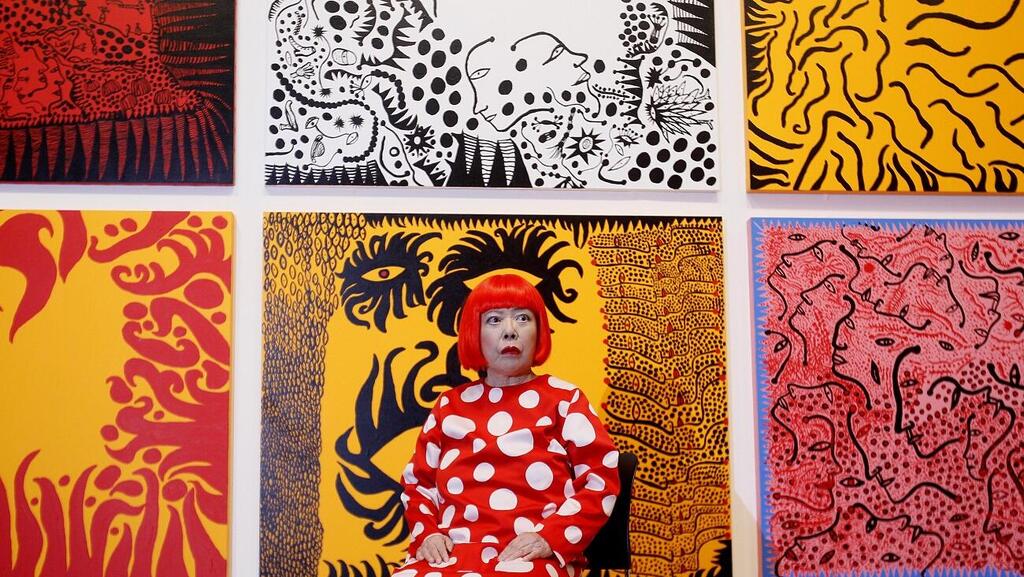
(Photo: AP)
Although Kusama had established herself as an avant-garde innovator in the 1960s, her transformation into a global cultural phenomenon came much later. Her brightly colored installations and Infinity Mirror Rooms attracted huge crowds, while her trademark red wig and polka-dot clothing became almost as recognizable as the art itself.
The rise of social media introduced her work to an even broader audience, with visitors lining up to photograph themselves inside her mirrored installations. Major museums around the world exhibited her work, and collaborations with fashion brands such as Louis Vuitton extended her reach far beyond the traditional art world.
Kusama's work also became a major cultural phenomenon in Israel. The Tel Aviv Museum of Art presented “Yayoi Kusama: A Retrospective” in 2021 and 2022, her first large-scale exhibition in the country.
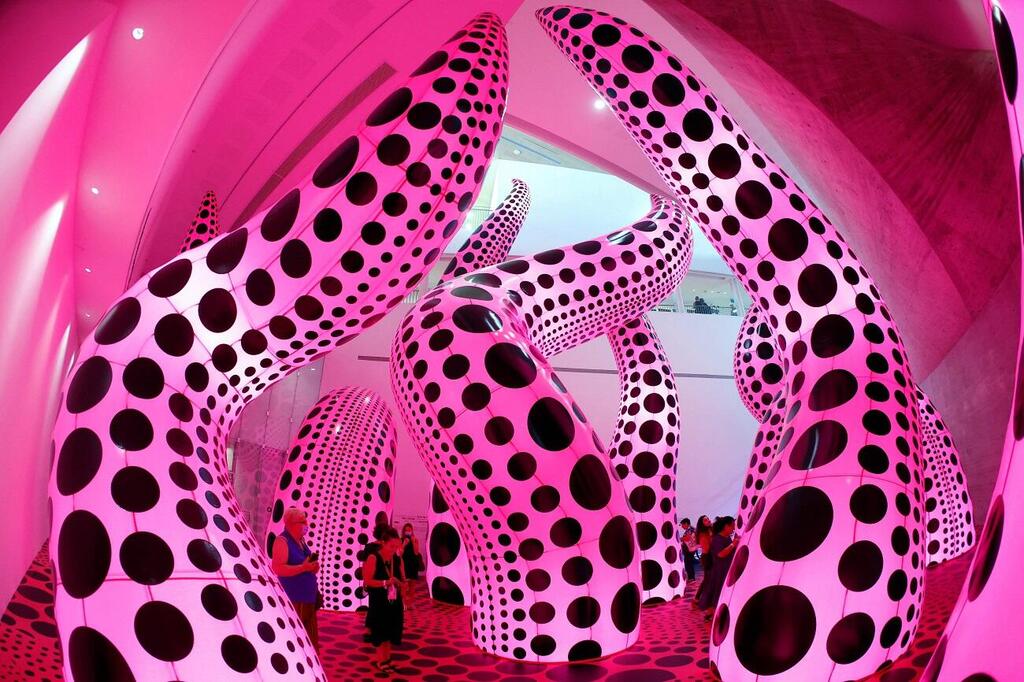
(Photo: AFP)
Hundreds of thousands of visitors attended the exhibition, which brought together about 200 works spanning roughly eight decades of her career. It included paintings, sculptures and installations as well as four of her signature Infinity Mirror Rooms.
One of the mirrored rooms was created specifically for the Tel Aviv exhibition and remained on display at the museum after the retrospective ended.
Kusama continued working into her final days. In announcing her death, the museum and foundation said her career had encompassed visual art, performance, fiction and poetry and pledged to carry forward her belief in art as a source of hope.
For an artist whose work repeatedly returned to ideas of infinity, repetition and eternity, creation remained a constant until the end.