

For most of her life, Linoy Ashram’s schedule was dictated by others: coaches, competitions and flights. Every hour was planned in advance, every meal was scrutinized and every decision was measured against one question: Does it bring her closer to the dream? Then the dream came true, leaving another question: What does someone do after reaching the top before turning 23, when the only thing she truly knew and that filled all her time suddenly comes to an end?
“I live a completely different life now. Suddenly I have the option to do whatever I want, whenever I want, and set my own schedule,” Ashram, 27, said on “Habirziya,” the podcast of ynet’s weekend magazine. “Suddenly I’m free. I can go out and have fun with friends, things I didn’t have before. It’s fun to rediscover myself.

“I look at it as though I retired early at 22. There are athletes who can’t find themselves afterward, because this is something I did my entire life, and then suddenly you have to find something else you’re good at, something else you love and want to do for the rest of your life. It is difficult at first, but I’m very practical. I knew that no matter what, I would start doing things, trying things and experiencing things until I understood where I belong and what I connect with.”
Winning the gold medal brought you a level of fame you had never known before.
“Yes, you could say that, but I didn’t plan for it. Sometimes I enjoy it and sometimes I don’t, because sometimes I want my peace and my private space, which a well-known person doesn’t necessarily have. But sometimes it’s nice when I’m just walking down the street and a mother comes up to me and says, ‘Wow, you’re an inspiration to my daughter. You’ve given her so much, and now she believes in herself.’ Then it’s nice to understand that, in the end, I also inspired people.”

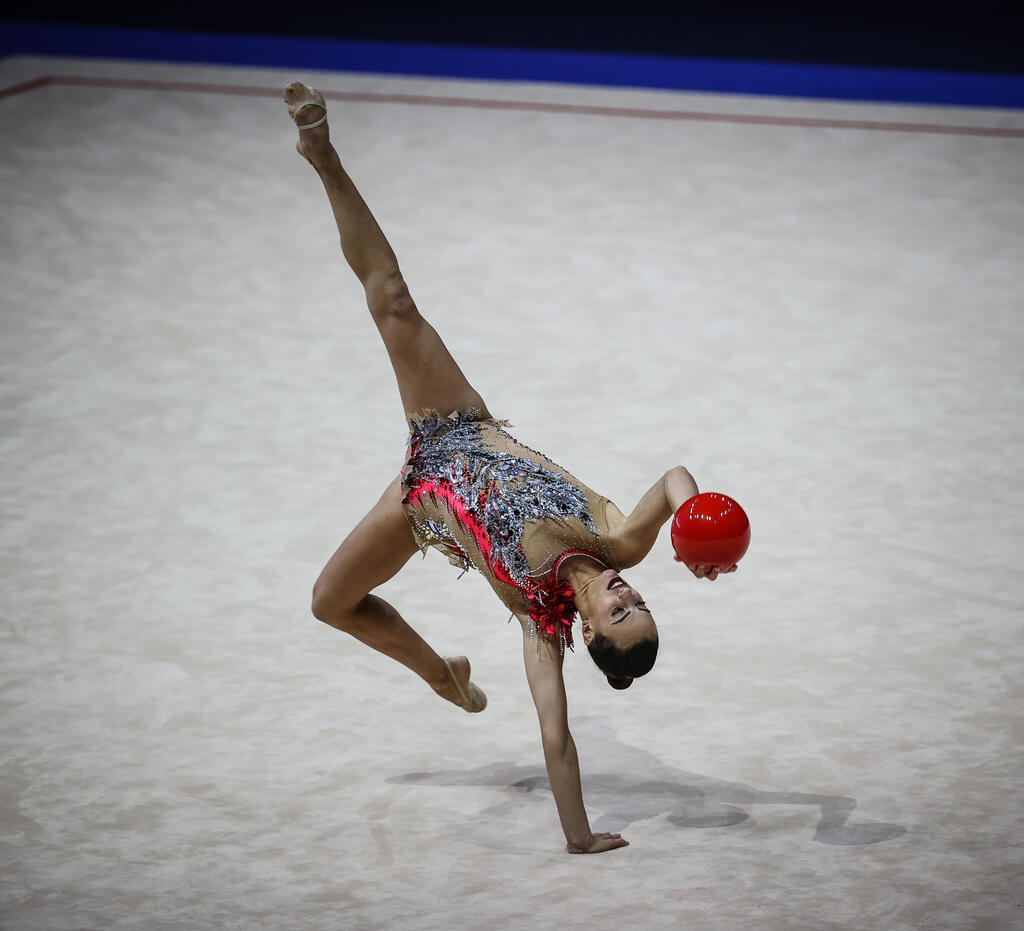
(Photo: Shay Franco)
Did you think you could achieve that?
“No, never. I imagined and dreamed about bronze. That also seemed the most realistic. In the competitions before that, the world championships and European championships, Russia always took the top places. Both I and at least four other gymnasts from around the world were all aiming for a bronze medal, and that was what we were fighting for. After the qualification round, which was the day before the final, I had this tiny thought about gold for the first time. Until then I hadn’t thought about it at all.”
What does the day of such an important competition look like? Can you sleep the night before?
“I usually don’t get nervous before competitions. I love competing. For me, it gives me energy and fire. It brings something else out of me. One of the only times I was really nervous, I think, was at the Olympics. We arrived there a week beforehand, and that whole week I simply didn’t sleep. Maybe it was jet lag and stress together, because after all, it was Japan and there was a time difference. I would regularly go to sleep around 10 and wake up at 2 a.m. At some point we spoke to the sports physician and she gave me a small sleeping pill. In the end, I needed my body to be strong.”
Were you afraid the lack of sleep would affect you in the competition?
“Very much, and it did affect me. Somehow you can survive a day or two without sleep, but by the third day I was completely exhausted and could barely get through training. It was really difficult. I felt heavy and like I couldn’t move my muscles.”

(Photo: Reuters)
How did you feel when they announced that you had won gold?
“The Russian gymnast went last, and it took a very long time for them to give her the score. I think we sat there for about 15 minutes. It was the most stressful moment imaginable, because I knew I was ranked first at that point, but the Russian gymnast had done a good routine and I had made a mistake. When her score appeared, I still didn’t know where I had finished. I didn’t even have time to look at the scoreboard. I just heard everyone start clapping and shouting.
“It’s a moment that doesn’t register immediately. It’s like, what, I did it? I won gold? Who could have imagined it? It didn’t seem possible. It was crazy. It’s a moment I’ll never forget.”
‘At 25, a gymnast is considered old’
Millions watched the moment in Tokyo when Ashram won gold. Far fewer know about the grueling years that came before it: trying to squeeze schoolwork between training sessions and competitions, the exhaustion and lack of desire to get out of bed, and classroom events that took place without her.
“I completed 12 years of school, but I don’t have a full matriculation certificate. I would study at home, whether after training or before training. On my only day off during the week, I would go to private tutors, and I would come to school only for exams. I would take driving lessons at 5 a.m. The instructor would pick me up and I would drive to Tel Aviv, to my training hall. I would get out there and he would continue.
“I was simply exhausted. I came to training with no desire, no strength and no energy. There were days when I told myself, I don’t have the strength, I want to stay under the blanket and not get out of bed. I want to be a normal kid. The kids at my school would go on annual class trips and I wouldn’t. Those are things that, as a child, are difficult at first to understand and accept. But I loved it so much, and for me the Olympics were the biggest dream I wanted to fulfill.
“I didn’t look at those things as something I had given up. They went on a school trip, but I flew to competitions all over the world. I always knew that no matter what, I could complete my studies later. A career in gymnastics ends at a very young age. Very few gymnasts continue beyond 25. By then you’re already considered old. I knew this was my time to fulfill my dream, and afterward I would make room for other things.”

(Photo: Shay Franco)
Did you ever consider returning to competition?
“To this day I miss gymnastics. I miss being a gymnast. I miss competing. I don’t think there’s anything that can recreate the adrenaline and energy I had when I was on the gymnastics floor. Almost nothing compares to it. There were times when I thought about coming back. I said that if I continued, I wouldn’t compete individually, I wouldn’t continue as an individual gymnast, but maybe I would join the group. I had doubts and I even tried. I went to the gym and tried. But I told myself, ‘Enough, Linoy. That’s it. Let go. I know it’s hard, but let go.’”
Your hair was also damaged during that period from being pulled so tightly.
“Yes and no. It doesn’t happen to every gymnast. Pulling my hair tightly did affect me. I can’t say that if I had been a regular schoolgirl and had worn a tight ponytail all day it wouldn’t have happened, so I can’t blame it entirely on gymnastics. But in the end, I was required to tie my hair back relatively tightly, and it did cause some damage.
“I slowly started filling it in, whether with colored hair spray or black eye shadow. There were routines where my hair would actually brush against the floor and I would leave a black mark. At first I would laugh about it and understand that I didn’t really have a choice. This was the situation and I had to deal with it. After I retired, I realized it was already bothering me in everyday life. I couldn’t tie my hair back because you could see the bald spot. When I colored it in, I could kiss someone and leave some of the color on their cheek. It started becoming embarrassing.”
(Photo: Oz Moalem)
What did you do?
“I decided to get a transplant. It’s very frightening, especially for a woman. Most hair transplant procedures require shaving most of the hair, almost completely bald. I was prepared to do that, and then I heard about someone who performs hair transplants for women without shaving the hair. It was a long process and not an easy one. It didn’t hurt that much because I was under anesthesia, but I think the process itself is frightening. Only after I got through the first 10 days did I understand that it wasn’t as terrible as I had thought.”
‘My whole life, I’ve dealt with criticism’
Leaving the protected bubble of the training halls suddenly turned Ashram into public property and forced her to confront the less pleasant sides of fame, including the question that would nag at her whenever someone wanted to get to know her: Was he interested in her, or in the brand? In April, she and her partner, Omer Reitman, became engaged after three years together, providing her with a decisive answer.
“We met through mutual friends. A good friend knew someone from his work. They were talking on FaceTime and just turned the phone toward each of us. We hadn’t really spoken, we didn’t know each other, nothing. They just turned the phone around and we looked at each other like, OK, what’s happening here now? The next day he already sent me a message.
“At first I was worried about meeting a partner. Maybe he wanted to be with me because I’m Linoy Ashram and not because of who I really am. There were people who approached me and said, ‘Hey, champion, maybe we should get to know each other.’”
With the demanding lifestyle you had over the years, did you have relationships?
“I was in a three-year relationship during the Olympic period. We broke up about two months afterward. It was a completely different relationship from the one I have today. Most of my life revolved around gymnastics and the fact that I had to watch my diet and stay fit, and I didn’t have much time to meet up or go out. But it was important to me at that point. It opened me up to so many worlds I hadn’t known. Because I learned to love, I also became a better gymnast. I could express what I wanted on the floor much better.”
After gymnastics had been the center of your life for so many years, you suddenly became a star. What did that feel like?
“Sometimes it works against me. People feel comfortable coming up to me and expressing every possible opinion, whether it’s asking why I gained weight or saying I don’t look good like this, or people writing to me on social media asking how I even dare upload a photo when I look like that. These are comments I wouldn’t wish on anyone. Sport gave me a lot of resilience because my whole life I’ve dealt with criticism.
“They always told me I wasn’t good enough, that I wasn’t pretty enough, that I wasn’t flexible enough, that I wouldn’t succeed and that nothing would come of me. I know which criticism to take seriously, because there is criticism that is meant to build me up and make me better, and there is criticism that is simply meant to insult and hurt. What matters most to me is what I think. If I look in the mirror and I like the way I look, then it really doesn’t matter what other people say.”
How do you respond to people who say things like that?
“At first I didn’t know what to say. I also took it harder. The first few times I would simply walk away and maybe even cry sometimes. But I told myself, it isn’t worth it, because you genuinely love yourself, so why does it matter what that person says? One of the reasons I talk about it on social media is that I know there are so many people going through this, especially teenage girls. When I talk about it, I can help someone else, and that is what gave me the strength to show other women going through the same thing that they are not alone.
“There was one situation where a mother made a comment to me in front of her daughter. We were at a Hanukkah party for my gymnastics programs. There were sufganiyot, and I’m like any normal person: On Hanukkah, you eat a doughnut. One of the mothers raised her phone and started filming me. I looked at her and said, ‘Excuse me, why are you filming me?’ And she said, ‘I’m showing everyone that you’re eating a doughnut.’ And the girl was looking at her mother, trying to understand what she was saying.
“I said, ‘What do you want from me? I feel like eating a doughnut. What do you care?’ Why does the girl need to hear her mother say something like that? What if she’s also going through it and doesn’t allow herself to eat a doughnut, or she’s bothered by the way she looks? That can hurt your own daughter. Why would you say that? I can’t understand people who think they have the right to come up and comment on another person’s body. Look at yourselves. Don’t look at other people.”