

After the success of his Academy Award–winning documentary “Navalny,” director Daniel Roher is making his leap into narrative feature filmmaking with “Tuner.”
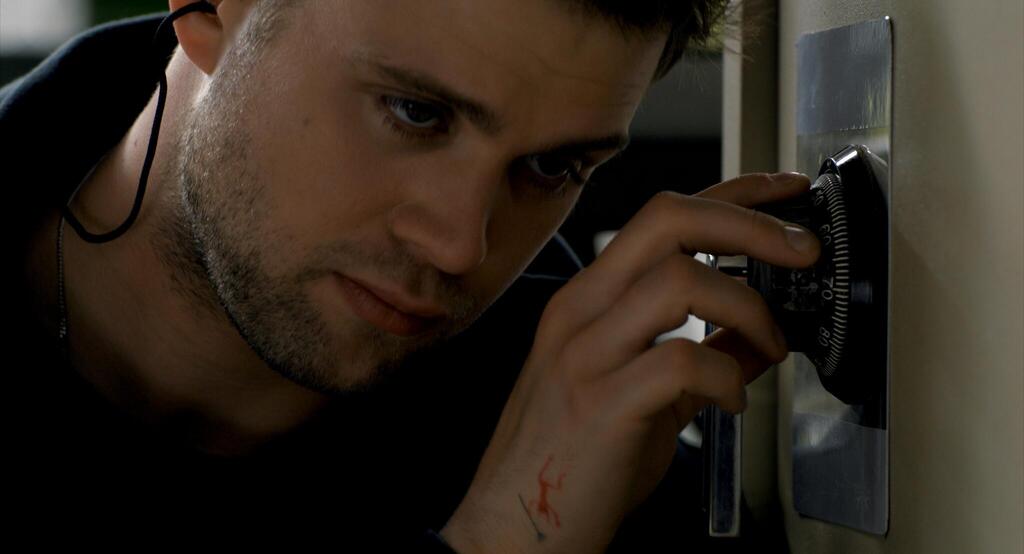
The idea for the film was sparked when Roher spent a day shadowing his friend, piano tuner Peter White. He became fascinated by the solitude of the job, the discipline it requires and the extraordinary auditory precision of people with absolute pitch, a rare gift sharp enough not only to tune Steinways but also to crack safes.
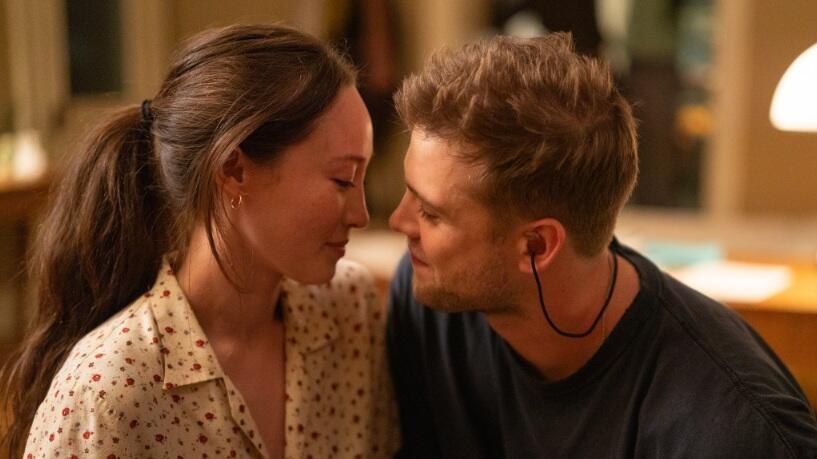
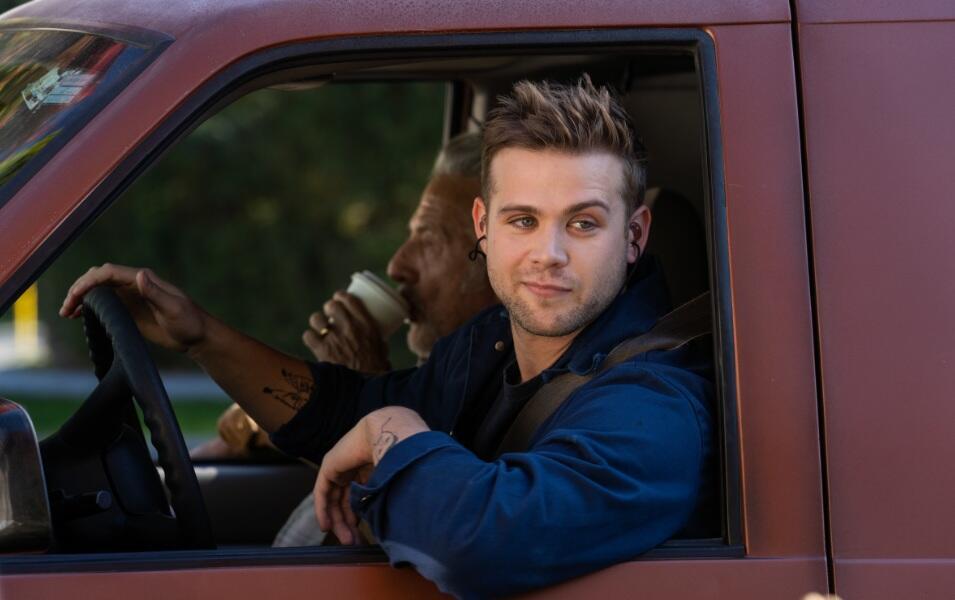
In “Tuner,” Leo Woodall stars as Niki, a gifted young piano tuner whose heightened sense of hearing draws the attention of criminals eager to exploit his talent. Once a promising pianist, Niki now works across New York City under the guidance of his mentor, Harry Horowitz, played by Dustin Hoffman. Along the way, he encounters a vivid cast of characters, including composition student Ruthie, portrayed by Havana Rose Liu, with whom he forms an unexpected romantic connection.
As Niki’s involvement in safecracking deepens, it begins to threaten both his relationship and his safety, pulling him into increasingly dangerous territory.
For the film’s villains, Roher cast three Israeli actors: Lior Raz, Gil Cohen and Nissan Sakira. Raz, best known as the creator and star of “Fauda,” plays the owner of a locksmith company who uses his business to gain access to wealthy clients’ homes.
At first, Hoffman was uneasy with the idea of portraying the villains as Israelis.
“He said, ‘Let’s make them French Canadian,’” Roher recalled in an interview with Ynet. “I told him, ‘Dustin, do you really want me to fire these three Israeli actors? They’re already having trouble finding work because of the war.’”
That argument convinced Hoffman to back down. In any case, Roher noted, no one except Israelis and Jews would recognize the actors as Israeli, since their nationality is never mentioned in the film.
(Photo: Black Bear)
Although it was Roher’s first time directing such established actors, he said the experience was anything but intimidating.
“It could have been intimidating, but Dustin is such a lovely man with a great spirit,” Roher said. “He’s so passionate about making movies and loved being on set. He treated me with such kindness and respect that it wasn’t stressful at all. It felt like having Grandpa or Uncle Dustin on set, and I loved him very much.”
Roher was born in Toronto to a Jewish family and grew up surrounded by Holocaust survivors, an experience that found its way into the film. His step-grandfather survived Auschwitz, and Roher vividly remembers listening to his stories.
“I can still hear his slow Hungarian accent in my head,” he said. “He came to Canada with nothing and married my grandma later in life. I was a little boy then.”
His grandmother, also a Holocaust survivor, was one of nine siblings. Only three survived. One settled in Canada, another in Florida and a third in Israel.
“I’m still very close with my Israeli cousins from this lineage,” Roher said. “Even though we’re far away, we make the effort.”
(Photo: Black Bear)
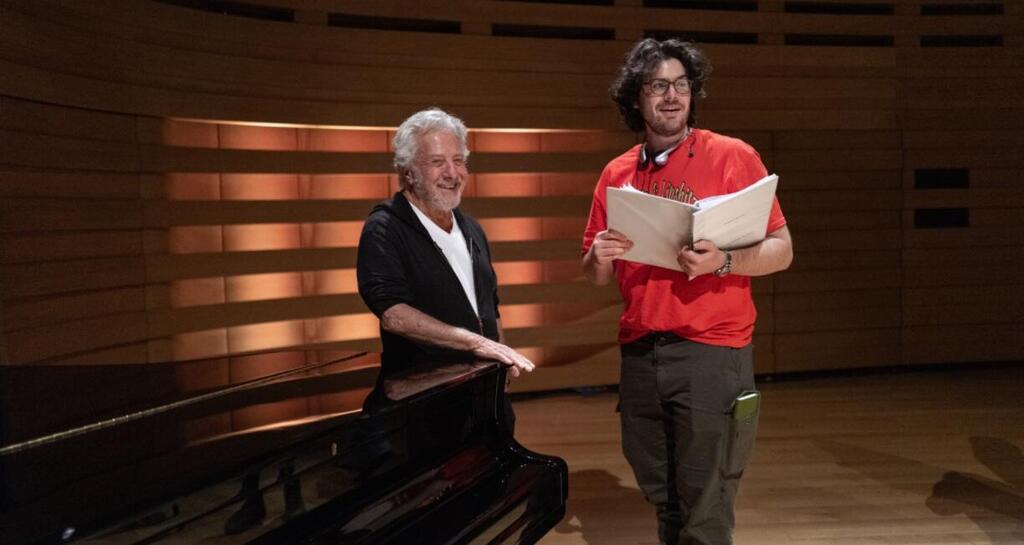
Dustin Hoffman and Daniel Roher
(Photo: Alan Markfield; Courtesy of Black Bear)
He singled out his cousin Dr. Yotam Shiner, who helped lead an initiative to vaccinate undocumented people in Israel, including Palestinians, despite government restrictions.
Another cousin, Gideon Shiner, after whom Roher named his two-year-old son, was a professor at the Technion in Haifa. Roher has visited Israel many times and once traveled alone to Auschwitz.
That familiarity made it natural for him to write Israeli antagonist characters. It also reflected reality, he noted, since Israeli immigrants dominate much of the locksmith industry in New York and Los Angeles.
“Hollywood is already full of Eastern European villains,” Roher said. “I wanted to do something different. I felt I could write a more authentic bad guy, one who was actually fun to hang out with.”
“There’s something stereotypical but also kind of true,” he added. “They’re pushy and stubborn, these Israeli machismo guys. I recognized my own cousins in them.”
Another standout element of “Tuner” is its music. Composed by Will Bates, the score enhances tension and intimacy while complementing the film’s immersive sound design.
The interview took place the day Roher returned from Sundance, where he screened both “Tuner” and his new documentary, “The AI Doc: Or How I Became an Apocaloptimist.”
The documentary, co-directed with Charlie Tyrell, follows Roher as he prepares for fatherhood and grapples with the future of artificial intelligence, balancing existential fears with cautious optimism.
“It’s a hard movie, but it’s very important,” Roher said. “It has no business being as funny as it is, and it has a lot of heart.”
At the Sundance screening of “Tuner,” a woman from Australia approached Roher with a pointed question: Why make the villains Israeli?
“She works on combating antisemitism in Australia, and she was very taken aback,” Roher said.
Others criticized the film as “Zionist.”
“When you put Israelis in your movie, it’s a lose-lose,” he said. “And that’s ridiculous.”
Despite the controversy, Roher remains enthusiastic about his Israeli cast.
“I’m really lucky I got to work with those guys,” he said. “Lior Raz is a national treasure. Gil and Nissan are amazing. I can’t wait to screen the film in Israel. I think people will have a lot of fun.”