

Nuremberg tells the story of U.S. Army psychiatrist Douglas Kelley (played by Rami Malek), who was tasked with evaluating the mental fitness of top Nazi leaders before trial and found himself in a tense psychological exchange with Hermann Göring (Russell Crowe).
Despite the rare bond between the two and the opportunity to probe the mind of evil up close, the film takes a conventional path, favoring familiar courtroom drama over the psychological depth inherent in its material.
Nuremberg - Trailer
(Video: Courtesy of United King Films)


“You will leave no trace in this world,” Hermann Göring tells Douglas Kelley. “I am the book. You’re the footnote.” In this case, the Nazi criminal wasn’t wrong. Few today remember Kelley, who stands at the center of Nuremberg, which follows a series of events on the margins of the trials of surviving senior Nazi officials.
Between November 1945 and October 1946, 22 Nazi war criminals were tried in Nuremberg by a tribunal made up of representatives from Britain, France, the Soviet Union and the United States, charged with crimes against humanity and war crimes.
Yet, despite the seemingly perpetual relevance of this history, director James Vanderbilt’s film struggles with a perspective that feels simplistic and limited.
Kelley served as the military psychiatrist at the Nuremberg prison, where his job was to assess whether the defendants, among them Rudolf Hess, Robert Ley and Julius Streicher, were mentally fit to stand trial.
The film focuses on Kelley’s evolving dynamic with Göring, once commander of the German Luftwaffe and a key architect of the so-called Final Solution, an issue raised during his prosecution.
Göring is portrayed by Russell Crowe, who reportedly weighed close to 285 pounds during filming — in line with the historical figure, who, second only to Hitler in rank, was a gluttonous, opiate-addicted Reichsmarschall who took as many as 40 painkillers a day.
The film’s attempt to portray the unusual bond between man (Kelley) and monster (Göring) had the potential to uncover complex layers of human evil. Unfortunately, it doesn't quite get there.

That’s largely because Kelley’s character, as played by Malek, is not particularly well-developed. The film fails to explore what he experiences while undertaking the horrific task history assigned him: to coax insights from some of the most notorious figures in modern evil and draft psychological profiles.
Kelley’s presence in this setting is challenging the boundaries of professional ethics and human understanding, while giving him the unique central role of analyzing the minds and motivations of history’s villains.
He administered Rorschach tests, conducted extensive interviews and compiled his findings in the 1947 book "22 Cells in Nuremberg."
What is the proper emotional and professional distance a psychiatrist should maintain in such cases? Nuremberg suggests that Kelley and Göring developed a bond.
Göring, who initially insisted on speaking only German through a translator, agrees to speak directly to Kelley in English. Kelley, for his part, would later describe Göring in his book as "a brilliant, brave, ruthless, grasping, shrewd executive."

Nuremberg focuses on courtroom drama
(Photo: Courtesy of United King Films)
How do you hold an egomaniac criminal accountable when he claims ignorance and insists he did nothing wrong? How do you confront someone acutely aware of his place in history? And what is the significance of the “footnote” insult Göring throws at Kelley?
Nuremberg never really develops a compelling dynamic between Göring and Kelley, and Vanderbilt’s screenplay — based on Jack El-Hai’s book The Nazi and the Psychiatrist — instead strays into other dramatic subplots: a story about Supreme Court Justice Robert Jackson (Michael Shannon), who becomes chief prosecutor at the tribunal; a subplot involving a British journalist Kelley meets, whose presence is negligible; and a tangent about Göring’s wife and daughter, with whom Kelley supposedly forms a bond — for reasons never clearly justified.
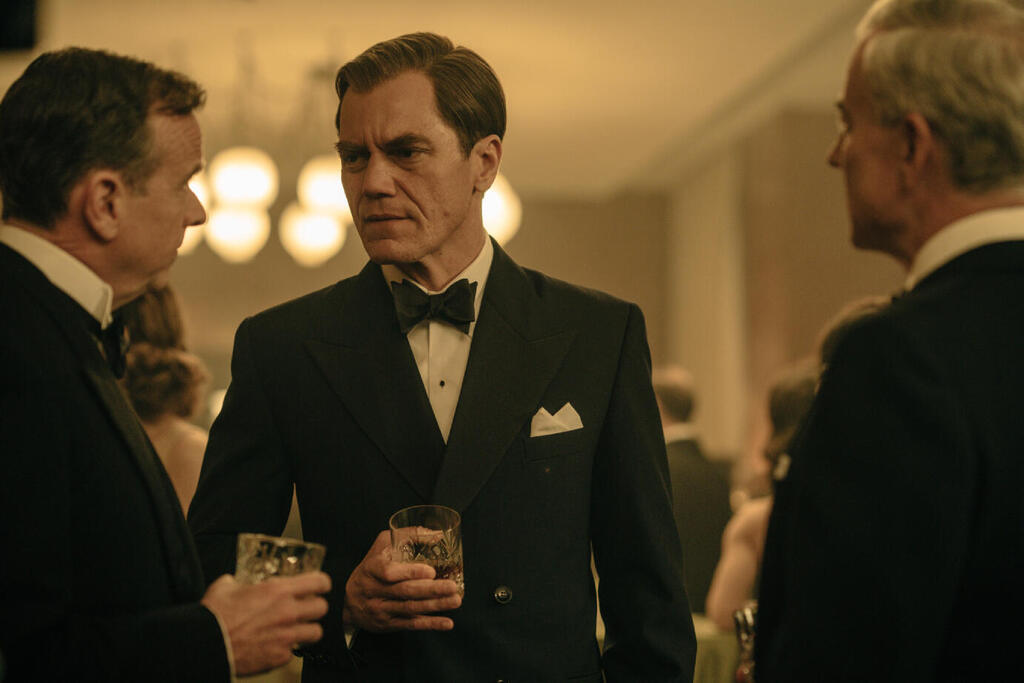
From Nuremberg
(Photo: Courtesy of United King Films)
Rather than delve into the relatively obscure character of Kelley, the film chooses to follow familiar courtroom proceedings aimed at convicting the Nazi war criminals. As if Stanley Kramer’s 1961 film Judgment at Nuremberg and numerous documentaries and dramatizations hadn’t already done this.
The significance of Kramer’s film (starring Spencer Tracy, Maximilian Schell - who won the Academy Award for Best Actor, Burt Lancaster and Marlene Dietrich) lay in its didactic intent.
The film was released about 15 years after the trials and is still considered one of the most powerful dramatizations of Nazi atrocities, despite focusing on lesser figures tried in subsequent proceedings.
Nuremberg, in contrast, needs a compelling, contemporary lens to justify its existence. And though it is competently made, it struggles to provide one. It offers no new insights, and its final scenes feel especially superfluous.
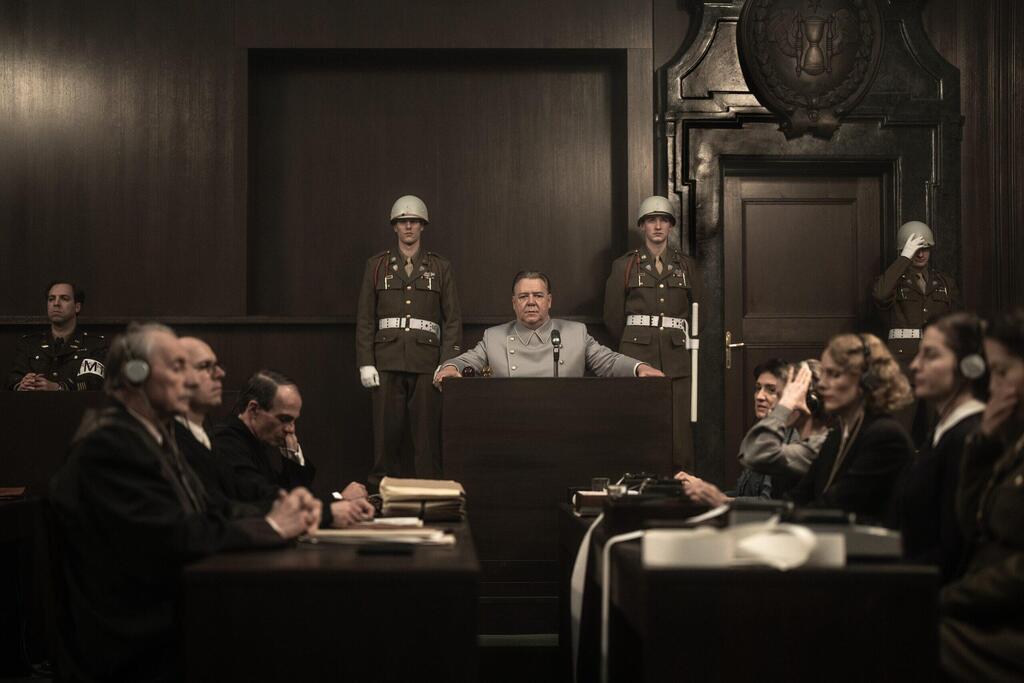
From Nuremberg
(Photo: Courtesy of United King Films)
Why, for instance, do we need a courtroom scene detailing Göring’s conviction (presented by a British prosecutor played by Richard E. Grant)? Or a graphic depiction of Streicher’s execution (including bodily functions triggered by the hanging)?
By the end of the film, we’re left with little understanding of Kelley. What happens to someone who stares into the heart of evil? How did the experience affect his personal life?
Kelley died by suicide in 1958, the same way Göring did, by swallowing a cyanide capsule (apologies if this constitutes a spoiler). But rather than explore how the Nuremberg trials scarred Kelly, the film stops at the predictable endpoint: the Nazi criminals face justice. This is not a film about the trauma of the “footnote,” but about the headline.
Did Kelley come to understand Göring? Did he see not a monster, but a man — the kind anyone might become? Göring himself seems surprised to find himself in the defendant’s chair. But Nuremberg avoids every one of these questions.
When Kelley completed his assignment, he received a note from Göring: “I regret your departure from Nuremberg, as do my fellow inmates. I thank you for your humane approach and your effort to understand our motives.” That line could have illuminated Kelley’s character, but it remains vague, and Nuremberg ends up a nearly trivial film.
Vanderbilt, best known for his screenplays for Zodiac, directed by David Fincher and The Amazing Spider-Man, missed the chance to tell the story of a man who got closer than anyone to evil — and paid the price for it.