

Do you take selfies, look at the results and find yourself disappointed time and again? You may already know this, but for those who don't: Your phone's front-facing camera, which has become something of a mirror for young women in recent years, can distort your facial features by about 30%. It can make your nose look longer, alter the distance between your eyes and ultimately lead women who examine themselves through the lens to want to fix flaws that don't actually exist.
This realization inspired Brazilian makeup brand Natura Faces to launch an intriguing campaign. Natura invited young influencers to participate in an experiment, showing them the selfies they were accustomed to seeing through their front-facing cameras alongside portraits taken with a conventional camera, without the lens distortion.

The main reason selfies distort our faces has to do with the physics of camera lenses and perspective. Smartphone front-facing cameras are equipped with wide-angle lenses designed to fit as much background or as many people as possible into the frame, even when the camera is held just an arm's length away, approximately 12 to 16 inches.
When a wide-angle lens is positioned so close to the face, it creates an effect known as "perspective distortion." Features closest to the lens, usually the nose, forehead and chin, appear significantly larger relative to the rest of the face. Meanwhile, features farther away, such as the ears and the contours of the cheeks, appear smaller and narrower, giving the face a more convex appearance that differs from reality.
A study by Rutgers University researchers and the American Academy of Facial Plastic and Reconstructive Surgery (AAFPRS) found that a selfie taken from approximately 12 inches away makes the base of the nose appear 30% wider on average than in a standard photograph taken from about 5 feet away, a distance that more closely reflects how the human eye perceives us in real life.
It now turns out that this optical distortion has become much more than a technical problem. It has given rise to a recognized psychological phenomenon known as "selfie dysmorphia", also called "Snapchat dysmorphia."
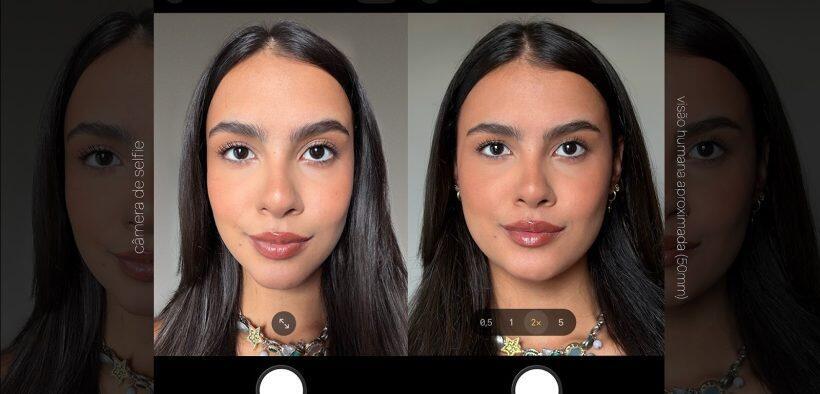
Left: A selfie. Right: A conventional portrait. From Natura's campaign
(Photo: Screenshot)
Young women and girls who consume and create content on social media every day become accustomed to seeing themselves almost exclusively through the distorted perspective of front-facing cameras and filters. As a result, they begin to regard these distorted images as their true appearance.
The phenomenon has led to a dramatic increase in requests for cosmetic treatments and plastic surgery, with women seeking to correct perceived "flaws," such as the width of their noses or the distance between their eyes, that exist only through the smartphone lens.
The beauty brand's campaign addresses precisely this sensitive issue. By presenting influencers with two images side by side — the familiar, distorted selfie and a professional portrait taken with a lens that more closely replicates human vision, typically a 50mm or 85mm lens — the campaign promotes self-acceptance and offers a rational, scientific explanation for why women should stop judging their appearance based on selfies.
For women whose lives are deeply intertwined with the digital world, realizing that their dissatisfaction with their appearance stems from an optical distortion rather than a physical flaw can be particularly liberating. It also sparks a broader conversation about beauty standards in the age of social media.
Daniel Benaya is an advertising and creative professional who runs a WhatsApp group called "What's Happening in Advertising," where he shares campaigns from around the world. It was through his group that we first learned about Natura's campaign.
"I first came across this campaign, created by advertising agency Africa Creative, at the Cannes Lions advertising festival this past June," he says. "Every morning, the festival publishes the shortlists for that day's awards, and all the creative professionals gather around screens set up throughout the venue to watch the work.
"I have two daughters, ages 8 and 5, and my 8-year-old has already started taking selfies and puckering her lips for the camera. At such a young age, that's already how she's getting to know her own face.
"That's why this campaign made such a strong impression on me. I think it's the kind of work that deserves to be written about and shared widely. It felt fresh and clever and, if we put cynicism aside, empowering as well.
"Unfortunately, the campaign didn't win an award, which just goes to show how difficult it is to win at this festival. But it certainly left a lasting impression on me."

Daniel Benaya
(Photo: PR)
What did the campaign involve?
"First, they brought in influencers and photographed each of them twice — once using a selfie camera and once with a professional photographer's camera. They then displayed the two images side by side in an exhibition at a museum in Brazil.
"The influencers were invited to see themselves, and their reactions were filmed. Of course, they were also encouraged to document the exhibition and share the experience with their followers. So the campaign existed both in the physical world and on social media.
"The exhibition was also open to the general public. Women who attended received a small mirror that could be attached to their phones, essentially solving the problem by allowing them to apply makeup while looking into a mirror rather than at a selfie camera that distorts their faces."
Natura's campaign points an accusing finger at technology, but ultimately, the advertising and beauty industries fully embrace influencers who post selfies. Isn't that hypocritical?
"That's a good and very fair question. There are plenty of contradictions in our industry. On the one hand, brands try to earn the public's trust through campaigns like these. On the other, their ultimate goal is to grow and sell more products.
"But I think brands like Natura, which make an effort to offer something of value beyond simply selling products, earn goodwill from the public.
"Personally, I like buying from brands I identify with beyond the products they sell, and I think that's even more true of the younger generation."
As an advertising professional, do you see this kind of 'real beauty without filters' campaign as part of a genuine trend that will change how brands market skin care and makeup products, or is it a passing attempt to generate buzz?
"This has been happening around the world for many years. Dove pioneered this approach about 20 years ago. In Israel, Kotex has also been doing similar work through the McCann advertising agency, helping normalize conversations about menstruation.
"I think this is what audiences around the world expect from brands today.
"I once attended a lecture by Dove's global chief marketing officer. Someone asked him whether this approach actually worked, and he replied, 'We wouldn't keep doing something for 20 years and investing tens of millions of dollars in it if it didn't work.'"
How do you think a campaign like this, which shatters the illusion of perfection, would be received in Israel?
"I think teenage girls in Israel would connect with it just as strongly as girls in Brazil because it taps into a genuine, universal insight that transcends cultures.
"Israeli parents would also relate to a campaign like this. As a parent, I found it to be a startling revelation, something I'd never considered before seeing the campaign.
"And for a commercial advertising campaign, that's a real achievement."