

I sometimes wonder whether people who use cannabis are aware that the substance they roll at the end of the day, the one meant to ‘calm,’ ‘open’ or ‘release,’ them, does not affect only their brain, but also shapes their romantic relationships, their desire and the way their partner sees them, even if no one says it out loud.
Most discussion around cannabis focuses on what it does to the individual. Alongside certain benefits for people with clear medical needs, growing research suggests cannabis is far less benign than many assume. There is increasing concern that it erodes brain systems responsible for mood regulation, sexual functioning, memory, attention and motivation. In other words, it weakens the ability to cope with stress and increases the risk of depression, anxiety and dissatisfaction, all through a gradual process that often goes unnoticed.
Gallery
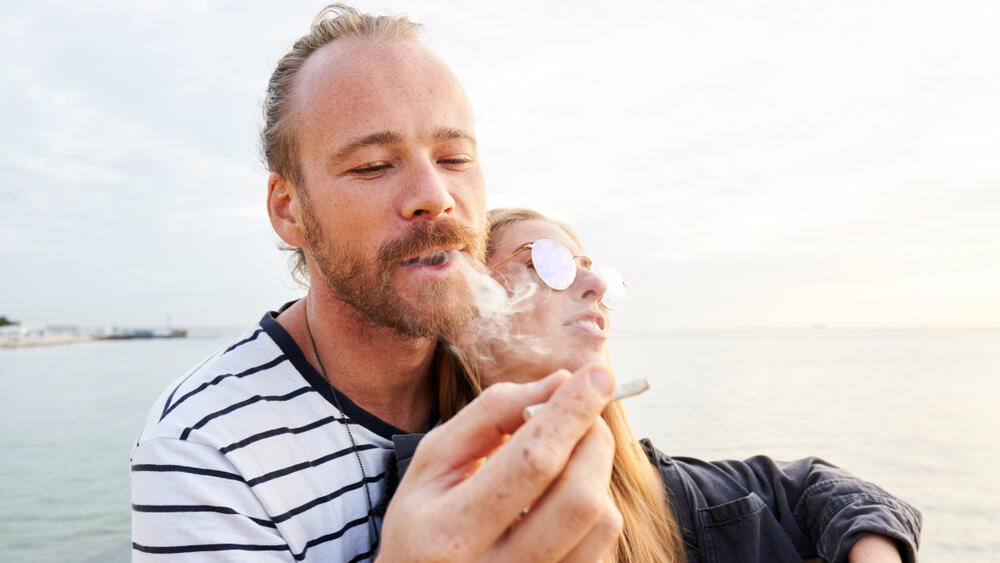
When only one partner uses cannabis, the other may carry the full emotional burden of the relationship
(Photo: Shutterstock)
As important as it is to talk about personal risks, there is another, darker side of cannabis that receives far less attention: its impact on our most intimate relationships. Relationships do not exist in a single brain. They exist between two people. This is where the picture becomes even more complex, especially when one partner uses cannabis and the other doesn't.
The goal here is to set aside, for a moment, the question of harm to the individual and focus on a space largely neglected in research discourse, perhaps because it provokes anxiety that is difficult to confront. It is time to shed light on how cannabis use reshapes romantic dynamics and alters how partners perceive one another.
A romantic relationship requires synchronization; though not perfect, it should be enough to align in presence, attention, responsibility and emotional availability. When one partner uses cannabis and the other does not, that synchronization begins to crack. It does not always involve a dramatic rupture, but rather occurs through slow erosion.
The user moves in and out of altered mental states, often more internalized and slowed, while the other partner remains grounded in everyday reality. At first it may seem negligible. Over time, however, cracks begin to form, and the gap becomes increasingly tangible.
Research based on in-depth interviews with such couples consistently points to a recurring sense of loneliness among the non-using partner. Physical presence remains, but emotional and empathic presence becomes uncertain, gradually heightening relational anxiety.
Over time, the lens through which the cannabis-using partner is seen begins to shift. Attraction in mature relationships is not just about chemistry. It is deeply tied to a sense of agency. Simply put, does our partner have the capacity to act, initiate, hold complexity and take on the emotional responsibility required to manage life together?
Repeated cannabis use, especially when framed through ongoing justifications, can erode that perception, not because the user is viewed as lazy or disengaged, but because they are seen as less clearly steering the relationship.
As a result, non-using partners often begin, sometimes without realizing it, to assume an exclusive role. They are the ones who initiate difficult conversations. They are the ones who carry the tension. They try to understand, contain and steer the relationship. It starts to feel less like a romantic partnership and more like emotional parenting or ongoing care.
This is a critical turning point. Parental or caregiving roles may sustain a relationship, but they extinguish desire. Desire requires symmetry. Once one partner ‘holds’ and the other is ‘held,’ sexual polarity starts to dissolve.

Dr. Itamar Cohen. It is time to talk about the less glamorous side of smoking weed
(Photo: Zohar Shitrit)
At the same time, the partner who uses cannabis often feels under constant scrutiny, as though under a magnifying glass that casts a heavy shadow over behavior, thoughts and emotions. They feel compelled to explain themselves, to justify their needs and experience the dynamic as a kind of emotional attack.
If that were not enough, the quality of sexual intimacy itself can also be compromised when one partner uses cannabis and the other does not. Cannabis often disrupts attention, bodily awareness and the perception of time. For the sober partner, sex can feel dissonant, awkward or out of sync.
Users drift in and out of presence and are less responsive, while the other partner seeks reciprocity, shared rhythm, eye contact and, above all, presence. What one experiences as connection, the other experiences as disconnection. Gradually, cannabis itself becomes a turnoff. Not for moral reasons, but because it repeatedly disrupts the basic synchronization that good sex requires.
Taken together, this erosion is often accompanied by confusion, guilt and sometimes a desperate search for alternative explanations. Here, deeper, even evolutionary psychology comes into play. Our attraction systems seek basic signals that suggest the likelihood of successfully passing on genes.
In this context, those signals include emotional regulation, stability, initiative and a willingness to invest in a relationship over time. Passivity, emotional detachment and inconsistency are unconsciously read as red flags. Not because anyone has done something wrong, but because the system detects a mismatch with a stable intimate partnership.
Problematic cannabis use fits squarely into this space. Even among intelligent, sensitive and high-functioning individuals, repeated emotional withdrawal or diminished initiative can be perceived as a sign that something is not fully connected. The nervous system struggles to trust that our partner is resilient or reliable enough.
What makes this especially painful is that the user does not always understand what is happening within the relationship. From their perspective, cannabis helps them function better. It calms and balances them. But relationships are built not only on intentions, but on patterns. When one partner repeatedly exits the shared emotional or sexual space, the other is left to carry everything alone. Over time, concern can replace desire, and resentment accumulates where attraction once lived.
The darker side of cannabis in relationships is not the use itself, but the imbalance that can follow. It disrupts emotional alignment, blurs relational roles and gradually wears down both emotional and sexual reciprocity. As cannabis use becomes increasingly normalized, the focus should shift from its effects on individuals to its impact on intimate bonds. Relationships rarely collapse because of one joint. They deteriorate when repeated use quietly pulls partners onto separate tracks.
Dr. Itamar Cohen is a researcher at the Center for Psychedelic Research at Tel Aviv University and Tel Aviv Sourasky Medical Center (Ichilov). On January 14, the event “The dark side of weed” with Dr. Cohen will be held at Beit Radical in Tel Aviv.