

Until the 14th week of her pregnancy, Maya Oz was certain she was expecting twins. Then, during a routine ultrasound, the doctor casually pointed to the screen and announced there was another baby.
“I suddenly saw three fetuses,” Oz recalls. “We were in shock. After the examination, we sat on a bench outside and didn’t say a word for half an hour. When we told our families, everyone thought we were joking. At first, no one believed us. It took time for our friends and relatives to realize we were serious.”
Gallery
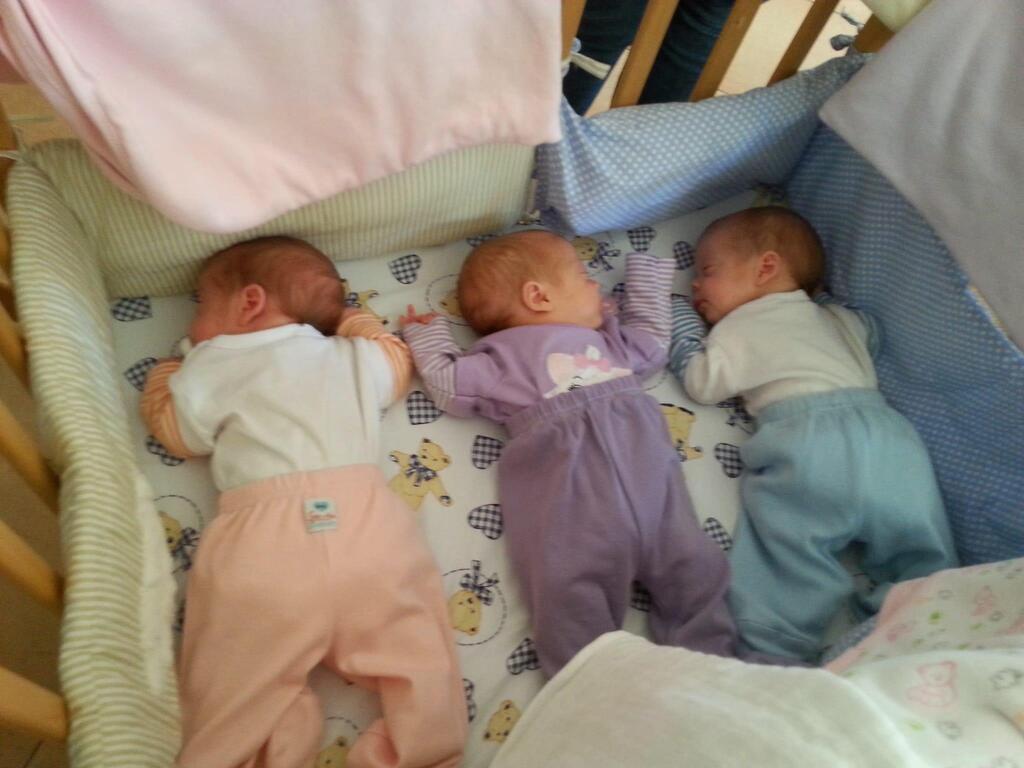
'We painted each girl’s big toenail a different color so we could tell them apart.' The Oz family triplets
(Photo: Private album)
Triplet births are relatively rare in Israel, with roughly 60 to 100 recorded annually in figures published over the years by the Central Bureau of Statistics and Health Ministry. Multiple pregnancies also carry greater medical risks, and some parents are advised to consider fetal reduction.
After all, the weeks, months and sometimes years after childbirth are demanding for any parent, especially amid pandemics, war and prolonged economic uncertainty. Multiply that by three, and the challenge becomes enormous. Yet the families who chose to continue their pregnancies and care for three newborns at once describe a reality that is not only exhausting, but also deeply rewarding.
“The biggest shock was going in an instant from being a couple to being a couple with three children,” Oz says. “It didn’t feel like a slap in the face but more like a complete knockout. Your whole life changes. There was never a dull moment.”
Her daughters were identical triplets, creating another immediate challenge: telling them apart. “We had to find a way to know who was who so we could keep track of who had eaten and whose diaper we had changed. We painted a different color of nail polish on each girl’s big toe, so caregivers and relatives who came to help could identify them by color. And every time we left the house, it had to be carefully planned.”
What did that involve?
“It’s nothing like maternity leave with one child, when you can relatively easily go out with a stroller. We used a train-style triplet stroller that was so long it could only fit in freight elevators. It didn’t fold into the car like a regular stroller, so we had to secure it to a double bicycle rack on the roof. It was not simple at all and required a lot of work.
“We also went through enormous quantities of diapers and formula, about one container a day. We spent many sleepless nights with three girls waking up at the same time. To this day, I can pour exactly 120 milliliters in complete darkness just by listening to the sound of the water.
“We also got a huge amount of attention everywhere we went, and when you have three babies crying at the same time, it’s not exactly the ideal moment for small talk. When all three started crawling, we had to come up with a creative way to contain them safely. We took the furniture out of the living room, put in a huge inflatable pool with mattresses underneath and filled it with toys. That became their safe play area.”
I assume there was an emotional challenge as well.
“We tried to take all the complicated situations with a smile. I remember one day when the girls were tiny and I gave them bread with mashed avocado. All three were sitting in high chairs in front of me. At exactly the same time, one smeared avocado in her hair, one threw it at the dog and the third smeared it on the wall. I remember thinking, ‘Who do I stop first?’ “The answer, by the way, is the one smearing it on the wall, because avocado leaves stains.”

'People play ‘spot the difference’ with us.' The Oz sisters today
(Photo: Dafna Ben Nun)
How did people around you react?
“People never stayed indifferent. Everywhere we went, they stared, whispered or asked questions. When they were small, I was once walking down the street with the stroller and a driver stopped next to me and said, completely seriously, ‘Could you stop for a second? I’m trying to take a picture and it’s hard when you keep moving the stroller.’
“When I got into an elevator with them, people would start playing ‘spot the difference’: Why doesn’t this one have a ponytail? Why is that one wearing a skirt and the other pants? Now that they’re older, the questions are directed at them, but they’re used to the attention and don’t get excited about it anymore.”
How do they get along today?
“Age 12 isn’t simple. They fight with each other, they fight with us, like any teenagers. But they’re extremely close and have a very special bond. They’re almost telepathic. One day, two of them went separately to the library and came home with the exact same book.”
‘You can’t work with triplets’
Ariella Goldenberg and her former husband, Yoni Goldenberg, are parents to 12-year-old triplets from Holon. During the pregnancy, doctors recommended fetal reduction.
“I was still at a very early stage when the doctor said he could see twins and that something wasn’t right,” Goldenberg recalls. “He sent us to a specialist, who also said something was unusual and that we had identical twins plus another baby.”
How do you react to news like that?
“It wasn’t simple. We went to several doctors, and everywhere we were told that we should reduce the pregnancy, but we decided we weren’t giving up.
“We went to a rabbi and to a specialist who said that because the pregnancy had occurred naturally, we could wait and see what happened. From week nine, I was on pregnancy bed rest, and at week 30 I was hospitalized. Nobody expected me to make it that far.”
How do you manage with triplets?
“First of all, I left my job and stayed home with them until they were 3½. You can’t work with triplets. I was afraid of illnesses, especially because they had spent a month in neonatal intensive care.
“We had someone who came a few times a week for two hours to fold laundry and clean the house, but nobody except us gave them bottles or changed their diapers. That was my job.
“They slept in three-hour cycles. I would go through a round of diaper changes and feeding, then go to sleep when they did. When they were small, there were many difficult periods, like when all three had gas or were teething. Sometimes all three would be screaming in the living room and I would call Yoni crying.
“At one point we tried moving them into separate cribs, one for each child, but it didn’t work. Eventually I brought mattresses into the living room and everyone slept there together.
“Leaving the house was a major operation. A triplet stroller was too large for most health clinics, so we used a double stroller and a separate single stroller, which meant another adult always had to come with us.”
“We also changed cars so there would be enough room for them and the strollers. Until they were 3, I basically created an indoor playground at home. I couldn’t take them by myself to the mall, the park or even out for ice cream.”

The Goldenberg family triplets
(Photo: Riki Lugasi)
What challenges do you face now that they are teenagers?
“Adolescence is a serious challenge in itself, with attempted door-slamming and plenty of eye-rolling, but we deal with it. I tell them that if a door gets slammed, there won’t be a door.
“Today I work from home, mainly because three children come home from school at the same time, and each one has something to say. The challenges don’t end after the baby years. And the next concerns are not just bar and bat mitzvah celebrations. Looking ahead, there will be driving lessons, cars and plenty more.”
People say triplets have a special bond. Is that true?
“Yes. They have a bond that’s impossible to describe. Last year, all three broke a finger on the same day.
“The way they look out for each other is extraordinary. From the beginning, they went to the same kindergarten and were in the same class. With this kind of parenting, you have to think constantly about individuality, especially when they’re in the same class. At the same time, each one has their own personality.”
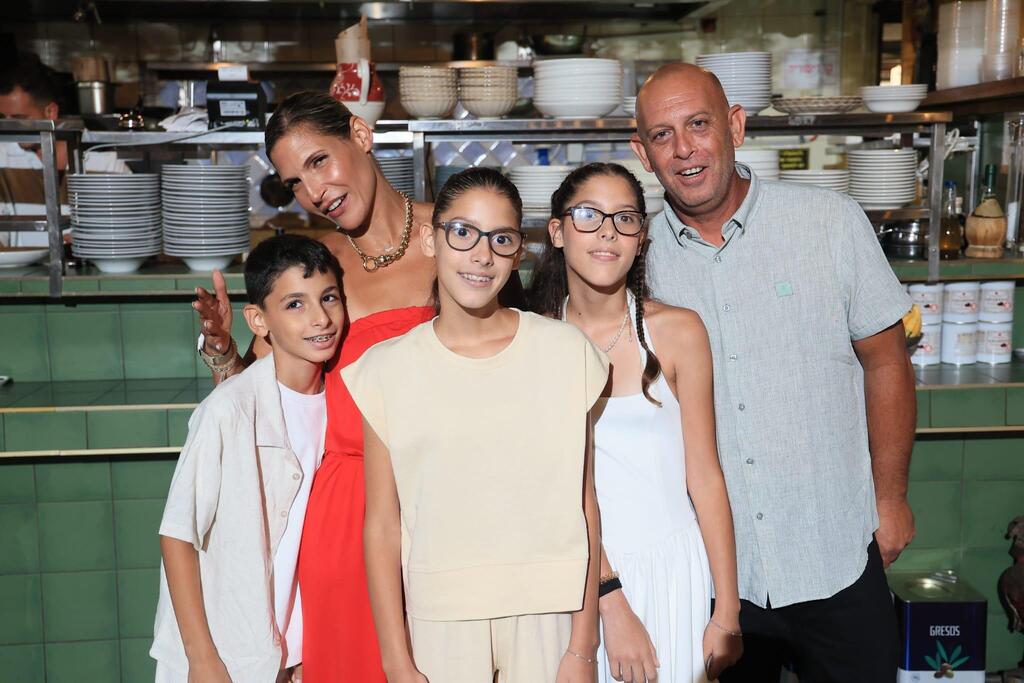
Doctors recommended fetal reduction. The Goldenberg family
(Photo: Oz Gabso)
Were you able to create one-on-one time with each child?
“When they were around fourth grade, I would set a timer for seven minutes and we called it ‘heart time.’ It started out as something technical, but it gave me a chance to be alone with each child, and each one knew their time would come.
“When they were little, they also never ate together or bathed together. I did those things separately because I wanted to really see each child and make sure they had their own time.”
‘We want to separate them, but they don’t want to’
Tali Reznik is the mother of three 13-year-old boys who have grown up as triplets in every practical sense, although they were born through two separate pregnancies.
Reznik underwent fertility treatments for 4½ years before turning to surrogacy. When the surrogate was already four months pregnant with twins, Reznik discovered that she herself had conceived naturally. The three boys have been raised together ever since.
“Managing three children the same age at once is a challenge,” Reznik says. “For example, if you want to go anywhere, you need at least two strollers, if not three.
“Luckily, I had help from my family. We had organized shifts until they were over 3. Each person would arrive at a certain time and stay until the evening. You prepare for the night in advance with bottles and measured portions. Being alone with three babies is a whole operation.”
How do you cope day to day?
“You don’t have much choice. You learn how to do things. It’s hard and intense, but it’s also concentrated. The baby stage ends, and then it’s over. You finish diapers and bottles all at once. A bar mitzvah? One event and it’s done.
“Financially, I always get a ‘triplet discount,’ but you still have to pay for everything three times. Life here is expensive, and you definitely feel it.”
As the boys grew older, Reznik decided it was important for each of them to be placed in a different class. “Since they were little, they’ve always been in three different classes in the same grade,” she says. “They’re together all the time and they’re a force to be reckoned with, so at least this way they have different classmates and different friends.”

The Reznik triplets when they were younger
(Photo: Courtesy of the family)
Over the years, have you managed to create one-on-one time?
“It’s very difficult, especially when they were younger. We always aimed for it, but we didn’t really succeed.
“All three play soccer, all three are in the Scouts, all three are in the same social circle. You want to go to a movie with one of them, and then you discover all three want to see it. It’s very noticeable because they have the same interests. If they sleep over at a friend’s house, all three go. Everything is together.
“The biggest advantage is that they have a lot of self-confidence and they have no problem sharing. They’ve shared everything since before they were born: a room, clothes, toys. They still share one bedroom. We want to separate them, but they don’t want to. Every night they talk to each other before going to sleep. They’re best friends.
“To me, that’s their superpower. They’re always there for one another and always together. Of course they fight sometimes, but at the end of the day they’re more friends than anything else. They have an incredibly strong bond. They can entertain themselves completely on their own. It’s an entire world.”

'They’re best friends.' The Reznik triplets today
(Photo: Courtesy of the family)
So there are plenty of advantages too.
“Absolutely. Even when we arrive somewhere new, I don’t worry because they have each other. Four years ago, we moved to China for a one-year assignment. I imagine many parents would have had a lot of concerns in that situation, but they arrived as a trio, and that gave them a major advantage.”
How do people react to them?
“People are stunned. When we were in China, people would look at them in disbelief. There, one child is common and two is unusual, so triplets? That was like something from another planet.”