

Venice, last summer. As I pass a stunning villa overlooking the Lido marina, I notice dozens of journalists and photographers gathered in its garden. Curious about the commotion, security reveals that what can only be described as Italian aristocracy has arrived: director Giulio Bertelli, great-grandson of Mario Prada, who in 1913 founded a family business in Milan called “Fratelli Prada,” producing wooden goods, ivory, bags and crystal.
Giulio is the son of Miuccia Prada, who inherited the brand in 1978 and turned Prada into a global status symbol, synonymous with style and luxury. Miuccia oversaw the design and creation of the house’s modern aesthetic, while her husband, Patrizio Bertelli, took charge of the company’s management. Today, the Prada empire — which includes cosmetics, perfumes and accessories, as well as brands such as Miu Miu and Versace, acquired in 2025 — is valued at about $13 billion–$14 billion, with annual revenues approaching $7 billion.
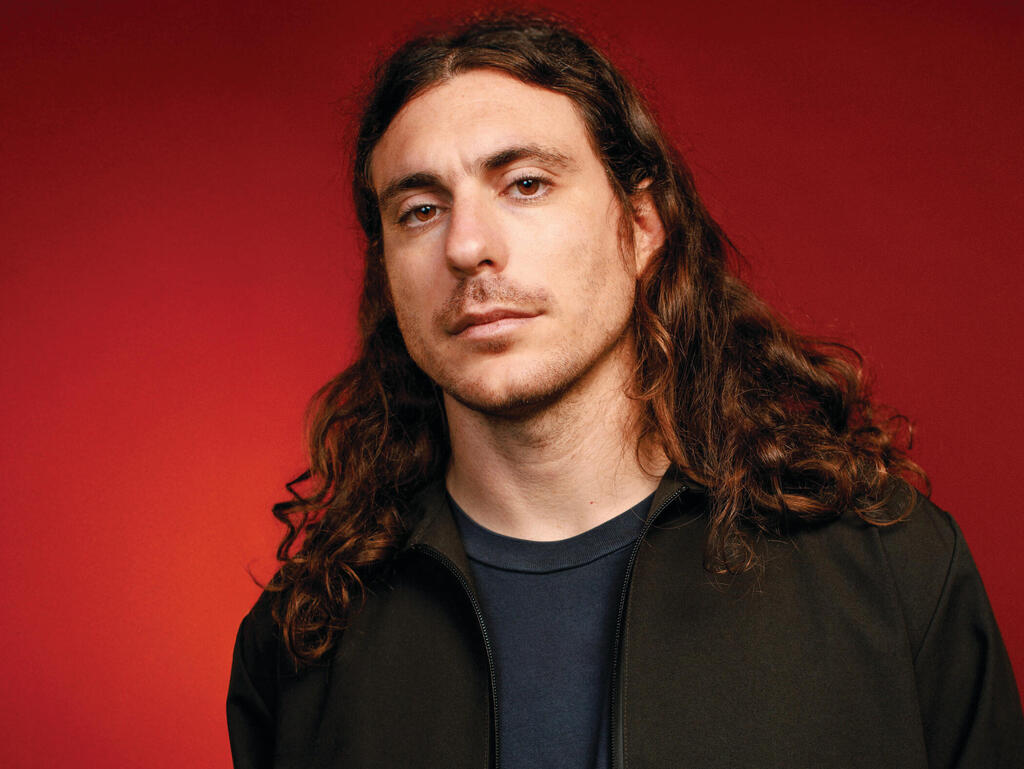
Miuccia and Patrizio have two sons. Lorenzo, the elder at 37, is a racing driver who joined the company in 2017 and now serves in senior roles, including head of corporate social responsibility and a strategic adviser to his parents. He is widely seen as the heir to the empire. His younger brother Giulio, 35, chose a different path: first competitive sailing, and later filmmaking.
At the latest Venice Film Festival, Giulio Bertelli arrived with his film “AGON,” fully aware he would face questions about his lineage. At the start of our conversation, we addressed the elephant in the room.
“How do I deal with questions about my family? Well, I deal with any question. Of course, I’m protective of my privacy, but I’m not shy, and I think it’s natural that people ask about my background. I understand why every journalist wants to know about it. Do I like it? No. Do I think it’s relevant? In my opinion, no. But I understand others think differently. For me, it’s just my family.”
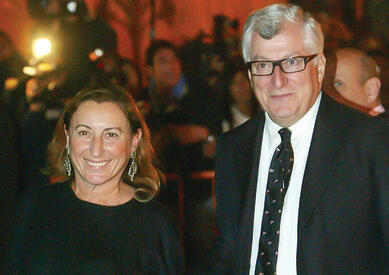
Miuccia and Patrizio Bertelli, owners of the fashion empire
(Photo: Rafa Rivas/AFP)
I noticed that Prada is not mentioned at all in the film’s credits. Was I right?
“That’s right, because the film has nothing to do with my family.”
And what is your relationship with the brand, your parents and your brother?
“We have a healthy family relationship — with my brother and my parents. Throughout my life — whether making my film, running other companies, working in academia and teaching in London, or during my sailing career — none of that was connected to my family. I just do my own thing. Independent from the family. At the same time, we have a good relationship. I’m very close to them.”
When I ask what it was like growing up in the Prada-Bertelli clan, he quickly tempers expectations. “Maybe this will disappoint you, but my childhood wasn’t filled with stars. Not really. My family is very private, and life as a child wasn’t glamorous.”
You didn’t spend time at fashion shows?
“Maybe as a kid I was backstage sometimes. But I wouldn’t say I grew up in the fashion world. Yes, I was lucky to spend time with interesting people in architecture and art — not necessarily the glamorous world you’re referring to.”
During the interview, Bertelli seems almost amused by his own detachment from his family’s fashion empire. Asked about his brother’s exact role, he replies: “I don’t know exactly what his role is now, but I know he’s a potential future CEO. He definitely works with my father, but I don’t think he’s already reached that position.”
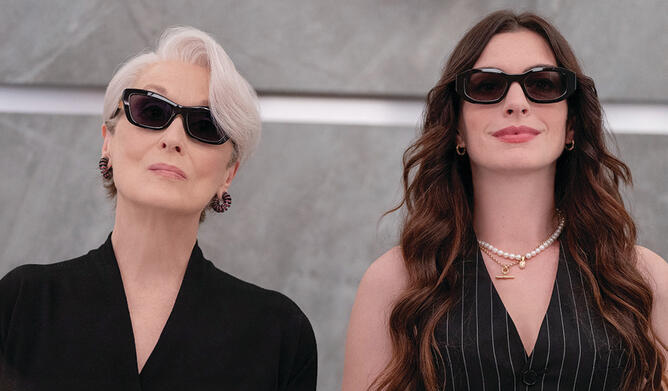
Scene from 'The Devil Wears Prada 2'
He is equally indifferent to one of the most anticipated film events of the coming spring — "The Devil Wears Prada 2", a sequel to the 2006 hit starring Meryl Streep and Anne Hathaway that helped cement the brand’s global recognition. “I wasn’t at the premiere of 'The Devil Wears Prada', and I won’t be at the sequel either,” he says.
'I tried to avoid costume design at all costs'
Bertelli grew up in Italy and studied architecture in London, but dropped out midway. “I started writing scripts, sailing and doing other things. But I maintained a good relationship with the school, so for almost 15 years I’ve been going back and lecturing on the relationship between design, screenwriting and architecture.”
His love of cinema began in adolescence. “I was always interested in photography, images and moving visuals. At 12, I saw a film that made me realize there was a director behind it — Spike Lee’s '25th Hour.' Suddenly I understood that someone had a unique perspective. In high school, I really became a film enthusiast.”
On his path to filmmaking, he also spent years at sea. “I competed in offshore sailing, even across oceans. At one point I sailed from Japan to Australia with an Italian team.”
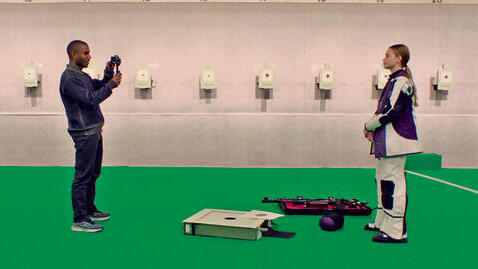
Scene from the film 'AGON'
It is no surprise, then, that his debut film focuses on sports. “AGON,” which premiered at Venice and was acquired for international distribution by MUBI, blends documentary and fiction, telling the story of three athletes — a shooter, a fencer and a judo champion — as they prepare for a fictional Olympic Games.
“I wanted to explore some less prominent sports that I find fascinating, and also the sacrifice required to reach that level. I wanted to get to know the athletes and portray the sport — even if it’s ultimately my interpretation — as accurately and realistically as possible.”
When I heard you were making a film, I assumed it would be about fashion — and then discovered it’s about sports.
Bertelli laughs. “I tried to avoid costume design at all costs. The actresses wear uniforms, sportswear and technical gear. Sport is one of the few places where people still wear uniforms.”
'I don’t rely on my background'
One of the film’s stars is Italian judo champion Alice Bellandi, who won gold at the 2024 Paris Olympics, defeating Israel’s Inbar Lanir in the final. “Since I was still an athlete just months before starting the film, it made communication easy. It was more of an athlete-to-athlete conversation than director-to-actress,” he says.
One of the film’s most striking scenes deals with sex and masturbation, focusing less on sexuality and more on control and compulsion. How did you direct it?
“No one has asked me about this scene yet, and I’ve been waiting to talk about it because it’s very interesting. In traditional male sports, there’s this idea that you shouldn’t masturbate before competition — that it lowers testosterone. Fortunately, these gendered assumptions are finally changing.
“In Italy, for example — and I won’t name names — some very prominent female Olympians have argued the opposite, that it helps them relax before competition. I’m not a doctor, but there’s definitely a debate among athletes.”
He reveals that the set was closed during filming. “We dedicated an entire day to that scene, very carefully. We rehearsed camera movements without the cast to minimize takes, and I think the actress would say she felt very comfortable. The idea was actually to emphasize censorship: the athlete is clothed, the scene takes place in daylight. It’s almost anti-porn. In Japan, for example, porn is always censored. The goal was to create a scene that might make the audience uncomfortable — but the discomfort is psychological. There’s no nudity.”
In the film you also talk about the financial hardship of athletes. Why did you want to deal with that?
“In 90% of sports, athletes earn very little, even though they exist in the same media environment as Cristiano Ronaldo or Roger Federer. Alice won Olympic gold, but she still earns a salary as a police officer. Her economic situation hasn’t changed. In Italy, France and Germany, Olympic athletes are essentially considered amateurs — they belong to military or police units that pay their salaries.”
Bertelli openly acknowledges that his privileged background has given him security. “I’m definitely lucky, and I don’t try to hide it,” he says. “If anything, I sometimes feel uncomfortable with it. But I know how I work, and I don’t rely on my background. My film stands on its own. The budget didn’t come from Prada. I had other partners. I try to operate as if I didn’t have that advantage.”
'I love working'
Bertelli has also founded a company specializing in freeze-dried food. “When I was sailing professionally, that’s what we ate at sea,” he explains. “The quality in that industry was poor, and I wanted to improve it. I even researched food poisoning — at the Olympics, athletes often eat a lot of McDonald’s because they’re afraid of getting sick before competition. That led me to think about food technology that allows athletes to ‘eat clean’ safely.”
You’re quite a Renaissance man.
“Thank you. I love working,” he says, adding that the pursuit of excellence and passion may be the common thread in his family. “I can only speak for myself, but I try to work very, very hard and do the best I can. That discipline may come from my family or from my sports background. Maybe I grew up seeing that constant work is normal — it made me feel that life and work are the same thing.”
When you create something, your family name inevitably comes up. Is it a blessing or a curse?
“Both. I understand the preconceptions. But I can’t complain — I know that growing up in the environment I did helped me. I’ve had so much luck and so many opportunities. I’ve been fortunate on so many levels that I’ll never complain.”