

How does a parent who has lost an arm put a baby into a carrier? What kind of vest can truly fit a female combat soldier and match the structure of a woman’s body? How can a platform be designed to help wounded veterans maintain a consistent, independent training routine after returning home? In the wake of the war, three students from the industrial design department at Bezalel Academy’s former Hadassah College, now part of the Multidisciplinary Academic Center Jerusalem, set out to find design solutions to these pressing questions.
The results may help better define the needs of wounded and disabled people and ease their rehabilitation and return to everyday life. For now, the projects remain theoretical prototypes that have yet to reach the market, and the designers hope that someone will eventually take them up and turn them into reality.
Gallery
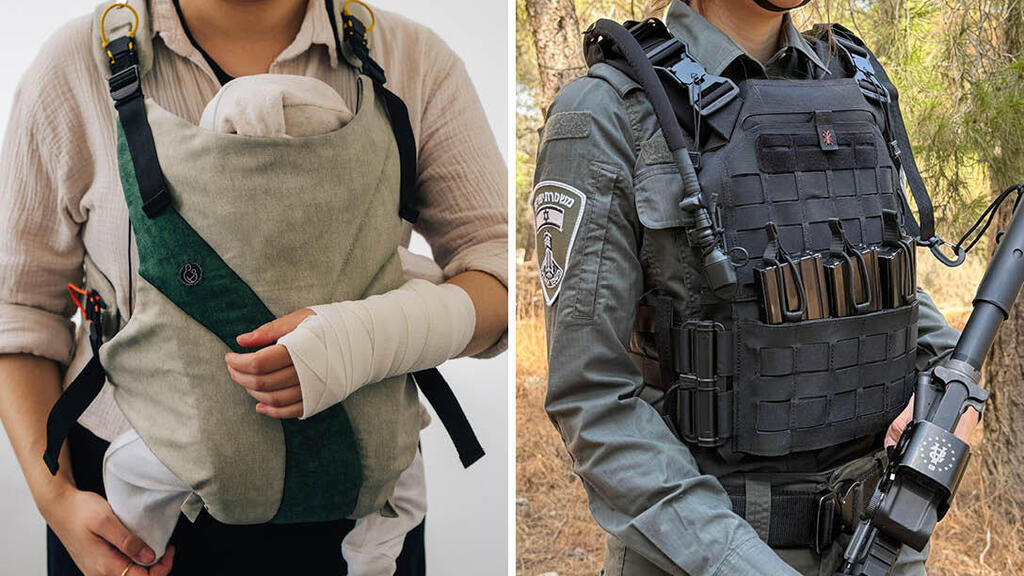
Necessity is the mother of invention — a baby carrier for people with limb loss and a vest for women
(Photo: Noa Cohen, Shmuel Cohen)
Vest for female combat soldiers
Noa Cohen knows the military vest well from her own army service. “After the war, when I started thinking about product design, I remembered one of the most basic items for every combat soldier: the vest. Female combat soldiers are an integral part of the fighting force, yet the vest women use is the same one designed for men. Our bodies are different, and our needs are different,” Cohen explains. “Using standard combat gear often causes discomfort, restricts movement, harms operational ability and sometimes even leads to injuries and long-term physical damage.”
To develop a vest designed specifically for women, Cohen worked with military standards, an ergonomics expert and the Hagor factory, part of Israel’s defense industry in the Gaza border region, which saw great importance in advancing the project. The innovative combat vest she developed, FEM FORT, was designed with close attention to the female body and the operational needs of female soldiers. It allows women to carry out their missions more effectively, taking into account female body proportions, especially in the chest, waist and shoulders.
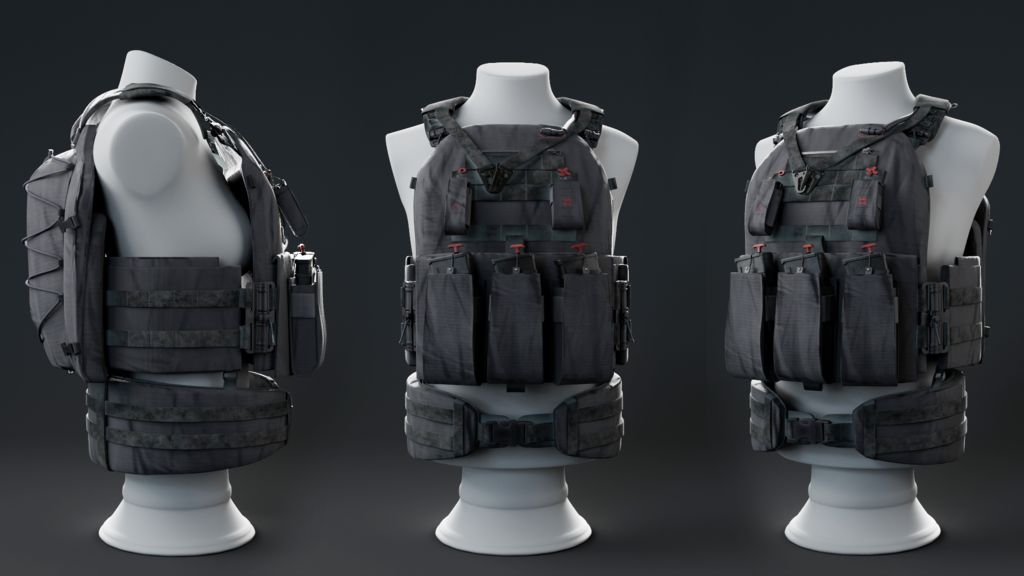
A vest tailored for women, taking the chest and other body characteristics into account
(Development and photo: Noa Cohen)
The vest offers advanced ergonomic solutions, including improved weight distribution, smarter use of surface area and a fit that allows maximum freedom of movement while maintaining safety, accessibility to equipment and long-term durability. It comes in a range of sizes to enable precise, personalized fitting for each soldier.
“A vest is not comfortable for anyone, but for women it is even less so, because of the chest, the weight and a design that was never meant for them,” Cohen says. “Women also need feminine hygiene products, and it is not always comfortable to ask a male soldier next to you to take something out of a rear pouch. These are the kinds of details I redesigned so they would be easier to access, discreet and more comfortable for women to use.”
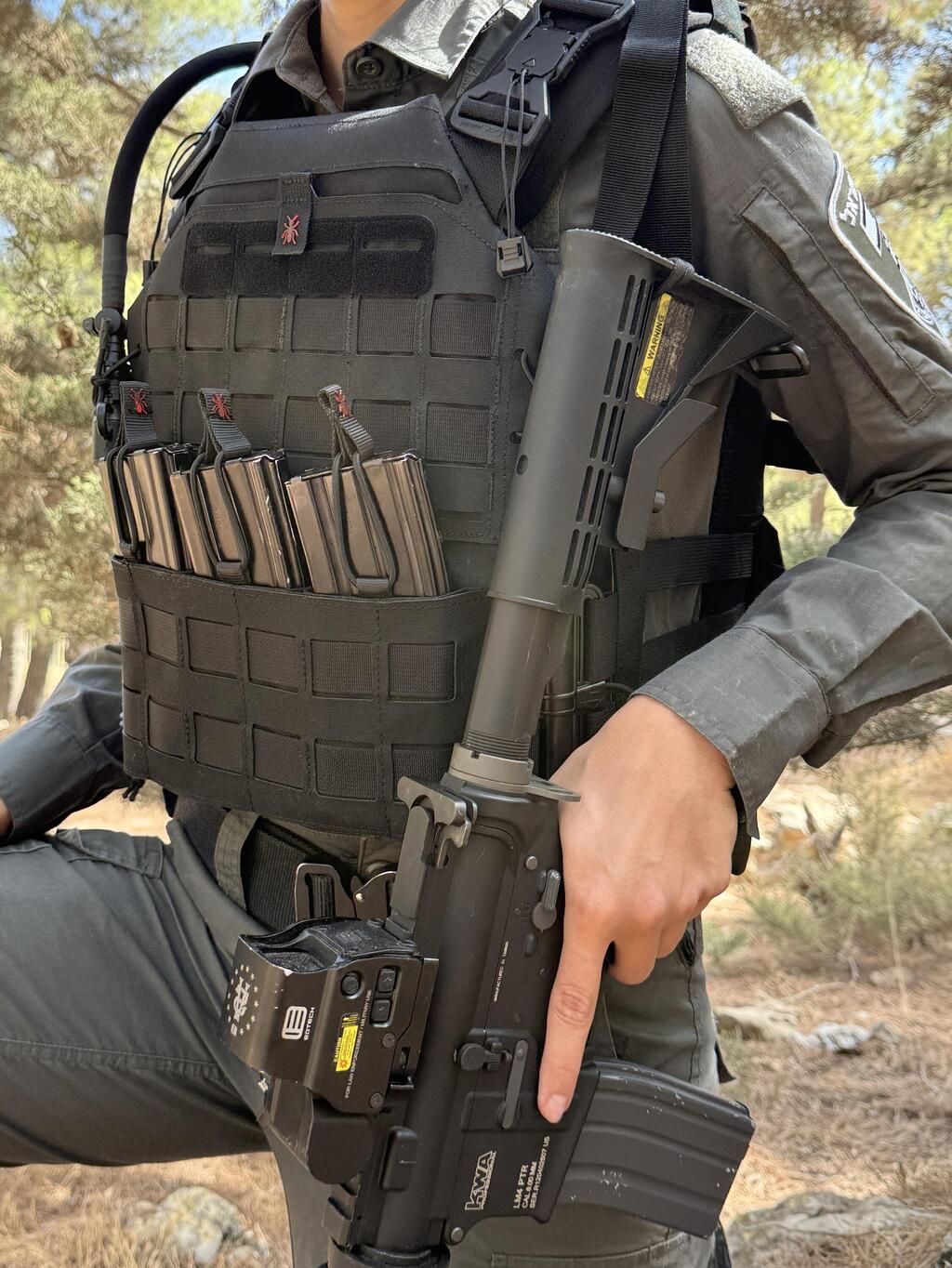
The innovative combat vest she developed, FEM FORT
(Development and photo: Noa Cohen)
To address the weight issue, Cohen created modular components that can be removed depending on the level of protection required in different areas and missions. Another solution focused on support and padding. “In my user research, female soldiers told me about numbness in their hands and pain caused by the vest pressing on delicate shoulder tissues,” she says. “The vest I designed offers greater support and padding, which helps distribute the weight. For me, it is a small step in design but a big step toward real operational equality. The world is moving forward, and as the number of female combat soldiers grows, their needs must be addressed.”
Baby carrier for parents with limb loss
A key part of returning to normal life after rehabilitation is the ability to function as a parent. The baby carrier developed by Amit Tal focuses on a basic, seemingly obvious aspect of life with an infant: the ability to carry a baby safely and move freely with the child close to the body.
“I was looking for an extreme user group for which I could design an accessible product,” Tal says. “Through conversations with friends, I started thinking about parenthood. Even a typical parent sometimes needs more than two hands to manage everything involved in caring for a baby, so what do people do if they only have one?”
Tal connected with several people who had lost an arm, whether from birth or injury, who helped her understand their needs and shared their daily challenges. “I realized there is a real difficulty using baby carriers, especially when putting the baby in and taking the baby out. Doing that with one hand and an asymmetrical body is very hard,” she says.
“Parents want to do everything for their children, even if it comes at a personal cost. People with upper-limb amputations experience overload on the healthy side and suffer pain from extreme movements. Physical contact between parent and baby is both a form of communication and bonding and a way to function in the world. Fathers who lost an arm told me it is hard for them to use a carrier independently, and also hard to hold the baby without one, because the healthy arm gets tired quickly.”
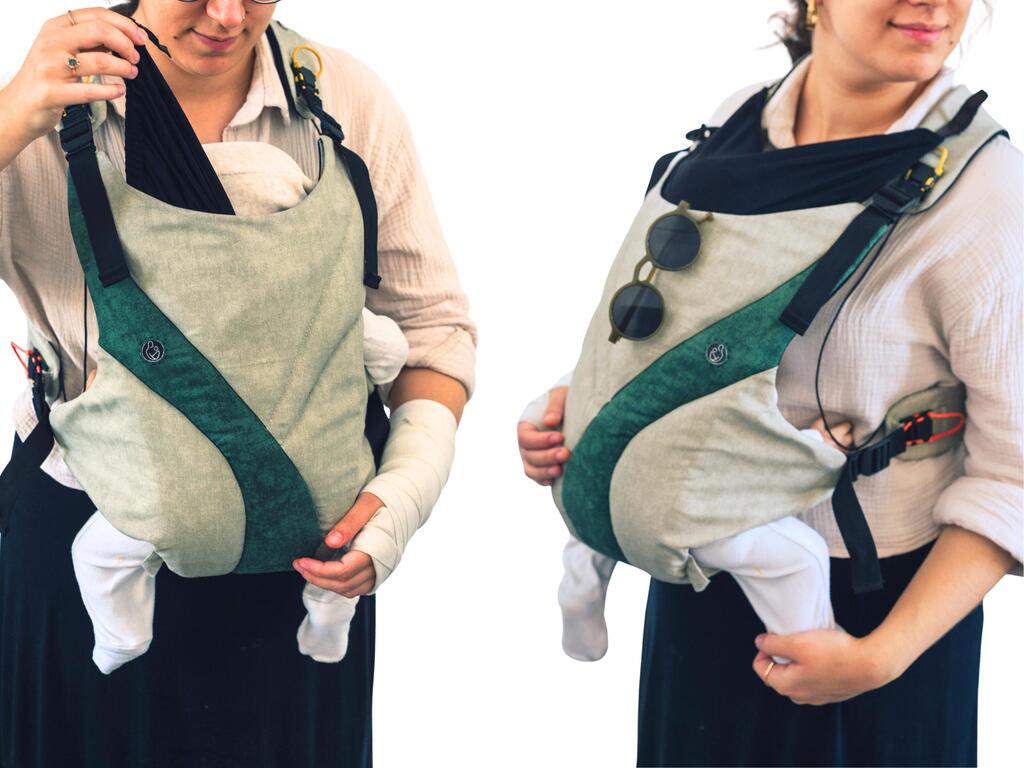
The unique Huga baby carrier developed by Amit Tal
(Photo: Shmuel Cohen)
The carrier Tal developed, called Huga, is ergonomic and accessible and can be used with one hand, right or left. It emphasizes parental independence, infant safety and ease of use. “It was important to me that the carrier look like a respectful consumer product, not something improvised or something that looks like a medical device and draws unwanted attention,” she says. “It was also important that it not hide the amputation. These people are doing the best they can with the challenge they face. That is impressive. It does not need to be covered up.”
Through her observations, Tal saw that parents with limb loss do not give up lifting their baby, but do so using unhealthy postures to stabilize the child during insertion and removal. She addressed those issues in her design. “The carrier can be used independently, without help,” she says. “The baby is secured while the carrier is laid out on a surface, and the buckles are magnetic and strong, connecting easily without forcing the wrist into harmful positions. Once the baby is secured, the carrier can be lifted with one hand.”
Returning to training independently after injury
Maya Halevy developed a digital platform to support home-based rehabilitation for people with limb loss. Halevy chose to meet wounded soldiers and speak with them about the challenges they face during rehabilitation. These conversations revealed a common problem: returning home after rehabilitation and continuing to cope with a new reality without the hospital’s support system.
“I met wounded soldiers, and one of them told me he does not train at all,” Halevy says. “When I asked why, he explained that he cannot bring himself to go back to the hospital. He feels like a ‘patient’ there. I realized that many people return home without adapted tools or ongoing guidance, and continuing the process independently is very complex.”
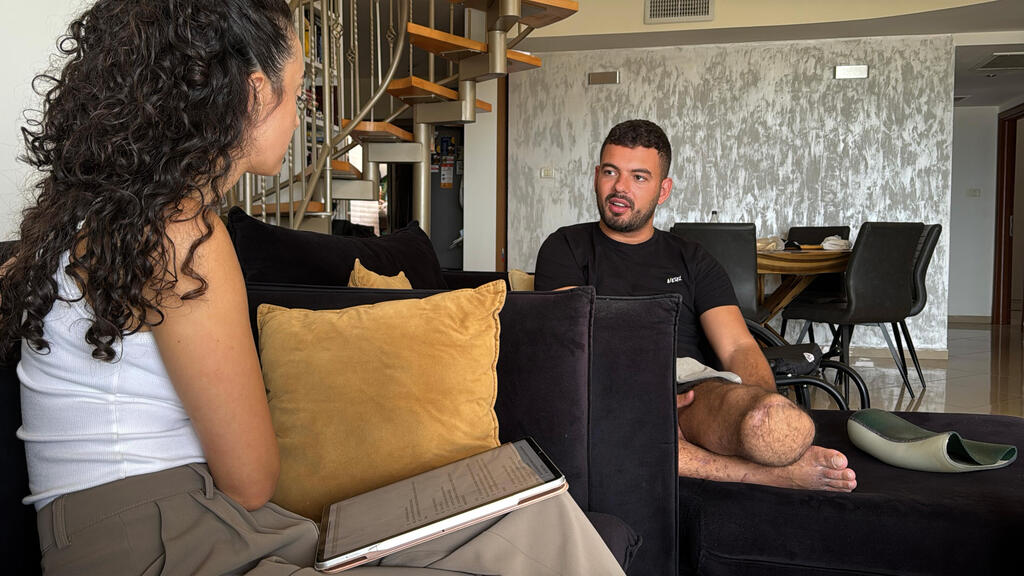
Maya Halevy with Yonatan, who lost a leg and is undergoing rehabilitation
(Photo: Ben Zion Mitzunshvili)
She explains that maintaining training continuity is a major challenge. The process is lonely and often affects motivation and progress. As a result, beyond the physical injury, psychological, functional and social harm can develop, ultimately undermining the ability to return to an independent life.
From that conversation, Halevy developed the idea for a product that would help people maintain structure as they transition to independent living after rehabilitation. She created a digital platform for young people with limb loss called Studio+, designed to help users maintain a consistent, independent training routine from home, tailored to their personal interests and aspirations.
“My app offers rehabilitation at eye level,” Halevy says. “It focuses on strengths, movement and reconnecting with identity, dreams and personal agency, helping users rediscover themselves away from medical language.”
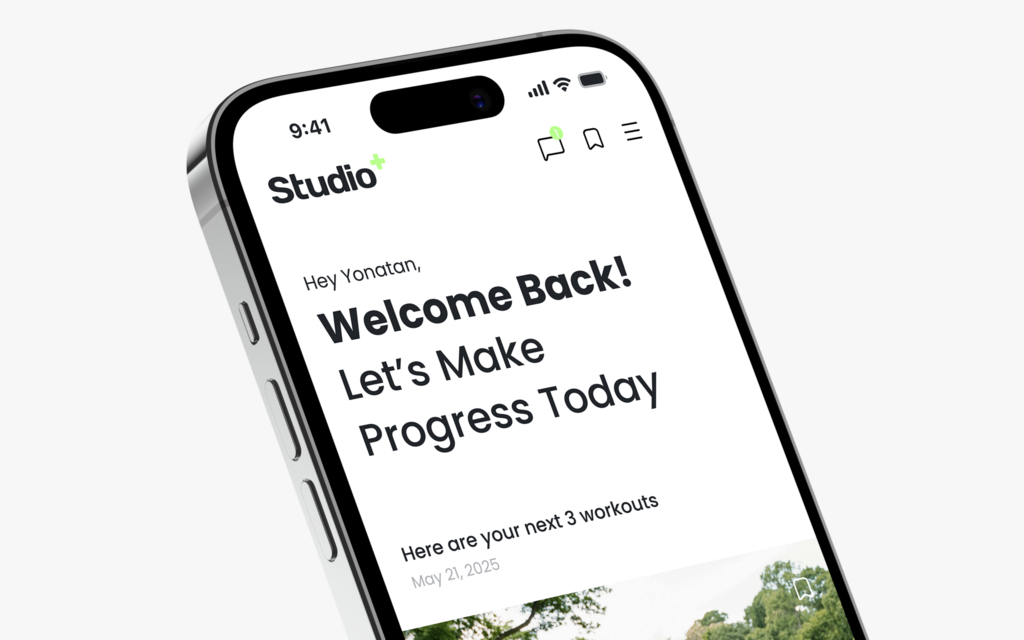
The Studio+ app for independent training for people with limb loss and wounded veterans
(Photo: Maya Halevy)
The system includes independent training through step-by-step instructional videos led by instructors who have undergone rehabilitation themselves and serve as role models. It provides real-time feedback based on artificial intelligence, using motion tracking to monitor movement, identify errors and guide corrections through visual display and voice prompts.
The platform also offers online group training, connecting users and therapists for shared sessions from home. Group training strengthens motivation and a sense of belonging, maintains personal human contact and supports training continuity. In addition, the system includes employment opportunities, tailored educational options and counseling as an integral part of the rehabilitation process, encouraging personal fulfillment.
“It was important to me to create a project that connects to the harsh reality we have all experienced and brings real value,” Halevy says. “I believe that genuine listening, empathy, attention and precision in small details are the key to meaningful design. To achieve that, you have to work with the target audience and truly hear what it needs.”