

“Kink is a Dutch word that means a certain kind of friction or roughness. In other words, kink is a kind of friction, something rough that doesn’t go down smoothly,” says Dr. Itamar Cohen, a clinical psychologist and lecturer who has spent the past year touring with a popular talk titled “The Psychology of Kink.”
So how can a person know what their kink is?
“If we look at sex as an internal theater, then we need to search for where our internal friction lies,” he says. “In other words, where in our story there is some kind of psychological friction that, if we press the gas there, could become something kinky.
Gallery

BDSM, part of the world of kink, always involves clear rules and ongoing consent
(Photo: Shutterstock)
“For example, if I ask you what the most vanilla position is, you’ll say missionary. But for a person who is frightened or deterred by intimacy, someone for whom intimacy triggers an element of anxiety, missionary might actually create the most friction. It’s not for nothing that studies show people with avoidant attachment tend to prefer doggy style.”
Cohen cites The Erotic Mind, the influential book by Dr. Jack Morin, which argues that many kinks, though not all, are rooted in emotionally intense experiences from childhood or early adulthood.
“Emotions we experience in the present, such as shame, guilt, fear, but also elation, which is a positive emotion, are intense emotions,” he says. “They are often linked to formative experiences from childhood. We remember those experiences well because a lot of dopamine was released at the time, and dopamine helps create strong memories.
“If I feel shame and guilt about a specific attraction, it may be that the source of that feeling is some very intense arousal I experienced at a young age. Kink is a unique way of touching those feelings. As an adult who can now set boundaries, kink allows me to visit that healthy anxiety, which can be understood as my erotic story.”
What does he mean by “healthy anxiety”?
“Learning always happens outside the comfort zone,” he explains. “In psychology, this is called the zone of proximal development, a kind of sweet spot. A task that is too easy will bore us. If it is too challenging, we will recoil from it and want nothing to do with it. But a place that is just slightly beyond our abilities is exactly where learning and development take place. That is the place of healthy anxiety, and it is good for us.
“In that place of healthy anxiety, something interesting happens sexually. We can, in a certain way, convert bodily arousal that may be anxiety or fear and ride it, turning it into sexual arousal. That is why kink requires a very high level of trust in the person who allows us to visit that anxiety. There must be framing: a beginning, middle and end. The participants must have control and the constant ability to say, ‘That’s enough for me.’ I can leave the game by using a safe word, for example, which makes it clear to the other person that we are now stopping.”
One of the theories psychologists most enjoy discussing is attachment theory, developed by British psychiatrist and psychoanalyst John Bowlby. Bowlby argued that the first emotional bond between a baby and the caregiving figure, usually the mother, is a cornerstone of a person’s emotional and social development. According to the theory, humans have an innate biological system that drives them to seek closeness, safety and protection, especially in times of distress. The quality of attachment, whether secure, anxious or avoidant, is shaped in early childhood according to how the caregiver responds to the baby’s needs.
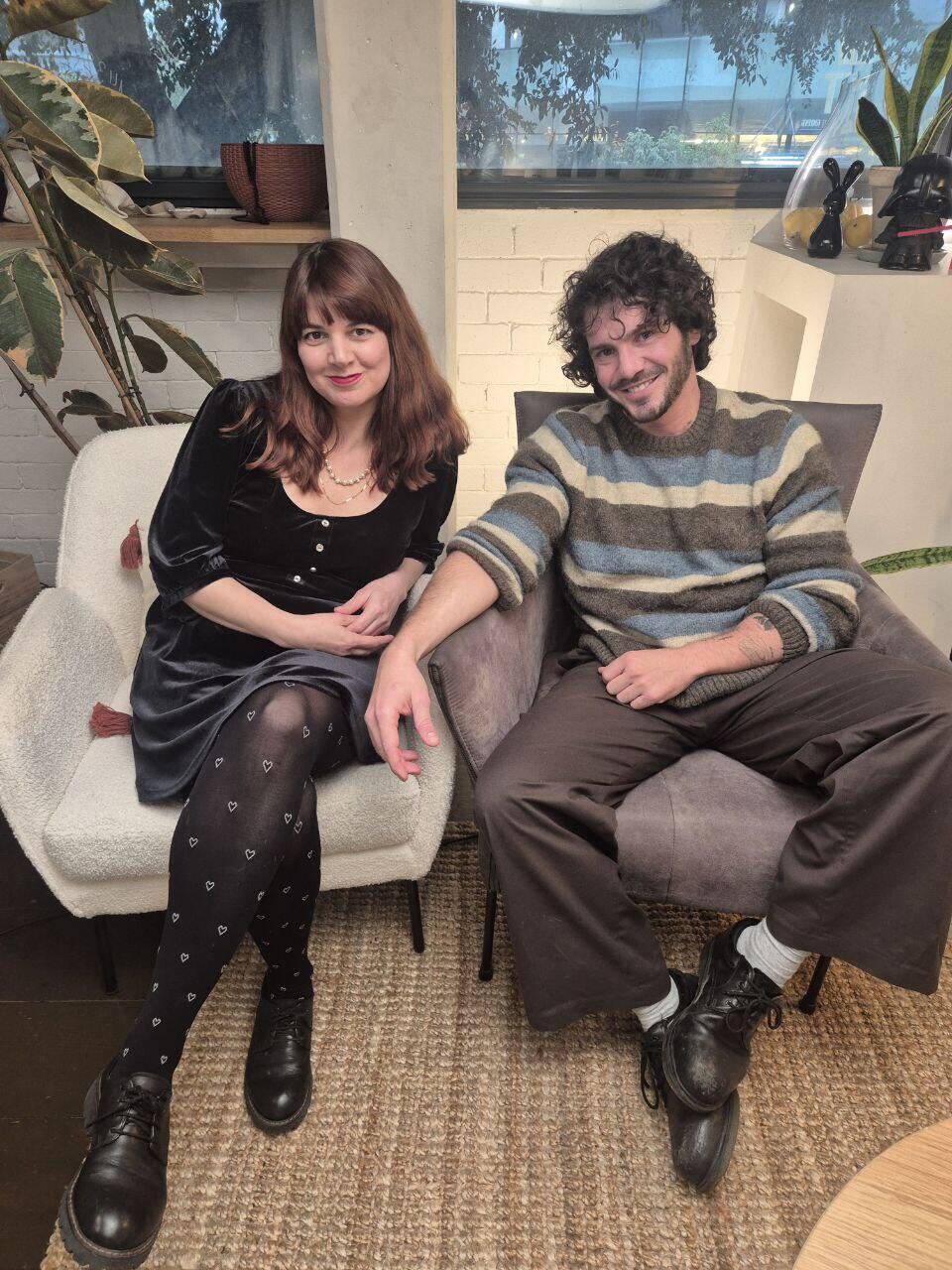
Lori Stadmauer and Dr. Itamar Cohen
(Photo: Nasita Shutser)
“There are interesting studies, for example, that examine the link between a person’s attachment style and the kink they are drawn to,” says Cohen. “The anxious person is constantly asking: Am I loved? Am I going to be abandoned? Am I worthy of love? Their way of coping with that is to seek closeness to the source they fear will leave them.
“Avoidant people, on the other hand, have low anxiety, but only because they take a step back very quickly. They need their space. When you look at kink, you see, for example, that people with anxious attachment are often more comfortable in the submissive role, while avoidant people are generally more comfortable in the dominant role. People with secure attachment usually like being switches, meaning they enjoy moving between both states.
“If we take that one step further, we can say that a person’s specific kink is a tool through which they can experience healthy anxiety, but with training wheels. The submissive can return to a state of helplessness, as they may have felt in childhood, but this time it is within a playful and held situation, so they feel protected. They visit that healthy childhood anxiety and convert it into sexual arousal.”
Cohen compares kink to having a hand on a volume button.
“When the environment allows me to, and I feel good, stable, safe, protected and held, I can raise the volume. That is where we enter the more extreme areas of kink. When is it too much? That is already a cultural question, a social question, a psychological question and an interpersonal question. But to me, that is why this world is so interesting and exciting, and why it has such high potential for growth. With an asterisk, of course: only for people it suits.
“That is why it is important for me not to present kink as some kind of cure for dryness or boredom in a relationship. No. Kink is an entire world. It is a stormy world you can surrender to, but of course there are people who are perfectly happy eating the same schnitzel and rice for lunch every day, and that is great. It says nothing bad about them.
“But if you are the kind of person who feels you need new content in order to stay interested and swept away, then kink may be a wonderful example for you. Studies also show that people who are open to kink and able to relax into it usually have a personality trait called openness to experience, and openness to experience is often associated with mental well-being.”
Touching pain
Dr. Itamar Cohen is a clinical psychologist by profession. He trained in London, where he lived for about eight years. “I started my doctorate when I was 28, finished it at 31 and then stayed in London for another five years,” he says.
He was first exposed to the world of kink through the British patients who came to him.
“People think Berlin is the capital of kink, but that is a mistake. Berlin is wonderful and stormy, but it has a very specific genre of kink. London is so large, so anonymous in a way, and so multicultural, far more than Berlin. To me, London is the Mecca of kink.
“As a therapist, I noticed that people who come from the world of kink have a different kind of zest for life, a pleasant, motivating restlessness. They are very open to experiences. They feel. They love the storm of uncertainty, and that captivated me. When we went into the details, they told me how, through kink, they were able to touch all kinds of early emotional pain.
“For example, I had a patient who was deterred by intimacy. I discovered that when he took on the role of the dom, the dominant partner, he was able to regulate the degree to which he saw the other person as a partner, as a subject, and he could decide how close he got to her. That was how he played with his anxiety. The more he saw his partner as an object, the lower his anxiety became. He played with distance. And the more comfortable he became in the relationship through kink, the more his partner became a subject to him, until they were even able to switch roles.
“To me, that is a living example of how people can touch early emotional pain and process it in a certain way, even without getting to the psychologist’s couch, speaking to a person and staying only at the cognitive level. Kink is a multidimensional experience, certainly behavioral and certainly emotional, and it becomes possible through action, through highly charged playfulness.
“But, and this is a very important but, let this be clear: kink is not therapy. That is the most important thing for me to emphasize, because people will exploit this. ‘I am the therapist, I will show you what you need to do sexually in order to solve your childhood problems.’ No. That is absolutely not what this is.”
So did seeing that patient make him decide the subject was interesting enough to explore whether he himself was kinky?
“Yes. I decided to go for it because I had seen too many good things in the clinic, and I dove into the world of London kink and discovered that it was exciting and stormy. My partner at the time and I began experimenting, and we checked what suited us and what didn’t.
“The thing about London is that because kink culture is so developed there, it already has a tradition with clear rules, and that creates a real sense of safety inside that world. There are very strict cultural rules whose purpose is to protect people within this special world, because it is a world in which we can become very vulnerable, even regressive. Some people really do return to a childlike place. That is why you will never see kink-shaming in London.
“In my view, the ability to enjoy kink is the ability to bring vulnerability, to bring softer and more vulnerable emotional elements into a relationship. If I am not being protected, I cannot truly release control. In the world of kink, the more the framework protects me, the more I can give free rein to my sexual desire and allow it to come out in a more authentic and real way, because I am protected.”
According to Cohen, kink cannot take place without clear consent between everyone involved. But this is not just consent; it is ongoing, updated consent.
“This consent needs to be updated regularly throughout the act, and it must be enthusiastic and continuous,” he explains.
The second element that must exist in kink is healthy communication.
“How do these two work together? For example, through the traffic light method. Green means I am enjoying this and want more of it. But if my partner wants to press the gas and raise the level of excitement, it may not suit me and may begin to approach my boundaries. Then I begin signaling that I am in the orange zone, meaning, ‘Go ahead, but carefully.’ In other words, kink involves a continuum. And of course, red means this is a boundary I am not willing to have crossed. These rules give me a safe space in which I can let go.”