

Most of us share the same basic needs: to feel significant, appreciated, strong and capable of managing our own lives. But there are also moments when we need to let go and feel small in the face of something larger than ourselves, whether nature, great art or even our own children.
At first glance, those states seem contradictory. Psychologists Arie Kruglanski and Sophia Moskalenko argue that they are actually complementary needs, and that the ability to move freely and dynamically between them may be essential to a more balanced and meaningful life.

In their recently published book, Feeling Big, Feeling Small: The Human Yearning for Significance and Wonder, they describe the two poles as Bigness and Smallness.
Bigness is the psychological state that fuels ambition, competition, achievement and a sense of control. Smallness fuels connection, awe and perspective. Neither state is inherently good or bad. Both can give us meaning and strengthen us, but both can also carry a price.
At its best, Bigness gives us the satisfaction of achieving what we wanted and moving closer to our goals. But it can also create an endless chase for more and an excessive desire for control, sometimes at other people’s expense.
Smallness, at its best, can make us feel part of something far greater than ourselves. But it can also become painful when it turns into weakness, insignificance or humiliation.
According to the authors, our natural ability to move between the two poles, like choosing where to sit on an imaginary seesaw, has been disrupted by the pressures of modern life. Contemporary culture heavily prioritizes Bigness, they argue, leaving many people with a chronic shortage of Smallness. That is where problems begin to emerge across different areas of life.
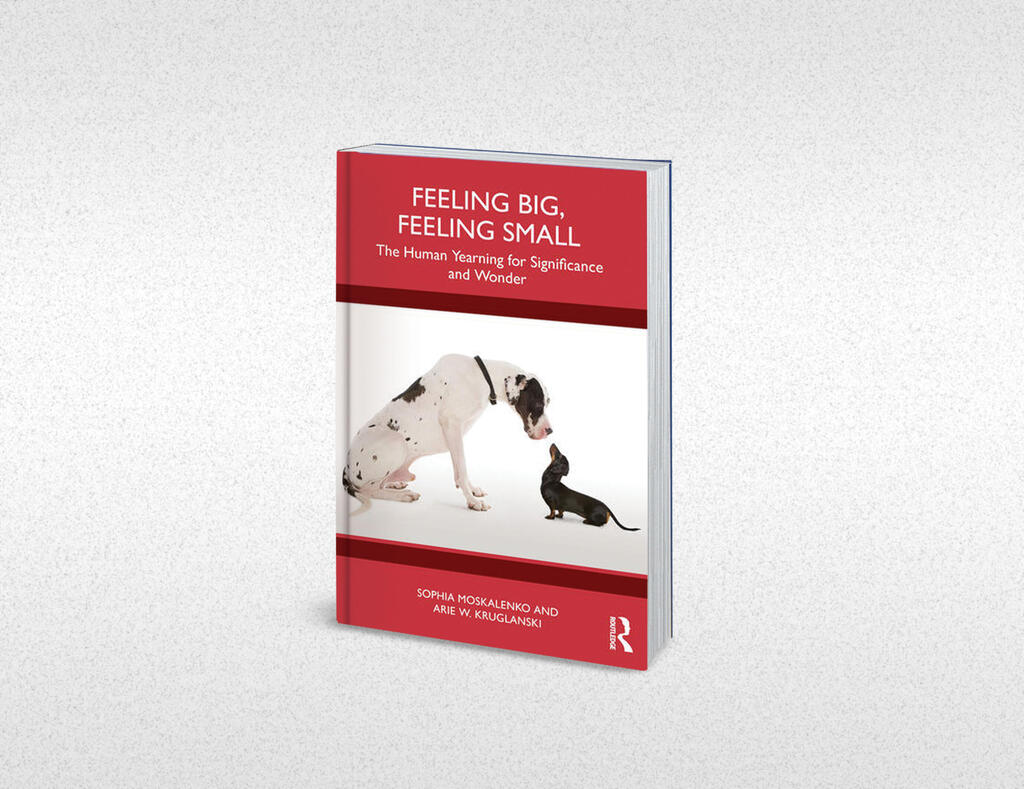
Feeling Big, Feeling Small book cover
(Photo: Courtesy of the publisher)
Kruglanski, 86, was born in Poland, grew up in Israel and is a research professor at the University of Maryland. For more than five decades, he has studied subjects including meaning, motivation and radicalization. Moskalenko, 50, is a professor of psychology at the University of Latvia who also researches radicalization and extremism.
Drawing on their own work and that of other researchers, the authors examine why restoring movement between Bigness and Smallness matters, how both states contribute to creativity, with Bigness supplying ambition and Smallness inspiration, how mental disorders can reflect distortions in that balance, and even how radical movements can manufacture a false and dangerous form of Smallness that draws people toward extremes.
“In the book, we want to invite readers to free the seesaw that has become frozen in one position and recognize this inner movement as the heartbeat of meaning,” they say.
Romantic love: A seesaw of emotions
Understanding the movement between Bigness and Smallness can also help explain how romantic relationships begin and evolve over time.
What makes us fall in love? The researchers identify two central forces. We fall for someone whose qualities we admire, which can create a sense of Smallness in the face of their perceived greatness. At the same time, we also need to feel valued by the person we love, producing a powerful sense of Bigness.
Both forces make us feel significant, either because we matter deeply to someone else or because we step outside ourselves and recognize the full significance of the person in front of us.
So why does the spark of early love so often fade? Over time, we become accustomed even to the most wonderful qualities in our partners. Things become more predictable, and limitations become easier to see. As a partner’s Bigness diminishes in our eyes, it becomes harder to experience the Smallness that once came from being in awe of them.
But there is also reason for optimism. Research shows that couples who continue trying new and exciting experiences together, or who learn new things independently and then share them with their partner, report greater satisfaction and more passion.
The early Smallness of being dazzled by a partner can gradually be replaced by another form of Smallness, one rooted in a secure bond and the stability that develops over time.

The secret to relationships is respecting and appreciating each partner’s Bigness and Smallness
(Photo: Chat gpt)
Another way to maintain balance in long-term relationships is to recognize the different areas of life in which each partner has an advantage based on natural talents or acquired skills, while respecting both partners’ Bigness and Smallness.
“In long-term relationships, it is important for partners to remain conscious of the qualities of Bigness and Smallness,” the authors write.
“Feeling small can be good in the sense of being deeply in love, but it can also be bad when it means feeling humiliated or ashamed. Bringing your partner coffee in bed can make them feel ‘small and loved’ and make you feel ‘big and good.’ But if you nag them to pick up the socks they left on the floor or repeatedly urge them to lose weight, they may feel ‘small and ashamed’ even while you feel big and in control.”
Parental love: Contracting and expanding
Good parenting, the researchers suggest, is essentially the art of changing size. The relationship between parent and child begins with an enormous biologically rooted imbalance. To an infant, the parent is everything: a source of warmth, food, security and meaning.
The baby may be physically small, but also gives the parent meaning and a sense of power. During the early years, the parent’s Bigness dominates: We hold you, we know what you need, we are responsible for you.
But as the child grows, the parent must learn to make themselves smaller in a healthy sense: I will not decide everything for you. I cannot protect you from every frustration. You are separate from me and need to develop your own abilities.
“Modern parenting invests considerable effort in minimizing children’s exposure to frustration, failure and risk,” the researchers explain.
“Many ordinary experiences of Smallness, such as getting lost, failing in front of others or becoming bored, are systematically reduced or prevented. That has consequences, because genuine Bigness also grows out of Smallness. A child competes and strives, sometimes falls, then gets up and continues.”
Parental love, they argue, must evolve. Over time, parents have to step back and allow children to grow not only physically but psychologically.
The goal is not to abandon parental protection but to redefine it. That might mean giving children greater freedom without constant supervision so they can strengthen their sense of competence. It can also mean reducing or eliminating exposure to social media and encouraging shared activities, all with the aim of increasing the chances that children encounter frustration and failure and learn how to recover from them.
“The difficulty of this process is emotional as well as developmental. When we see our child moving away from us, making independent choices that leave us outside the picture, loving other people, it can feel like a return to Smallness. But that is not failure. It is humility, and it means giving another person room to grow beyond us.”
“Healthy parental love is essentially a dynamic process of contraction and expansion. In moments of protection or teaching, the parent reclaims Bigness. In moments of listening, forgiveness or letting go, the parent returns to Smallness.”
Gender roles: More flexibility, less rigidity
Traditional gender roles established a rigid division. Men were encouraged to pursue Bigness through control, status, resources and power. Women were encouraged toward Smallness through emotional caregiving, nurturing and preservation.
When those expectations fit a person’s circumstances, they may feel natural and reassuring. But when external demands change, those old roles may no longer fit.
In modern society, the researchers argue, physical strength is no longer central to economic survival and there is less reason to separate earning from caregiving.
Yet many women today are expected to maintain professional Bigness while still providing Smallness at home and in their relationships.
The solution, according to the authors, is greater flexibility and a willingness to loosen entrenched expectations.
“When both men and women are allowed access to the full range of human Bigness and Smallness, relationships become more stable and individuals feel more fulfilled,” they say.
Another route is entirely physical: building muscle, for example through weightlifting. Research cited in the book suggests that over time, women who lift weights develop greater self-esteem, satisfaction and a stronger sense of capability. They grow not only physically but psychologically.
The corresponding challenge for men, the authors argue, is becoming more comfortable with Smallness.
4 questions to ask yourself in an important situation
- Am I trying to feel big right now? Am I trying to prove myself, win, control or gain recognition?
- Can I feel small without feeling worthless? Can I listen, learn, be amazed or admit that I do not know?
- Am I stuck on one side?
- What does this situation require from me right now, Smallness or Bigness?
2 questions to ask yourself at the end of each day
- Where today did I feel significant, capable or influential?
- Where today was I able to feel awe, listen, learn or recognize that I am part of something larger than myself?
If you consistently have no answer to one of those questions, there may be an imbalance worth noticing.
10 steps to balance feeling big and feeling small
- Build a sense of self-worth that does not depend entirely on achievement. Achievement creates Bigness, but if your entire sense of worth depends on success, every failure can feel catastrophic. You need other sources of value as well.
- Practice Smallness. Spend time in nature, listen to music, learn something you do not know, look at the sky and seek experiences of awe that remind you that you are part of something larger.
- Do not always try to be the most important person in the room. Sometimes the way to become more meaningful is to make space for others. Smallness can make you a better leader.
- Feel that someone is disrespecting you? Pause before reacting. A blow to your sense of significance can trigger the urge to “show them who I am.” Ask yourself: Do I really need to solve the problem, or am I just trying to restore my sense of importance?
- Aim high, but not at any cost. Ambition is not the problem. The problem begins when the need to be “big” becomes endless: more money, more status, more recognition, another victory.
- In relationships, be significant but remain open to influence. Bigness says: “I want to be important to you.” Smallness says: “I am willing to see you, learn from you and recognize that you are not always right.”
- Failure does not have to become toxic Smallness. Failure does not mean that you are small or worthless. You can acknowledge a limitation without turning it into your identity.
- Look for goals that connect both poles. The strongest goals are those that give you a sense of meaning and influence through Bigness while also serving something beyond your personal ego through Smallness.
- Pay attention to people who try to ‘feel big’ through an ideology or group. The need for significance can be exploited by radical groups that offer identity, importance and mission while taking advantage of a person’s desire to belong.
- The goal is not to choose one side but to know how to move between them. Sometimes you need to say, “I can do this,” and sometimes, “I don’t know.” Maturity lies in being able to do both. Do not try to be big all the time, and do not be afraid of being small. Learn to move between the two states