

A 6-year-old girl from China has set a new women’s world record in the Rubik’s Cube, solving a 3x3 cube in an average of just over four seconds.
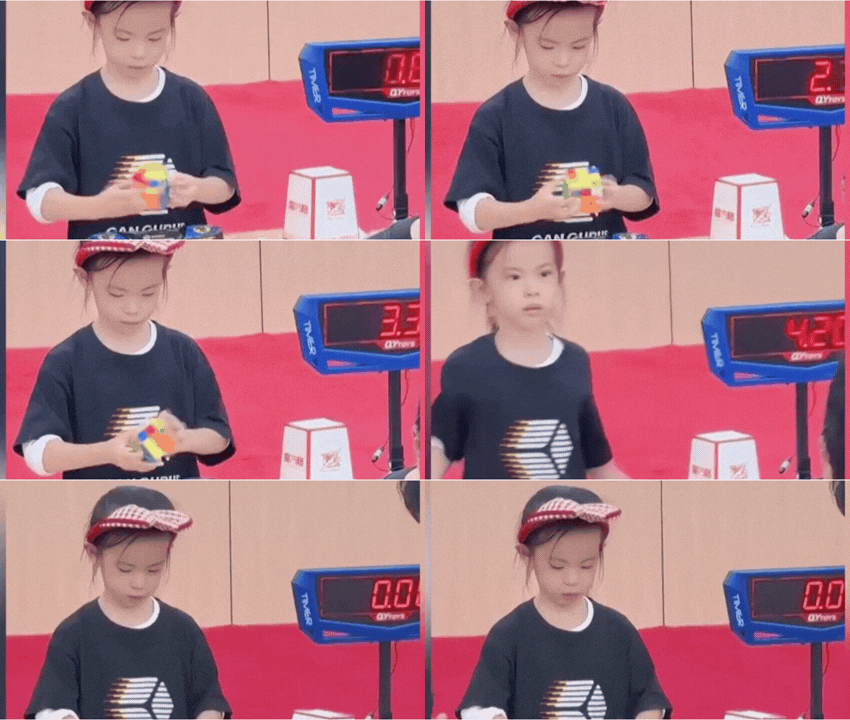
Young Lian Yongji broke the world record twice during September at two official competitions sanctioned by the World Cube Association, or WCA, the international body that oversees Rubik’s Cube competitions, held in the Chinese cities of Wuhan and Guangzhou.
In the average-solving event, each competitor must solve the cube five times as quickly as possible, with the average time recorded as the final result.
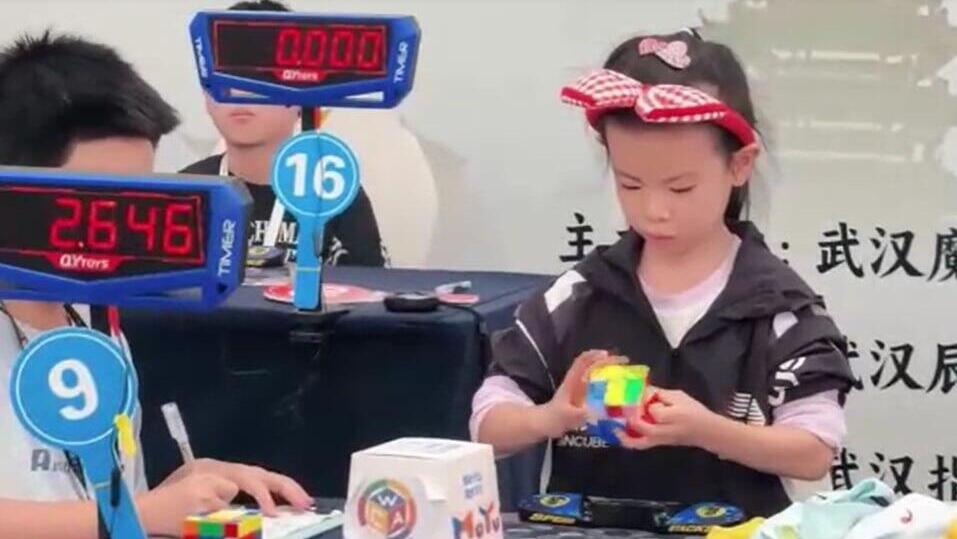
Concentrating on solving
(Photo: Reuters)
At the first competition, Lian posted an average time of 4.52 seconds. At the second, she improved that to 4.27 seconds.
According to Chinese state broadcaster CCTV, Lian is the first competitor ever to record an average below 4.5 seconds. In one of her individual solves during the competitions, she completed the cube in 3.54 seconds.
Watch ian Yongji, 6, solve the Rubik's cube and hoist the trophy
(Video: Reuters)


According to the World Cube Association, the men’s world record in the same category belongs to another Chinese competitor, Yiheng Wang, with an average of 3.51 seconds.
The men’s world record for a single solve stands at 2.76 seconds and was set by Poland’s Teodor Zajder. The women’s single-solve record is 3.24 seconds, set by China’s Cao Qixian.
In a video published by CCTV, the young champion, wearing a red ribbon in her hair, can be seen rapidly twisting and turning the cube with impressive skill. The moment she solves the puzzle, she places it on the table, claps and raises her fist in victory.

Raises her fist in victory
(Photo: Reuters)
Lian’s mother, Lin Yangxi, told Chinese news outlet Red Star News that the Rubik’s Cube is only one of several activities her daughter pursues outside school, alongside dance and music.
She first tried solving a Rubik’s Cube at age 4, when it took her 90 seconds to complete. She later devoted herself to training and dramatically improved her times.

Lian and the winner's trophy: Take your victory lap
(Photo: Reuters)
“She used to be an introverted child, and now she is full of confidence wherever she goes,” her mother said.
According to Lin, her daughter has already memorized more than 1,300 move sequences — the “algorithms” used to solve the cube — and practices for two to three hours a day.