

Five years ago, while eight months pregnant with twins, Rinat Kara received a phone call that changed her family's life.
Her husband Meir's health was deteriorating rapidly, she was told, and he needed to begin searching for a kidney donor.
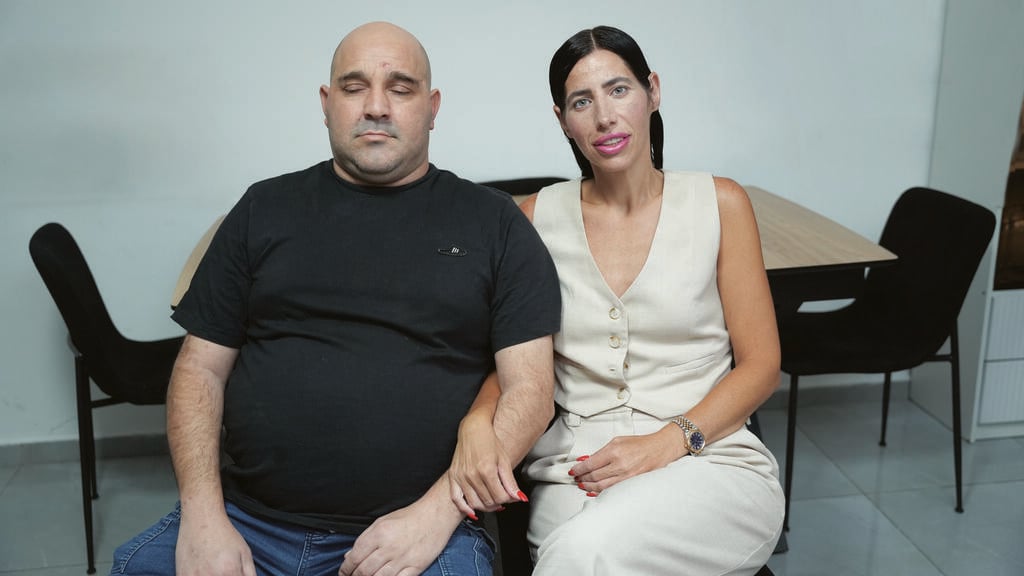
For Rinat, there was little question about who should try first.
"I knew it was on me, that I had to save him," she said. "How could I ask other people if I hadn't checked myself first?"
There was one major obstacle.
After her twin pregnancy, Rinat weighed about 130 kilograms, and a transplant specialist told her she would have to lose a substantial amount of weight before doctors would even evaluate her as a potential donor.
"I told the doctor in the transplant department at Beilinson that I would be happy to see if I was a match," she recalled. "He looked at me and said, 'Sweetheart, have you looked at yourself in the mirror? Go take care of yourself and then come back to me.'"
The comment hurt deeply.
"I'll never forget that conversation," she said.
But it also hardened her resolve.
"At that moment I decided I was going to lose however much weight I needed to donate a kidney to my husband, no matter what."
Eighteen months later, she had lost 70 kilograms.
Diabetes took his sight, then his kidneys
Meir Kara, now 41, was diagnosed with diabetes at age 12.
He acknowledges that for years he failed to manage the disease properly, ignoring dietary restrictions and not consistently taking the treatment he had been prescribed.
"I was stupid," he said. "I thought it wouldn't happen to me."
The consequences eventually became severe.
About a decade ago, when he was 31, Meir lost his sight.
"I was working at a food stand, and one day, while preparing a dish, I suddenly couldn't see the knife," he recalled.
He said bleeding began inside his right eye. He was taken from Yoseftal Medical Center in Eilat to a hospital in central Israel.
Meir believes his treatment at the time was inadequate and says he should have received an Avastin injection to control the bleeding. He says his retina progressively deteriorated and he ultimately lost vision in that eye, followed later by the other.
"Eventually the sight in the second eye went too," he said.
His diabetes also caused neuropathy, with numbness, tingling, burning sensations and what he described as electrical sensations in his hands and feet.
Eventually, his kidneys began to fail.
His creatinine levels rose sharply, leaving him facing either dialysis or a transplant.
At the time he was also a heavy smoker.
"One day Rinat told me, 'It makes no sense that you've gotten us into this situation and you're still smoking,'" Meir recalled.
He was holding a cigarette.
"I finished it and told her, 'That's it. This is the last cigarette.'"
He quit immediately.
‘I knew I had to save him’
When doctors told the couple that Meir needed a kidney, Rinat was determined to become his donor.
"The idea was clear to us: We were going all in on a kidney transplant," she said.

(Photo: Yossi Dos Santos)
"But finding someone who is both compatible and willing to go through everything involved is not easy."
At first, she had not realized her weight could disqualify her.
"I was healthy overall," she said. "I didn't understand what the doctor meant."
When he explained that she needed to lose a significant amount of weight, she was devastated.
Meir says the physician's bluntness was characteristic of a top transplant specialist focused on the medical outcome.
"He doesn't play games," Meir said. "Whether you're offended or not doesn't interest him. What matters is the result."
For Rinat, the result became her mission.
She had struggled with her weight since childhood and said she had spent much of her life repeatedly trying diets without lasting success.
"Every Saturday night I would tell myself that Sunday morning I was starting over," she said. "Then Sunday would come and I would forget."
Meir, she said, never pressured her to lose weight.
Once she asked him whether it bothered him that his friends had thin partners while she was overweight.
"No," she remembers him saying. "Because I saw your heart right away."
Losing 70 kilos
Rinat said she lost the weight using Ozempic over roughly a year and a half.
She said the medication suppressed her appetite so strongly that there were days when she barely ate, and that she did not have dietary supervision or exercise regularly during the process.

Rinat and Meir Kara with their son Avihai and the twins, when Rinat was at her highest weight
(Photo: Erez Cohen)
She had previously undergone bariatric surgery at 26, a year after giving birth to the couple's eldest son, Avihai.
She initially lost about 15 kilograms but regained the weight, she said, and did not want to undergo another operation.
This time, the motivation was different.
Her husband's kidneys were failing.
"I didn't have any doubts about donating," she said. "If the situation were reversed, I have no doubt Meir wouldn't think twice."
Dialysis takes over
As Rinat lost weight, Meir's kidneys deteriorated further.
He eventually spent three months undergoing dialysis while she completed the testing required to become a donor.
From the start, Meir said, he was convinced she would be a match.
"She posted on Facebook looking for donors, but I told her, 'Don't make too much of it. You're a match for me. There's no need to advertise.'"
Rinat underwent extensive medical and psychological evaluations.
"They make sure you're not only physically suitable but psychologically capable of donating," she said. "They want to know that you have support around you, that you're doing it for the right reasons and that nobody forced you."
Eventually, she was approved.
A surgery date was set.
Then, two weeks before the operation, the transplant coordinator called at 7:30 in the morning.
Rinat immediately feared something had gone wrong.
Instead, doctors had a proposal.
The kidney she lost 70 kilos to donate went to someone else
A 61-year-old patient had been on dialysis for 16 years without finding a donor.
Rinat was an exceptionally good match for him.
Doctors proposed a paired kidney exchange: Rinat would give her kidney to the other patient, while Meir would receive a kidney from another altruistic donor.
The arrangement could save two people rather than one.
Meir immediately agreed in principle, but he had one concern.
"I told them, 'I have no problem saving another person along the way, but I want insurance,'" he recalled. "Hopefully both transplants succeed, but if something goes wrong, where am I going to get another kidney?"
The coordinator assured him that if the transplant failed, he would receive priority on the transplant list.
"That calmed me down," Meir said. "I told her, 'Let's do it, with love and a whole heart.'"
Rinat's operation went smoothly.
She remained in hospital for about a week and said her pain subsided relatively quickly.
Meir's recovery was far more complicated.
For eight months after his transplant, he was repeatedly hospitalized with infections.
"He would get antibiotics, be fine for a week, then another infection and another hospitalization," Rinat said.
Eventually, doctors identified the problem, and Meir says he is now doing well.
‘It changed our whole family’
The most dramatic change for Meir was the end of dialysis.
"Just not having to go to dialysis changes your life," he said.
The treatments drained his energy so severely that he sometimes needed two days to recover, only to return for the next session.
Three times a week, hours at a time, life revolved around the treatment.
"It's like being under complete house arrest," he said. "Everything has to be planned around dialysis because you simply cannot miss it."
For Rinat, the transplant transformed her life too.
"The transplant did nothing but good for our family," she said.
She had finally achieved a long-held goal of losing weight and said she is now more active with her children and feels healthier.
"I don't know whether I would have managed it if I hadn't had the goal of saving Meir."
Living with one kidney, she says, has made little difference to her daily life.
"I don't feel any difference," she said. "People can live their entire lives with one kidney, and that's important to say."
Meir laughed that the issue has instead created a new source of marital arguments.
"You want to know what we fight about? She doesn't drink enough water," he said. "I argue with her every day because now she has one kidney and she has to take care of it."
A marriage tested by illness
Rinat and Meir have been together for about 15 years.
They met in Eilat after Meir moved there as a young man and began working for Rinat's uncle. Her sister introduced them.
Two years later, they married.
At the time, Meir had diabetes but remained active and employed.
Rinat says she never imagined how dramatically his condition could deteriorate.
Meir says he also underestimated the danger.
"I thought I was Samson the hero," he joked about refusing to properly manage his diabetes. "I ended up just Samson, without the hair."
"For me, he's still a hero," Rinat replied.
When Meir lost his sight, he told Rinat she did not have to stay.
"Listen, sweetheart, with all my love for you, and I really do love you, you don't need to go through this entire journey with me," he recalls telling her.
"If you want to go, the door is open. I'm letting you go with love. Go build a life. You're young. Get married again."
She was offended.
"We promised each other for better or worse," she said. "So now things are a little worse and we leave?"
For her, there were only two choices.
"You can sit and cry over your bitter fate, or you can get up, pull yourself together and move forward."
The transplant, she said, brought them even closer.
Their son now has diabetes too
The couple have three children: Avihai and twins Emmanuel and Rafael.
Avihai, now 12½, remembers a time when his father could see and work.
That has made Meir's repeated hospitalizations particularly frightening for him.
"If I go with Meir to the hospital, the first thing Avihai asks is whether he's coming back," Rinat said.
The family also worried that their children might inherit diabetes.
Those fears were partly realized when Avihai was diagnosed at age 9 with MODY, a hereditary form of diabetes.
The twins have been tested and, so far, have not been diagnosed.
Connected by two kidneys
The couple remain in touch with both the person who received Rinat's kidney and the man whose altruistic donation ultimately went to Meir.
The recipient of Rinat's kidney prefers to remain anonymous.
Meir's donor was Eitan Nahushtan, a 35-year-old teacher from Merkaz Shapira who had never met him.
Nahushtan was one of three brothers who donated kidneys altruistically, Meir said.
The families now speak regularly and meet when possible.
For Meir, that community of donors has left him with a simple message.
"Anyone who can donate should do it, without fear," he said.
He believes spending even an hour inside a dialysis ward is enough to understand what his donor gave him.
"You see 12 or 14 people sitting there, suffering and praying for their lives," he said.
His appeal is to look beyond one's own immediate interests.
"Anyone who saves one life," he said, invoking the Jewish teaching, "is considered to have saved an entire world."