

When 47-year-old Merav Blumenfeld returned from Israel to her home in the Thai island of Koh Phangan, she carried more than a suitcase — she carried a pregnant belly. The reactions were a mix of shock and admiration.
“Women who saw me were stunned,” she recalls. “Everyone knew I was going to Israel for fertility treatments, but when I came back pregnant, they thought I was a witch. I got so many compliments — it was wonderful. My body stopped producing eggs around age 40, but it’s doing plenty of other things beautifully, and I’m deeply grateful for that.”
"Women tell me, ‘If I’d known I’d feel this way, I would have done it sooner.’ In my case, people even say Tamara looks like me. That’s nice, but honestly, it doesn’t matter.”
Just a month and a half ago, Blumenfeld gave birth in Bangkok to her second child, Maayan — little brother to four-and-a-half-year-old Tamara. Both children came from the same egg donor, after years of unsuccessful treatments.
“Tamara came into the world after three years of treatments, seven rounds of IVF and then another year of egg donation. Along the way, we had two donors and two miscarriages. The first donor didn’t work after five tries, so we switched. I thought that once I chose egg donation, I was on the winning track, and it would happen right away. But even that was another tough round. Maayan, on the other hand, took on the very first try.”
The frozen embryos that called to her
How did you even dare think of a second child after all that?
“The lucky part was that we had three frozen embryos left from Tamara’s process. Without that, I don’t know if I’d have gone through it again. It turns out everything happens for a reason — even the heartbreaks. In the end, I got more embryos, and one of them became my son, my daughter’s brother. A month before the decision, I still hesitated, but those embryos called to me.”
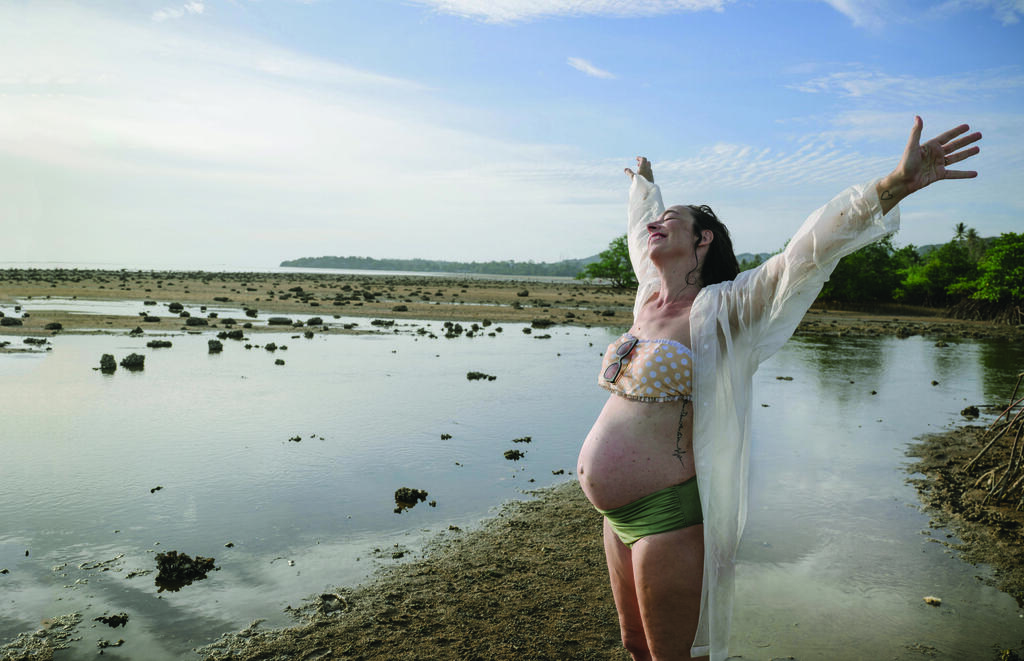
What was it like being pregnant at 47?
“Pure joy. Even better than the first time at 43, when I was paralyzed with fear of losing it. By then, I stopped listening to the phrase ‘high-risk pregnancy.’ We traveled the whole time — Berlin, Vietnam, Singapore — and everything went smoothly until the end. Honestly, pregnancy can be miserable at any age. Everyone gets the card they’re dealt.”
And giving birth in Thailand didn’t scare you?
“Thailand isn’t what people imagine. It’s advanced, clean, professional. I’m cautious by nature, so I planned C-sections both times. With Tamara in Israel, I chose a French-style C-section, where the mother takes an active role. For Maayan, Dr. Israel Handler — who had operated on me before — even flew to Thailand to persuade the Bangkok doctors. They refused, so Maayan was delivered by a standard C-section. Today, a month and a half later, I feel just fine.”
'I was broken'
Blumenfeld, a music publicist, describes her younger self as “the most conformist person in the world, boringly normative. If you’d read my CV, you’d have fallen asleep.” But the last decade has been anything but conventional.

Pregnant with Maayan
(Photo: Tom Bartov)
For three years, she’s lived in Koh Phangan with her husband, Yair Yona, 43, a personal development coach and the biological father of both children, in a villa with a pool.
“When Tamara was two, we spent a month here and had the best time,” she says. “We saw Israelis building a community and said, ‘Why not? Let’s move.’ We built a house here because we could actually afford it — nothing like in Israel. Back home, we were struggling financially. We hardly went out, babysitters were too expensive. Here it’s a third of the price.”
“Koh Phangan suits us. It’s a bit like Tel Aviv — parties, people searching for family — but also a place that pushes you toward personal and spiritual growth. Tamara goes to a private preschool with kids from all over, mostly Israelis. Her English is already better than mine.”

With husband Yair and daughter Tamara
(Photo: Tom Bartov)
She met Yair seven years ago at a nightclub in Tel Aviv. “It was right after my mother died. I’d been single for ten years. It felt like she sent him to me,” she says. “I’m 1.85 meters tall (6'1"), which made finding a partner tough. Yair is ten centimeters shorter.”
A honeymoon that ended in heartbreak
Seven years before meeting Yair, Blumenfeld was briefly married. Her first husband left her during their honeymoon in South America after falling for another woman.
“After a year of living together, we got married. Our souls connected. Looking back, I see we lacked attraction, ambition, growth as a couple. I was in hi-tech; he was doing temporary jobs. My mother wanted us to marry, so we did — on the roof of our rental.”
Their honeymoon turned into a nightmare. “Two months in, we met this stunning Frenchwoman. Suddenly, he couldn’t sleep in our bungalow and wanted space. He drifted away. Eventually, he admitted he was interested in her. I told him, 'okay, let’s go back home.' But he said he needed to be alone, and left me in Costa Rica. My heart was shattered.”
“The doctor said I’d need fertility treatments. At some point, he told me: ‘You should have come years ago. You’ll never be a biological mother'."
The marriage ended quickly. “I was broken. Embarrassed too. We were the cute couple, with a cool wedding and a world trip. And after three months, it was over. To this day, I’m shocked that story is mine.”
She stayed single for ten years. “When my mother was sick with cancer, I thought of having a baby alone, hoping it would keep her alive. She told me, ‘You can’t do this alone,’ so I gave up.”
Finding Yair
At that Tel Aviv club, Yair arrived with her niece. “He was a musician in a band with her boyfriend. We danced, we connected. A week later, we kissed. After years alone, suddenly I found the kindest man in the world. Six months later, we moved in together. A year later, we had a Purim-themed wedding with 100 guests in costumes and a disco floor.”
Did you talk about children?
“He said right away he didn’t want any. I was 39, but not in a rush. I was living like a teenager, going to shows, parties. But deep down, I knew I couldn’t give up on motherhood. I told him we’d revisit the subject in six months. And after six months, he was so in love he told me: ‘If you want a child, we’ll have one.’ He supported me through every treatment, fully committed.”
'There’s no woman who hears ‘egg donation’ and doesn’t cry'
At 40, they began trying. “The doctor said I’d need fertility treatments. At some point, he told me, ‘You should have come years ago. You’ll never be a biological mother. For you, it’s only egg donation.’ Then he turned to Yair and said: ‘Congratulations, you’ve got righteous sperm.’”

With husband Yair and children Tamara and Maayan
(Photo: private album)
How did you react?
“I barely understood what hit me. It was crushing. There’s no woman who hears ‘egg donation’ and doesn’t cry. But as my desire to be a mother grew, I agreed to anything. I didn’t care if it was science fiction — I just wanted to be a mom. Thirty years ago, I wouldn’t have had this chance. I’ve had no period for four years now, but with egg donation, age is no obstacle.”
Was it hard to give up the dream of genetic motherhood?
“Of course. But then I heard journalist Sarit Magen, who wrote Your Own Child, say on a podcast that egg donation has a 60% success rate. I thought, 'wow, can I really get odds like that?' Slowly, I accepted that this was the way.”
First time as a mother
“How did it feel becoming a mother for the first time?”
“Emotionally, I had postpartum depression. My first encounter with depression ever. I was terrified. How could I have my dream, such a beautiful daughter, and feel this way? I was anxious about losing her. I didn’t trust myself. Everything felt melancholic, as if the world had stopped. A friend moved in and helped raise Tamara with me. I started therapy, and that was the first step toward healing.”
Helping other women
Today, Blumenfeld helps other women on their path to motherhood. “I run a digital course and host a podcast called An Egg of Hope, where I interview women about their journeys. I tell them: ‘There’s hope. Don’t blame yourselves. Don’t judge yourselves.’ Almost every woman in fertility treatment has a poor relationship with her body. Many face mood swings, depression. I want them to see themselves with compassion, to be proud, to celebrate how hard they’re working for their dream.
“I said that if I can save them a few years of painful treatments, if I can tell them they can still hold a baby even without their genes — then I’ve succeeded.”
What do you tell women afraid they won’t connect to a donor-conceived child?
“I tell them the bond isn’t built from an egg but from everything you give the child — the touch, the looks, the voices, the hugs, the everyday life. It builds step by step. A child knows who his mother is through her heart, not her genetics. Women tell me, ‘If I’d known I’d feel this way, I would have done it sooner.’ In my case, people even say Tamara looks like me. That’s nice, but honestly, it doesn’t matter.”
Do you talk to your daughter about it?
“Of course. I tell her Mommy needed help. I keep it light. If you don’t make a big story out of it, then it isn’t one.”
Blumenfeld, who now runs the PR agency Music Factory, grew up in Nof HaGalil. At 21, she moved to Tel Aviv, finished a master’s in organizational behavior, and worked in hi-tech HR. “Twelve-hour days under neon lights were unbearable. Eventually, I quit. For two years, I had no steady job, until I stumbled into music PR.”
How?
“I posted on Facebook that I was looking for work. A friend suggested a company distributing CDs. The pay was lousy, but I loved it. A year later, the company went bankrupt, so I went freelance.
“From the start, I was drawn to emerging artists. They don’t take anything for granted — every radio play thrills them, every newspaper item excites them. I felt I could really add value. With famous musicians, nothing impresses them anymore. I worked with a lot of second-generation artists — Noam Banai, son of Meir; Itay Sakharof, son of Berry; Tomer Efron, son of Si Heyman; and Romi Hanoch, daughter of Shalom.”
Do you see similarities between guiding musicians and guiding women toward motherhood?
“It’s exactly the same. Every soul wants to fulfill a dream. One wants to break through in music, another wants to be a mother. Everyone wants to be heard. The common thread is uncertainty — and realizing it doesn’t all depend on you. You try another round of IVF, or another radio release. Sometimes it works, sometimes it doesn’t. The point is to keep trying until it does.”