

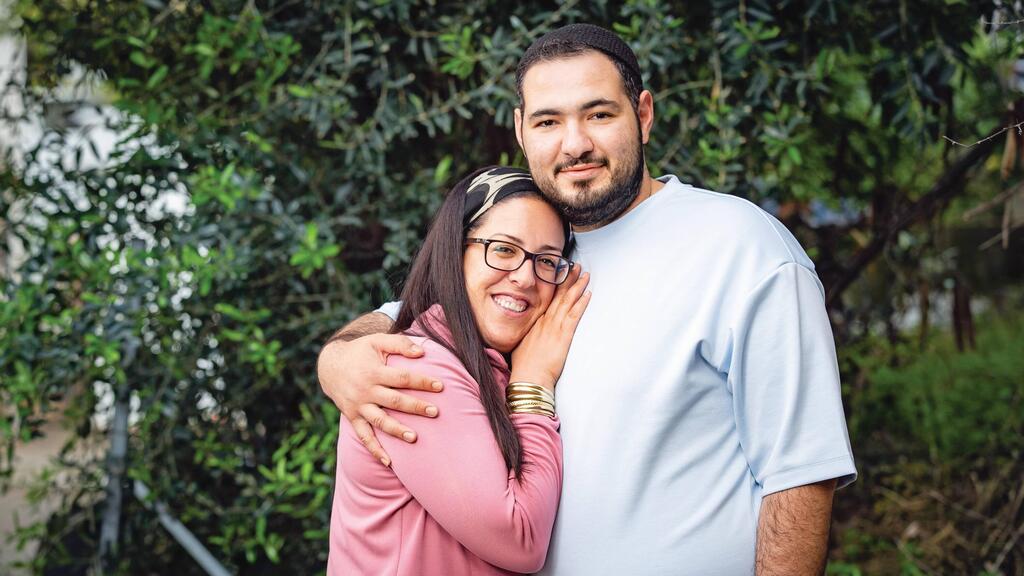
Vered Armayev, 42, an educator and lecturer, is preparing to publish a children’s book, “Noya’s Boots.” Her husband, Baruch Armayev, 32, works as a consultant helping people secure medical rights.
They live in Beit Shemesh with their five children: Itai Nissim, 12; Ilay, 10; Noya Ayla, 4; and twins Elad and Avital, 1.
Where we come from
Vered: “I grew up in Beit Shemesh in a Haredi (ultra-Orthodox) family, the eldest of six. I studied at a teachers’ seminary and later worked as a teacher in elementary and middle school, as well as with at-risk youth. At 21 I began dating through shidduchim (matchmaking).
"I had all the ‘right’ credentials to be matched easily with a yeshiva student, but even after meeting more than 100 men, I didn’t find the one my soul loved. I took it very hard. I remember crying into the tallit (prayer shawl) my mother bought me as a segula (a symbolic act believed to bring about a desired outcome) to find a match — it was soaked with tears.”
Baruch: “I was born in Russia and immigrated to Israel at age 2. When I was 4, my mother was diagnosed with cancer and she died when I was 14. I left school at 13 and only completed my education after she passed away.”
How we met
He was 12, she was 22.
Vered: “I was a substitute teacher in Baruch’s class. At first I only heard about him because he didn’t show up. I felt compassion for him — he was a challenge. I didn’t give up on him and would insist on bringing him to school. When that didn’t work, I helped enroll him in a youth advancement program where I worked. I wanted him to complete 10 years of schooling.”
Baruch: “What I remember from that time are the heart-to-heart conversations with Vered. Instead of studying, we spent hours talking about life and what I was going through. I was a very closed-off child, and that’s where I opened up. Vered calmed me — it was healing. She pushed me forward at every stage, told me I could do it and that she would be there for me.”
Becoming part of the family
Vered: “One day his mother called me and said I was the only one who had found the key to her son’s heart, and that she trusted me to look after him when she was gone. From the day she died, I didn’t leave Baruch or his younger brother. They became part of our home, including Shabbat and holidays. At my siblings’ weddings, they were even in all the family photos. Baruch used to call me ‘Mom.’”
Baruch: “I became attached to the whole family. I was like an adopted child.”
A shift in the relationship
Vered: “When Baruch enlisted in the army, our relationship changed. He matured a great deal during his service, and I went through a difficult period as my two younger brothers got married while I still hadn’t found a match. Baruch and his brother would drive me to dates and bring me back, and they were the first to absorb my disappointment when it didn’t work out again. At that stage I wasn’t in love with him, but I loved him. We knew everything about each other.”
Baruch: “We had an unusual emotional and spiritual connection. I had girlfriends before, but here I felt that if she married someone else, I would lose my best friend. I wanted her to be mine for life. Even when I drove her to dates, deep down I hoped I would be the one.”
How we fell in love
Vered: “On my 29th birthday, when Baruch was 19, I went to his home. A week earlier I had met a man who didn’t respect my observance of shmirat negiah (avoiding physical contact before marriage) and tried to touch me. I came home crying to my mother and said I was done with matchmaking. That day, Baruch asked to speak with me alone. He gave me a ring and said he wanted to marry me.”
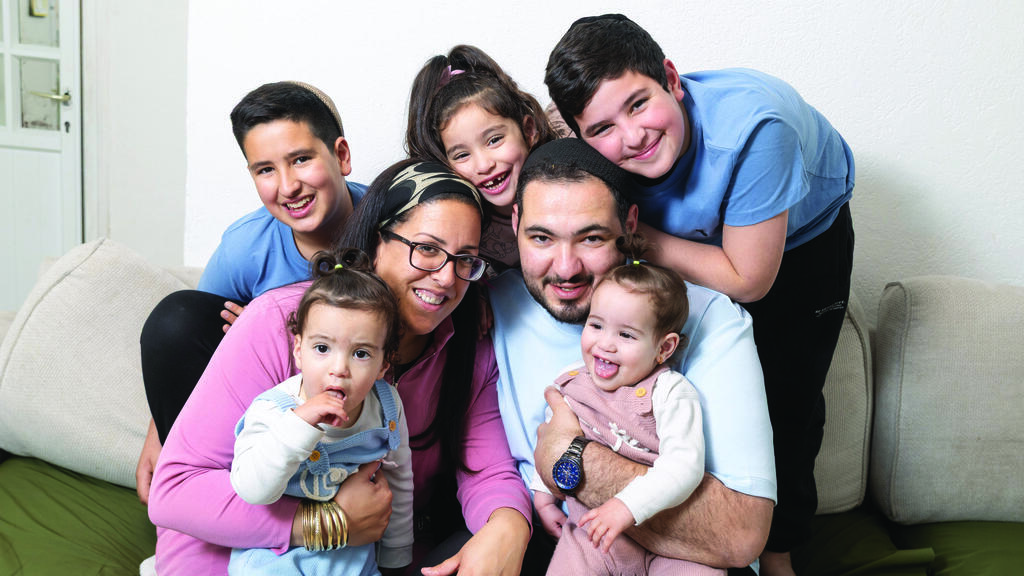
The couple and their five children
(Photo: Alex Kolomoisky)
How did you respond?
“I felt like I froze. I had never even considered us as a couple, and I actually argued with him. We didn’t speak for two weeks. I said, ‘What does this have to do with anything?’ It shocked me, even though he was the person I loved most in the world.
“After two weeks of inner turmoil, my heart felt that it did want this, but I still couldn’t accept the idea. I went to a psychologist and to a rabbi who knew me, until I reached the conclusion that I truly wanted him and that this is what would happen, even if our parents objected.”
Baruch: “I was worried she wouldn’t agree and would be afraid of what people would say. After all, I had been a street kid. I didn’t care what people would say.”
The reactions
Vered: “My mother was in shock. She was angry and said the relationship wouldn’t last and that I was making a terrible mistake. I said I didn’t mind marrying through the Rabbinate quietly and moving to another city so as not to embarrass them. My father, on the other hand, said he was happy for me. Baruch had grown up in our home, so he knew he was a good person. He also said that under no circumstances would I marry quietly — only in the wedding I had dreamed of.”
The wedding
Vered: “Our chuppah (Jewish wedding canopy) was on the beach, just as I had always wanted, and we celebrated in a hall with everyone who mattered to us. We observed shmirat negiah and truly waited for that moment.”
Baruch: “Toward midnight, I told her, ‘You and I are leaving now and leaving the guests behind.’ There’s even a video showing how we ‘ran away’ — we left everyone dancing and went off to be alone together. We walked along the promenade, and all we wanted was to be with each other. That was the beginning of our real life together.”
Love
Baruch: “We have a relationship not many people get to have, because before we are a couple, we are soulmates. We knew each other long before we married, from the deepest places and in the smallest nuances.”
Vered: “We are opposites in almost every way. One reason we overcame the age gap is that I’m quite childlike, and Baruch matured early. He is secular and I am Haredi, which is somewhat challenging, but over time I taught myself that what is mine is mine and what is his is his — I am not his rabbi. We keep a religious lifestyle at home, and the children attend religious Zionist schools.
“Ten years ago, Baruch was diagnosed with severe Crohn’s disease. For three to four years, we lived in chaos — hospitalizations, uncertainty, and financial and emotional strain. During that period, we established our business helping people realize their medical rights.”
Bottom line
Vered: “Baruch is my anchor.”
Baruch: “She’s a friend. That’s what I loved most about her, and still do.”