

Do your children refuse to wear certain clothes and insist on just one shirt — which, inevitably, is sometimes in the laundry — turning every morning into a nightmare? Do they refuse to go to the beach or play in the sandbox because they complain that the sand irritates or scratches them? Do they avoid the arts and crafts corner at preschool and recoil from glue or modeling clay? Do they show signs of discomfort and impatience in crowded places, or find the sound of a hand dryer or vacuum cleaner unbearable?
If you answered yes to at least one of these questions, and until now thought your children were simply spoiled or being difficult on purpose, the explanation may lie somewhere else entirely. That is what Sivan Gal also thought when she could not understand why her daughter Omer, then 3, insisted on fighting every morning over what to wear to preschool.
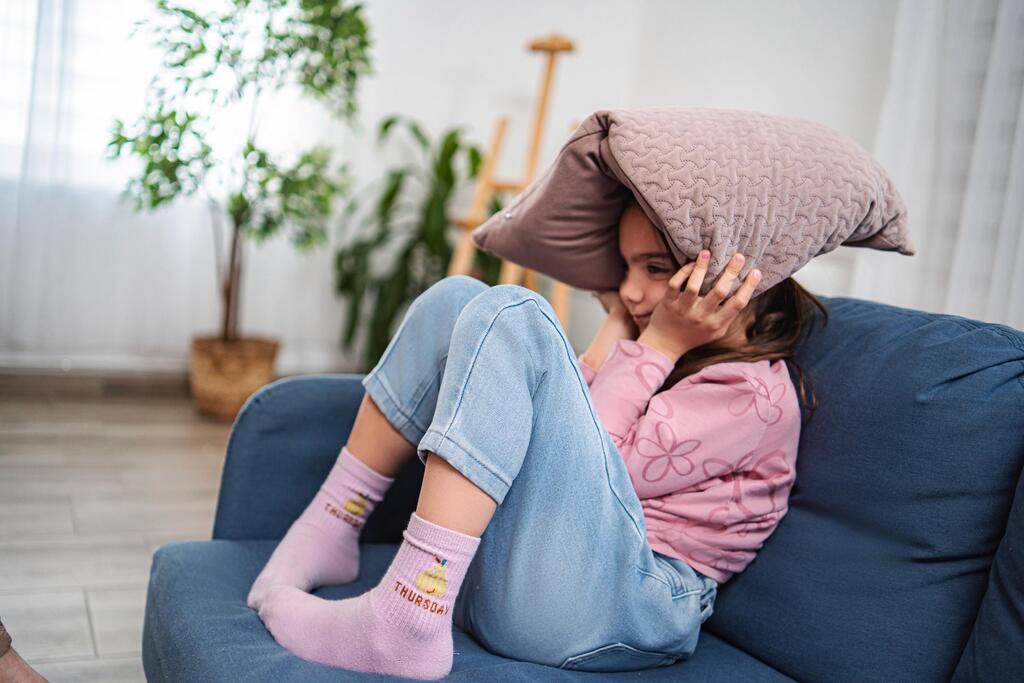
“I let her choose her clothes for preschool in the morning, but the moment she put on a certain shirt or socks — that she had picked herself — she would angrily rip them off,” Gal recalls. “She could not explain what was bothering her, and I thought she was simply being spoiled. After a period of fights like that, we sought parental guidance, and that was where we were introduced to the issue of sensory regulation. Once we had a definition, everything became much easier: We understood what was bothering her.”
You’re right, it bothers you
Gal, from Herzliya and mother to Omer, now 10, and Bar, 6, looked for a book that could help her explain to her daughter what she was feeling. When she could not find one, she decided to write one herself. The book, “Ugh! Too Tight!” illustrated by Shirli Weissman and published by Gam VeGam, tells the story of Rani, who wants to wear her favorite shirt on a camping trip but finds that it feels “too tight.”

Sivan Gal
(Photo: Courtesy)
Many parents complain that their child will wear only one item from an entire closet full of clothes. How do you deal with that?
“First of all, you understand. Omer used to approach everything related to clothing very combatively, and once we understood what was behind it and dialed back the battles, she gradually calmed down too. I realized she needs to feel movement and freedom in her body and finds tight clothes difficult. It is important to acknowledge that and say, ‘You’re right, it really does bother and irritate you.’ A sentence like that helps the child understand that they are not strange or different.
“Once the pressure eased, she was also willing to come to the store and try on clothes. And when she finally finds something comfortable and pleasant, we buy several of the same kind. Also, we buy only seamless socks. Until then, I had never even noticed the seams in socks. Most importantly, once we understood she was not doing it on purpose, the battles stopped. She wants to take her favorite shirt out of the laundry basket? I let it go.”
What else did you notice in Omer’s behavior besides clothing?
“At the beach, for example, she would not sit on the sand. I decided to expose her to it gradually. Every few days we went to the beach, and I let her feel a little more of the sand, using tools or other aids, until she got used to it. She also did not like playing with mud, modeling clay or other materials. She would really cry over it.”
And how does Omer cope today?
“I notice that sometimes she makes social compromises in order to dress according to fashion, or at dance performances when she has to wear something tight, but the rest of the time she wears what is comfortable for her. I have also taught her to come up with creative solutions. For example, if there was a shirt with a print she liked but the print irritated her on the inside, I sewed in a lining to separate the print from her skin. With another shirt she wanted, the sleeves bothered her, so we cut them off and then they no longer pressed against her and she felt comfortable.
“It is important to me to teach her to find creative solutions so she can take part. I also informed the preschool teachers, and if there was an activity with modeling clay, I brought her dough so she could sit with everyone. I want her to understand that she can do anything she wants and that there is always a solution.”
A mistaken interpretation
The book includes professional guidance from educational psychologist Sharon Zuntz, a member of the executive board of the Empathia association for parent therapy.
“Many children struggle with sensory regulation difficulties, which can show up as sensitivity to certain food textures, clothing tags, particular smells, sounds, strong or light touch and more,” Zuntz says. “These are real difficulties that are sometimes mistakenly interpreted by the environment as a behavioral problem. Children have difficulty explaining what they are feeling, so they usually express the difficulty through behavior — by crying, becoming angry and sometimes even avoiding the activity.”
 Sharon Zuntz Photo: Courtesy
What exactly is sensory regulation?
“A difficulty with sensory regulation, or sensory processing, refers to the way the brain receives and interprets external stimuli and responds to them — for example, noise, light, touch, smell and taste — as well as internal stimuli such as balance and the body’s sense of its position in space. For most of us, the brain knows how to filter out unwanted ‘background noise,’ for example, ignoring the sound of an air conditioner or the tag on a shirt. In children with sensory processing difficulties, that filtering system does not work efficiently.
“A sensory regulation problem exists on a spectrum between two extremes. Children with hypersensitivity experience the world too intensely. They may recoil from the feel of sand, water or glue, complain that a certain noise hurts their ears, refuse to wear clothes with irritating seams and be extremely picky eaters because of textures.
“At the other end are children with hyposensitivity, who need very strong stimulation in order to feel. They may seek intense physical contact, speak loudly, constantly touch objects and people around them or bump into them, listen to very loud music or spin around without getting dizzy.
“It is important to understand that these children are not spoiled and are not trying to make things difficult for us. Children with hypersensitivity experience overload, anxiety and helplessness because they cannot switch off these sounds and sensations, even if it is only a hand dryer in a restroom or a crowded line. Children with hyposensitivity, by contrast, feel as though they are living in a fog, and to ‘wake up’ they need behaviors that can sometimes appear too intense or unruly.”

The book cover
(Photo: Courtesy)
Zuntz offers additional examples of behaviors that may indicate difficulty with sensory regulation.
At home: When the morning routine turns into unpleasant battles over brushing teeth, putting on socks or combing hair; when meals become a source of conflict over food smells or textures; when transitions between activities, such as getting into the bath or leaving the house, are accompanied by tantrums.
In educational settings: These environments are naturally noisy and crowded. A child with hypersensitivity may find it difficult to concentrate in class because of other children talking or bright classroom lights and may avoid playing in the yard because of the noise and commotion. A child with hyposensitivity may struggle to sit quietly, touch classmates and disrupt the lesson, behavior that can mistakenly be labeled as an attention problem or a behavioral issue.
How does the environment respond to behaviors caused by sensory regulation difficulties?
“Unfortunately, because this is an ‘invisible disability’ — unlike, say, a cast or wheelchair — people sometimes interpret the behavior incorrectly. Parents may feel that the child is stubborn, manipulative or deliberately provoking them. Educators who have not received appropriate training may label the child ‘disruptive’ or ‘violent’ in cases involving pushing and seeking strong contact, or alternatively as ‘avoidant’ and unwilling to cooperate.
“Other children may distance themselves from the sensitive child who recoils from shared play, or become angry with the child who seeks contact and tends to bump into them or hug too tightly. These reactions can create a sense of social rejection, guilt, low self-esteem and the feeling that something is wrong with the child.”
Zuntz emphasizes that our role as parents is to serve as interpreters and mediators of the world for our children, and she offers several practical tips:
Understanding: The behavior is a symptom of a physiological difficulty, not a discipline problem. When we understand that the child is not “making things bad for us” but rather “feeling bad,” our response can shift from anger to empathy.
Preparing in advance: It is important to prepare the child for noisy events or changes in routine. For example: “Tomorrow we are going somewhere with lots of people and music. If it gets difficult, we can step aside.”
Adapting the environment: Help the child regulate stimuli. For a sensitive child, for example, remove clothing tags, use noise-reducing headphones in crowded places and provide a “quiet corner” at home. For a child who seeks stimulation, allow controlled activities such as jumping on a trampoline, helping carry groceries or doing obstacle courses at home.
Emotional mediation: Put the child’s experience into words. For example: “It really is very crowded and noisy here. Let’s take a deep breath and think about what might help.” When a child feels understood, their nervous system begins to calm down.