


An interministerial report has recommended establishing a national system to respond to marine oil pollution, warning that Israel currently lacks the capacity to deal with a major spill in its territorial waters.
The proposed system would cost about NIS 40 million to establish and require an annual operating budget of roughly NIS 37 million. The report recommends funding it through fees imposed on oil tankers unloading crude at Israeli ports.
Gallery
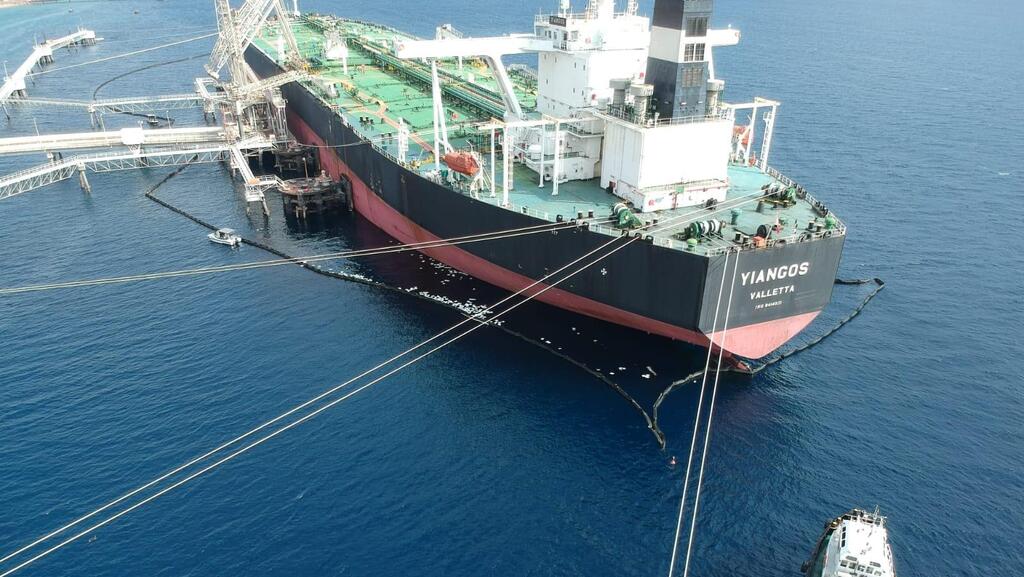
A localized fuel leak from a tanker in the Gulf of Eilat, November 2022
(Photo: Sagi Markman)
Its authors estimate that the impact of the fees on the economy and the cost of living would be negligible.
The proposed system is intended to give Israel the ability to respond to large-scale oil spills, an area in which the country currently lacks a complete national capability.
According to the report, Israel’s existing response capacity covers only about 30% of what would be required in a significant spill in territorial waters. In a deep-sea incident, that capacity falls to roughly 10%.
Major gaps in national preparedness
The report was prepared against the backdrop of the continuing dispute over the activities of the Eilat Ashkelon Pipeline Company, known as EAPC, and the possible expansion of oil transport through the Gulf of Eilat.
After the government canceled its “zero additional risk” policy for the Gulf of Eilat in 2024, EAPC challenged restrictions imposed on its Ashkelon terminal. The state then referred the issue to an interministerial team charged with developing a broader regulatory framework.
EAPC is a government company that transports, conveys and stores crude oil and fuel products. For years, it has stood at the center of public controversy over the environmental risks associated with its operations.
In 2014, the company was responsible for one of Israel’s worst environmental disasters, when millions of liters of crude oil leaked from one of its pipelines into the Evrona Nature Reserve, damaging an ecologically sensitive area.
The report stresses, however, that the need for a national response system extends beyond EAPC.
It presents a broader picture in which the state lacks sufficient equipment and operational capacity to handle a major marine pollution event.
Damage could reach NIS 122 billion
The report examined a scenario involving a spill of up to 4,000 tons of oil and warned of severe economic and environmental consequences.
In a major incident in the Mediterranean, the cost to the Israeli economy could reach as much as NIS 122 billion, partly because of potential damage to desalination plants and power stations along the coast.
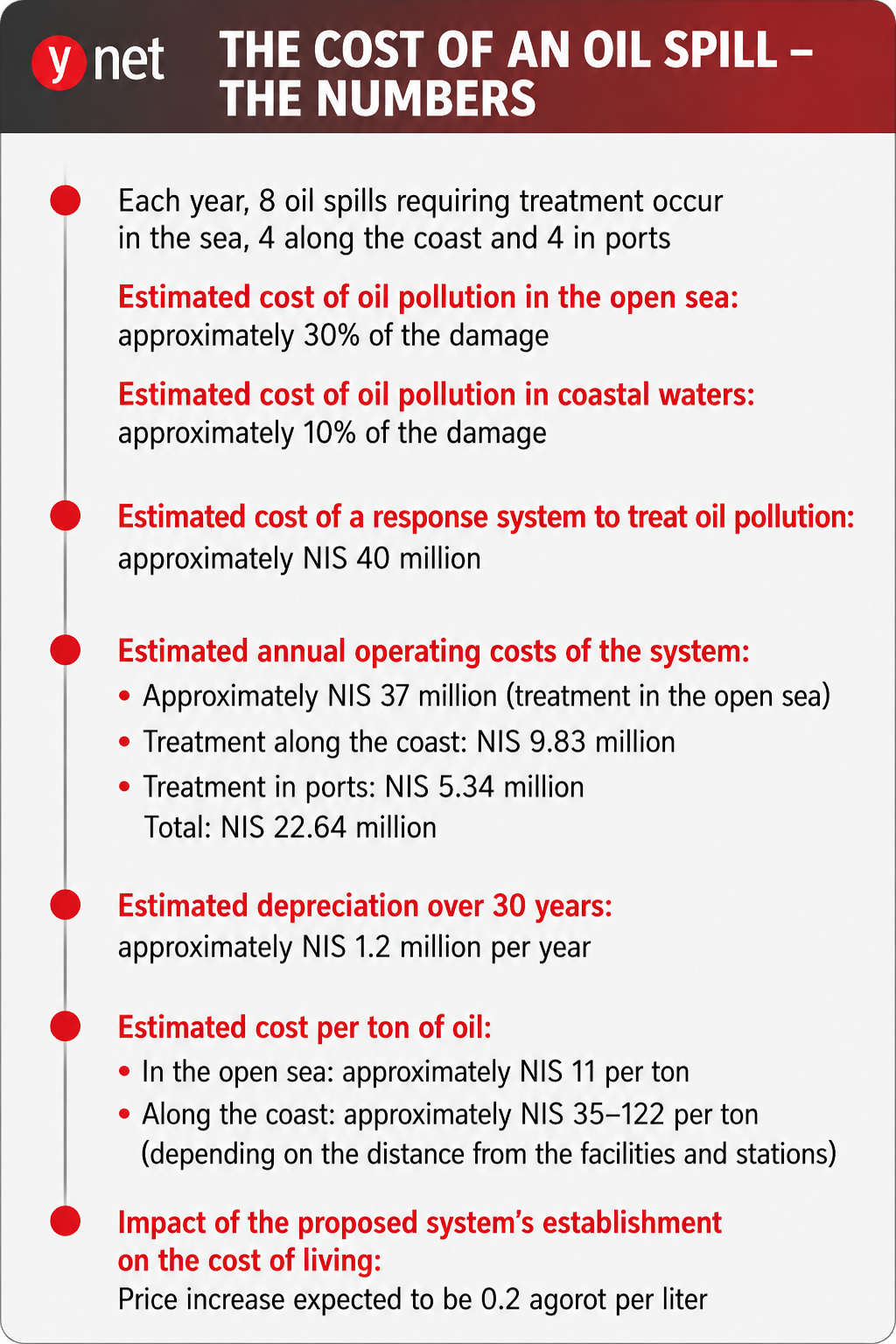
In the Gulf of Eilat, an area of exceptional ecological sensitivity and international importance, the potential damage was estimated at up to NIS 11 billion.
Under the team’s recommendations, the new national system would include six marine response units, four in the Mediterranean and two in the Red Sea to protect the Gulf of Eilat.
The units would operate vessels equipped to pump and collect oil, along with equipment for deploying floating containment booms.
A land-based and logistical system would also be established to handle waste reaching the shoreline and to manage emergency operations.
Who should pay?
The report also examined extreme scenarios, including the complete loss of an oil cargo from a vessel.
According to the document, EAPC opposed a requirement that it prepare independently for such a scenario, arguing that doing so would require extensive investment and impose substantial costs.
One of the central issues considered by the team was financing.
After reviewing models used in the United States, Britain and Australia, the team recommended charging tankers according to the amount of oil they unload at Israeli ports.
The report also calls for examining a differential arrangement, meaning a reduced fee for oil transported in transit, a central part of EAPC’s business.
The aim would be to avoid creating an unjustified regulatory advantage or disadvantage for any particular operator.
According to the report, the total burden imposed by the fee would amount to less than 0.1% of the annual value of fuel products leaving Israel’s refineries, estimated at roughly NIS 35 billion.
“The impact of the fee on the economy and the cost of living is expected to be negligible,” the report states.
‘The polluter pays’
The report emphasizes that establishing a national system would not absolve companies involved in transporting and storing oil of their responsibility to prepare for and prevent pollution incidents within their areas of operation.
The national system would be intended to respond only when an incident exceeds the capabilities of the companies involved and local authorities, in line with the “polluter pays” principle.
Until the system is established, the team recommends a transition period during which the Environmental Protection Ministry could require companies seeking to expand oil-transport operations to close preparedness gaps in proportion to the scale of their activity.
Although EAPC is not named explicitly, the recommendation could have significant implications for the company as it seeks to expand its oil-transport operations.
The document, signed by Amir Barkan, deputy director-general for economics and infrastructure at the Prime Minister’s Office, stresses that this would be a temporary arrangement until the national system is fully established.
Possible boost for EAPC’s regional plans
The report comes at a potentially advantageous time for EAPC, which has been working for years to promote an oil route that would bypass the Strait of Hormuz and the Bab el-Mandeb Strait.
The original proposal, developed by the company in 2017, envisioned connecting the Saudi port city of Yanbu to Eilat through a roughly 700-kilometer pipeline crossing Jordan.
From Eilat, the oil would be transferred through the Eilat-Ashkelon pipeline and then shipped from the Mediterranean to European markets.
Saudi Arabia already sends oil from the Persian Gulf to Yanbu through an existing bypass route.
The report could help advance that plan. It is not entirely favorable to EAPC because it assigns the company responsibility during the transition period, but it is arguably the best framework currently available to it.
EAPC: Responsibility lies with the state
EAPC welcomed the report and said it supported the interministerial team’s professional conclusions.
“The conclusions establish unequivocally that responsibility for territorial waters and preparedness for an extreme scenario lies with the state and not with the company, contrary to the position of the Environmental Protection Ministry,” EAPC said.
The company described itself as a national energy infrastructure operator working in accordance with the law and under the ongoing supervision of all relevant regulators.
“EAPC is prepared for any incident within its facilities and areas of responsibility, and continuously invests in safety, environmental protection, infrastructure maintenance and emergency preparedness,” the company said.
“We are studying the report and will provide our full response as part of our official submission.”