


One is familiar to virtually every diver in Israel. The other has been present for about 25 years but has barely been documented. Now, a new project is setting out to map sightings of two Red Sea fish species that have established themselves along Israel’s Mediterranean coast: the lionfish Pterois miles and the parrotfish Scarus ghobban.
Both species reached the Mediterranean from the Red Sea, and anyone who has dived or snorkeled in the Gulf of Eilat is likely to have encountered at least one of them. On the coral reef, they are protected native species that play important ecological roles, one as a predator and the other as an algae grazer. In the Mediterranean, however, both are invasive.
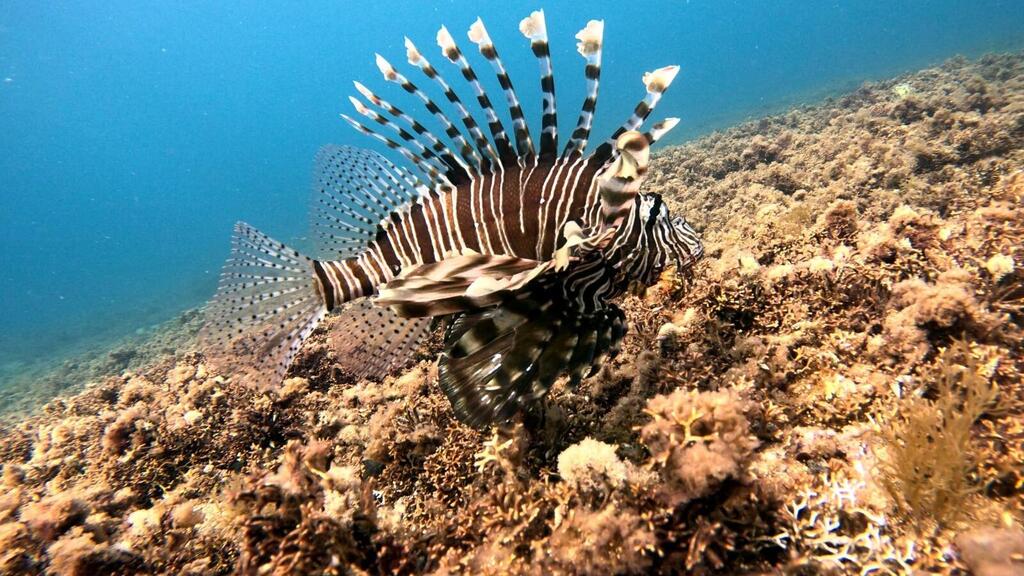
The Society for the Protection of Nature in Israel, which launched the project together with researchers from Israel Oceanographic and Limnological Research, is asking the public to report sightings through its SeaWatch app.
A voracious predator with few natural enemies
The lionfish is a voracious predator that feeds on fish and crustaceans and has almost no natural enemies in the Mediterranean. It also reproduces rapidly, with a single female capable of laying as many as 2 million eggs a year.
The species was first documented in Israel’s Mediterranean waters in 1991, but reports across the eastern Mediterranean began accumulating only from 2012. Its numbers have risen rapidly since then.
Today, lionfish can be seen almost everywhere along Israel’s Mediterranean coast. Because the species is spreading quickly, however, researchers say real-time reports remain important.
The parrotfish, by contrast, is herbivorous, feeding by scraping algae from rocks. On coral reefs it is among the species that help regulate algae cover, a food source already under intense competition in the Mediterranean following earlier invasions, particularly by rabbitfish.
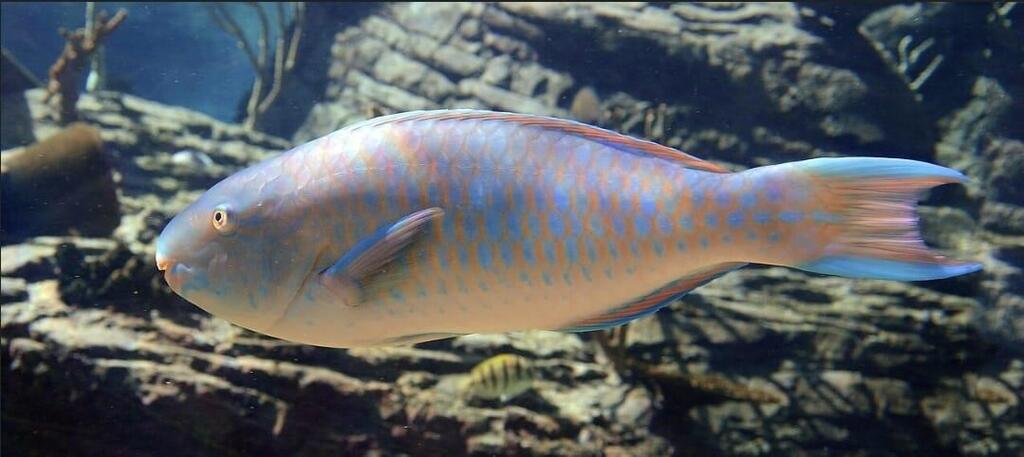
Blue-barred parrotfish
(Photo: Amada44)
The species was first recorded in the Mediterranean off Israel in 2001, when one was caught near Shikmona, south of Haifa. Since then, the number of documented sightings along Israel’s coast has remained low, leaving researchers without a clear picture of its distribution or the habitats and depths in which it is found.
‘The ecological community has changed dramatically’
Numerous other fish and marine species have already invaded the Mediterranean, including toxic pufferfish, sea urchins and a species commonly known as the false red mullet, which was first documented in Haifa Bay in 2006.
Hundreds of invasive species are now found along Israel’s Mediterranean coast, although not all have succeeded in establishing stable populations.
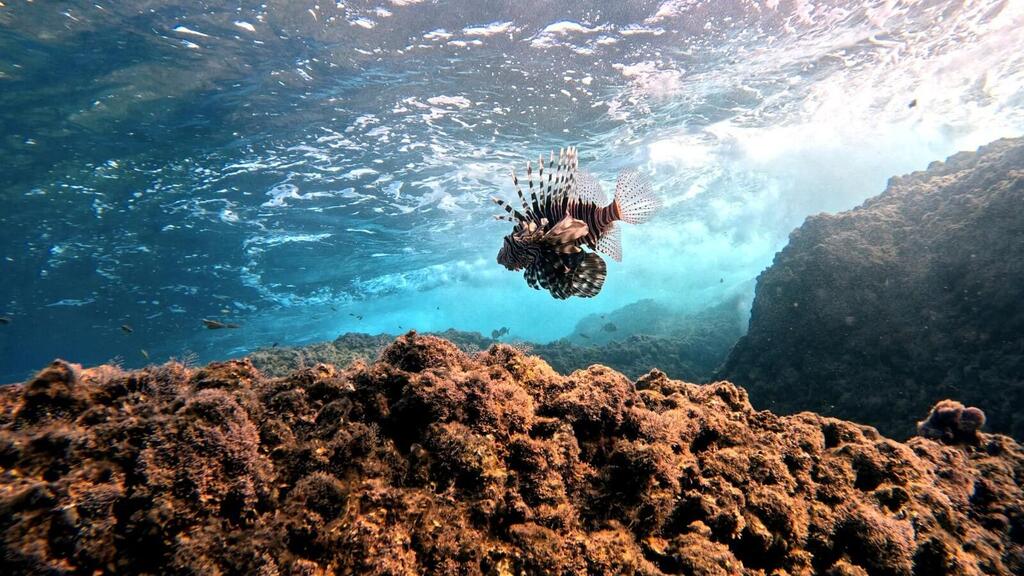
(Photo: Alex Greizner (Alex IFreedive))
“The ecological community on the rocky reefs along Israel’s coast has changed dramatically in recent decades,” said Prof. Gil Rilov of Israel Oceanographic and Limnological Research, who studies rocky reefs in the eastern Mediterranean.
“Forests of native algae are disappearing, many native species have become much rarer, and there is a constant influx of invasive tropical species arriving from the Red Sea, some of which now dominate large parts of the ecosystem.”
Understanding that transformation, Rilov said, requires information about species occupying different parts of the food web, from predators to herbivores.
“The lionfish is found almost everywhere along the coast, but not uniformly, and we haven’t examined the reasons for that,” he said. “The parrotfish is a different story. It appears that its prevalence jumped over the past year, but that has not yet been documented quantitatively, and without data we can’t know whether something is really changing.”
Turning divers into a real-time monitoring network
Bar Sternbach, SeaWatch coordinator and marine projects coordinator at the Society for the Protection of Nature in Israel, said both species were first documented in the Mediterranean around Haifa, and in both cases the information came from members of the public rather than scientific surveys.
“People who are in the sea notice unusual things before anyone else,” he said. “The difference today is that there is an app that transfers the information to researchers in real time.”
“We are asking everyone who is in the sea or on the shore to report every sighting of either of these fish. It is important to attach a photograph so the sighting can be verified, because only reports like these will be used for the mapping.”
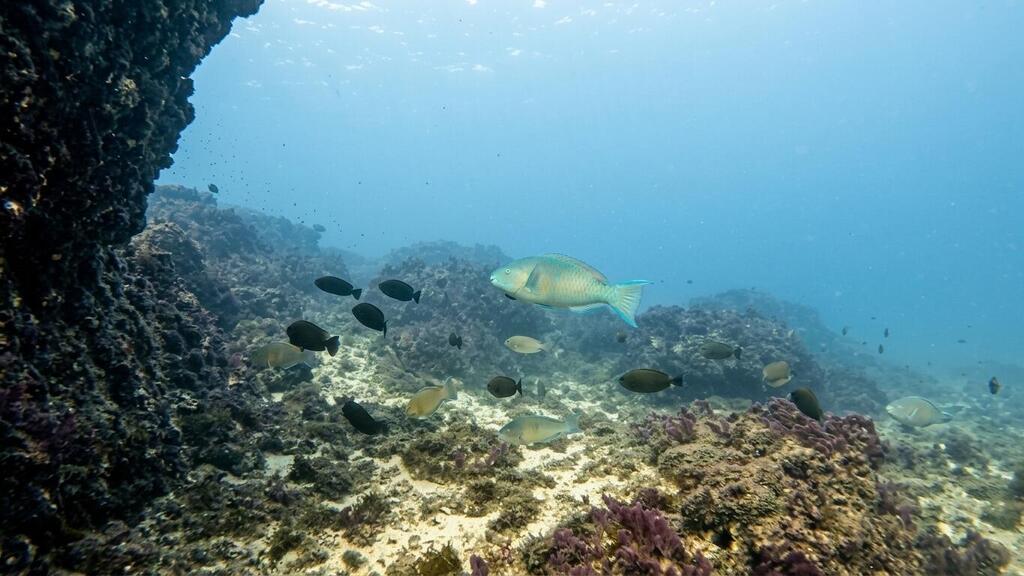
(Photo: Alex Greizner (Alex IFreedive))
Reports are valuable even when the fish is dead or the location has already produced previous sightings, Sternbach added.
“Even a dead specimen washed onto the shore is worth reporting, and so is a sighting at a site that has already been reported, because without repeated reports we cannot know whether the frequency is changing.”
Rilov said the lionfish presents a particularly difficult challenge.
“The lionfish is a highly successful and venomous predator, and it has also caused damage in the Caribbean,” he said. “We won’t be able to get rid of it.”
His research also focuses on the disappearance of native Mediterranean species, a process he said is driven primarily by warming sea temperatures.
“Today, dozens of species have disappeared, including shellfish, clams and snails such as the red-mouthed rock shell, while at the same time many tropical species have entered from the Red Sea,” Rilov said.
“We expect that species that are still here will also begin to disappear, and tropical species that have invaded will replace them. We need to learn which invasive species are problematic and how to deal with them.”