


A new agricultural pilot in northern Israel is trying to revive local sesame production and reduce the country’s near-total dependence on imports, which currently account for almost all sesame consumed domestically.
Some 140 dunams, or about 35 acres, of a new Israeli sesame variety called Mika have recently been planted in the Hula Valley. Developed at the Hebrew University of Jerusalem, the variety is designed for mechanical harvesting by combine, eliminating the need for labor-intensive hand collection.
The first harvest is expected in October.
If successful, the project could turn difficult peat soils in the Hula Valley into a source of locally grown sesame for Israel’s tahini and oil industries. The long-term target is to produce about 15% of the sesame consumed in Israel.
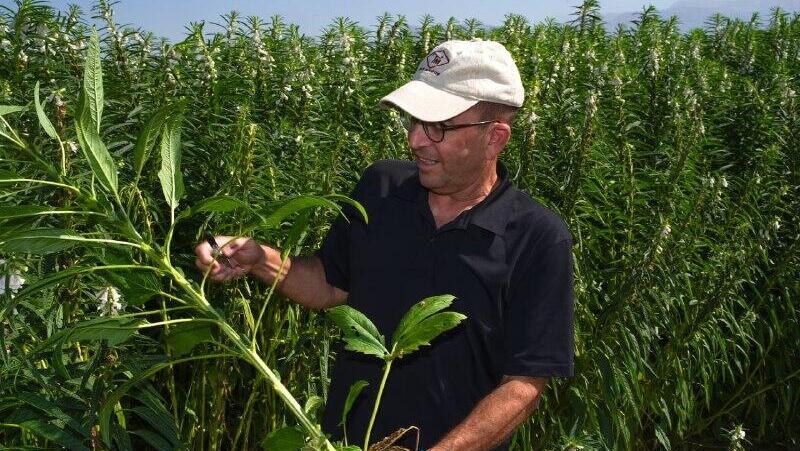
At Kibbutz Shamir, on the edge of the valley’s peatlands, farm manager Zamir Carmi is watching the new crop closely.
“It looks very good,” he said. “This crop could fit into our crop rotation and even improve the soil in terms of disease and other factors.”
The Hula Valley’s peat soil has long posed both agricultural and environmental problems. After Lake Hula was drained, the exposed organic soil began decomposing rapidly, creating dust that spreads through the valley.
Farmers must also keep the land continuously moist, even when nothing is growing on it, to prevent underground fires. That requires large amounts of water, much of it subsidized by the state.
Sesame, with its strong root system capable of penetrating hard soil, could offer one possible solution for these difficult plots.
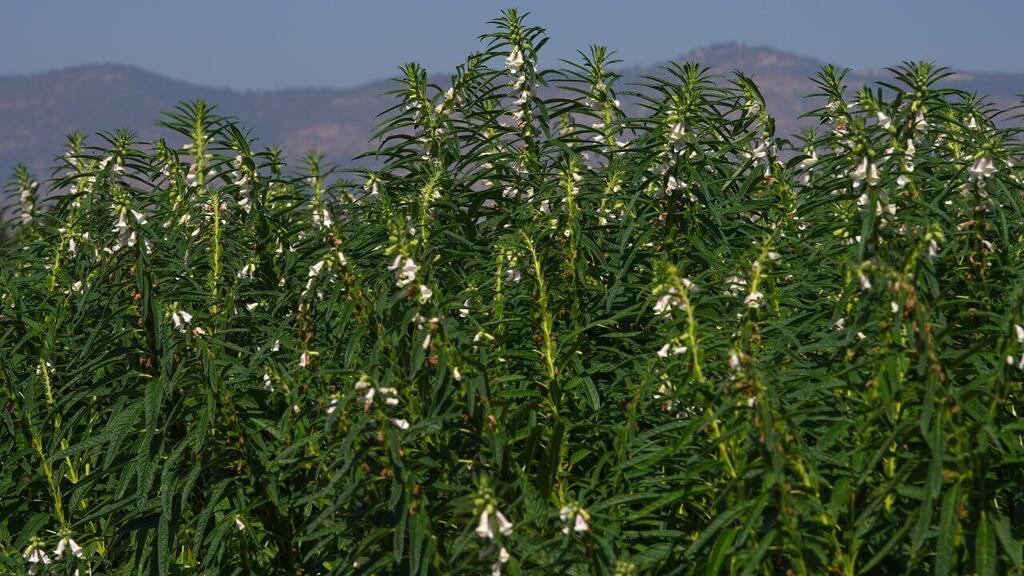
Sesame field in the Hula Valley
(Photo: Efi Sharir)
The current pilot is being led by Masik Kibbutz Magal and Maxom together with Kibbutz Shamir, and is based on work by Prof. Zvi Peleg and agronomist Assaf Avnery of the Hebrew University’s Faculty of Agriculture.
Unlike much of the world’s sesame crop, which is still harvested manually in a labor-intensive process, the Israeli variety was bred to be collected by large combines.
Mika, named after Avnery’s daughter, is intended to make commercial-scale sesame production economically viable in Israel.
Sesame is a major part of the Israeli diet. The seeds are used on breads and pastries, processed into halva and, most prominently, ground into tahini.
Despite that demand, Israel imports more than 99% of the sesame it consumes, around 80,000 tons a year, from countries including Ethiopia, Sudan, Turkey and Argentina.
Oren Hechter, CEO of Masik Magal and Sesame Israel, said that dependence leaves the country vulnerable to disruptions in global supply chains.
(Photo: Efi Sharir)
“Israel is the world’s second-largest consumer of sesame per capita after China, but more than 99% of the sesame consumed here is imported,” he said.
“The complete dependence on imports can create supply-chain difficulties, as we are seeing now because of the war with Iran, when Oman closed its ports to the movement of goods. Our goal is to reach production equal to 15% of domestic consumption.”
For farmers, the issue is not only food security but economic survival.
Carmi said the decision to plant sesame came only after careful examination of whether the crop could be financially viable.
“We planted 140 dunams this year to test the economics, and so far it looks excellent,” he said. “We will continue and expand the planting.”
The local crop may also appeal to tahini lovers for another reason: its nutritional profile.
According to figures provided by the project, imported tahini contains about 6.7 milligrams of iron per 100 grams, while the Israeli sesame seeds were measured at 58.6 milligrams.
The flavor is also somewhat different. The Israeli variety is described as sweeter and capable of producing a thicker tahini than conventional imported sesame.
For now, the coming October harvest will provide the first major test of whether sesame can once again become a meaningful Israeli crop.