

While the Eurasian griffon vulture is relatively common in parts of the world, including Western Europe, Israel’s population is critically endangered, numbering only around 200 birds, according to conservation experts.
Ahead of International Vulture Awareness Day, Prof. Or Spiegel of Tel Aviv University’s School of Zoology spoke about efforts to protect the species and how satellite tracking is helping researchers monitor their movements.
A griffon vulture chick


“The griffon vulture is one of Israel’s largest birds of prey, with a wingspan of nearly three meters,” Spiegel said. “It is adapted to soar over vast distances and feed on livestock carcasses, which it locates using exceptionally sharp vision. Its role in the ecosystem is critical, cleaning up carcasses and preventing the spread of disease.”
Vultures are social animals, roosting together and sharing information about food sources. “Thanks to this social behavior, griffon vultures quickly gather around a carcass and usually consume it within hours to a few days,” Spiegel said.
Spiegel cited India as an example of their ecological importance. Veterinary drugs used to treat cattle killed vultures, leaving carcasses unattended. The resulting rise in stray dogs and rabies outbreaks led to approximately 20,000 human deaths annually. “It’s a sobering example of the services vultures provide and the consequences when they disappear,” he said.
Behavior and habitat
Griffon vultures can travel tens of kilometers without flapping, using air currents to soar efficiently. Some journeys exceed 1,000 kilometers, researchers say. Unlike other predators, they rely almost entirely on carcasses. “They are ‘lazy predators’ in that sense,” Spiegel said. Misconceptions persist when farmers see vultures feeding on livestock and assume the birds killed the animals.
In Israel, griffon vultures are mainly found in the Judean Desert, the Negev, and a small population in the Carmel region. Once widespread in the Golan Heights, their numbers have dwindled, and they are nearly absent in the Galilee. Globally, they range from Southern Europe through the Middle East to India and North Africa.
Threats to survival
Poisoning is the primary threat, often from shepherds attempting to protect livestock or harm competitors’ herds. “Vultures usually arrive first at carcasses and are killed in large numbers,” Spiegel said. Other threats include electrocution from power lines, disturbances to nesting sites, and veterinary drug poisoning.
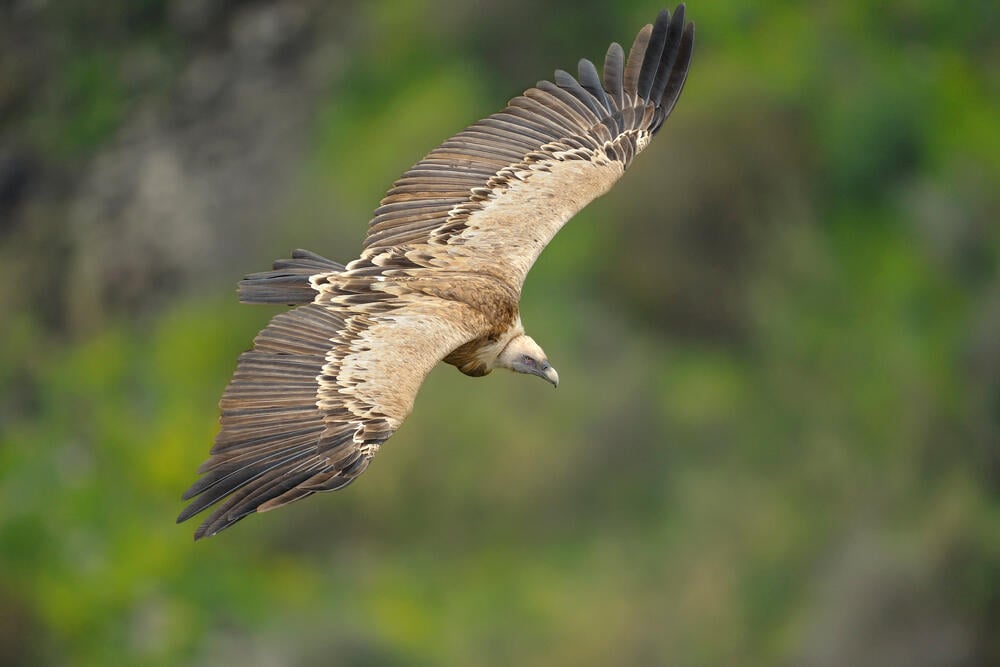
(Photo: Vladimir Kogan Michael/Shutterstock)
Historically, griffon vultures fed on wild animals, but human activity has shifted their diet to domestic livestock. Today, most livestock is kept in barns or enclosures, and vultures increasingly rely on artificial feeding stations that provide safe carcasses.
Climate change and conservation efforts
Research indicates short-term benefits from droughts, which temporarily increase food availability. However, long-term reductions in prey populations and rising temperatures threaten nesting and survival.
The Israel Nature and Parks Authority operates a comprehensive conservation program led by avian ecologist Ohad Hatzofe, including feeding stations, breeding centers, wildlife hospitals, and, until the COVID-19 pandemic, the importation of vultures from abroad. Satellite tracking has revealed that young griffon vultures travel across the Middle East and Africa before returning to Israel, helping connect regional populations. Researchers also monitor how behavior changes with age to understand population declines caused by poisoning and early mortality.
Spiegel urged the public to report injured vultures, avoid using poisons, and protect open natural areas.
The Eurasian griffon vulture, a symbol of strength and freedom, continues to rely on conservation efforts to survive and maintain its essential ecological role in Israel.
This article was produced by Zavit, the news agency of the Israeli Society of Ecology and Environmental Sciences.