

Researchers from the University of Haifa have uncovered a Hellenistic-era lead sling bullet at the ancient city of Hippos near the Sea of Galilee bearing a Greek inscription never before documented on such a projectile: “Learn.”
The find, discovered during archaeological excavations at Hippos in the Sussita Nature Reserve, dates to the second century B.C. and was recently detailed in the journal Palestine Exploration Quarterly, or PEQ, in a study by Dr. Michael Eisenberg and Dr. Arleta Kowalewska of the University of Haifa, together with Prof. Gregor Staab of the University of Cologne, Germany.
Gallery
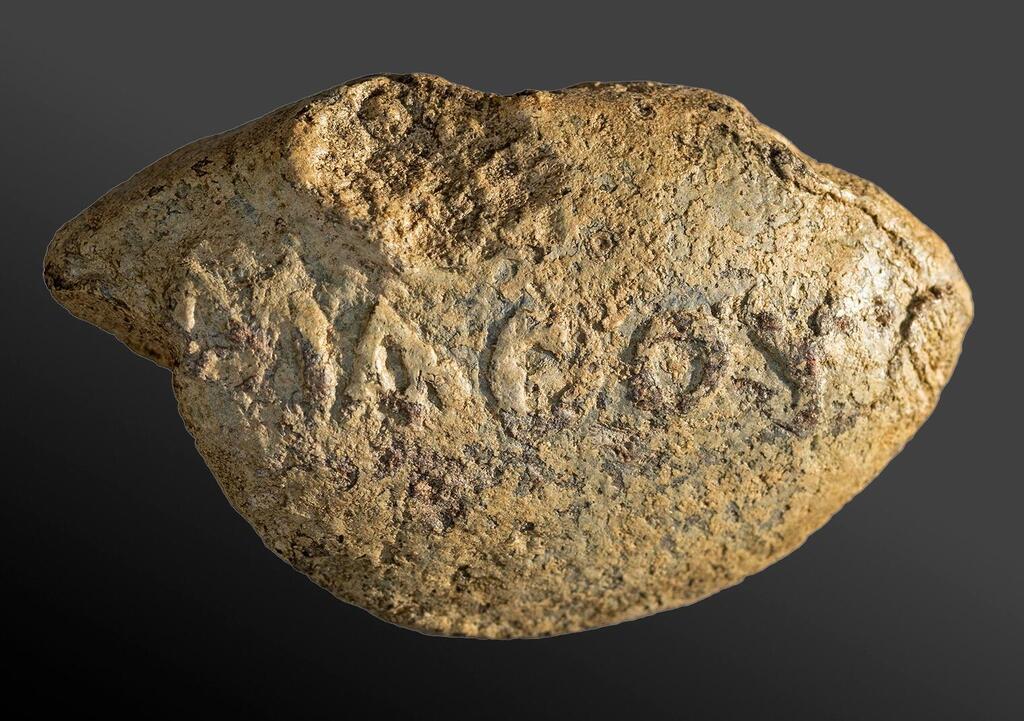
The sling bullet bearing the Greek inscription 'Learn'
(Photo: Dr. Michael Eisenberg/University of Haifa)
Eisenberg and Kowalewska have directed the Hippos excavations for years on behalf of the Zinman Institute of Archaeology. Staab serves as the expedition’s epigraphist.
“Sling lead bullets of this type are well known in archaeological research from many sites dating to the Hellenistic period, particularly from the second century B.C.,” Eisenberg said. “At Hippos alone, 69 such projectiles have been identified so far, but this is the first in the world to bear the inscription ‘Learn.’”
He said the inscription appears to reflect local sarcastic humor by the city’s defenders. “They wished to teach their enemies a lesson with a wink — ‘Learn your lesson!’” Eisenberg said.
The ellipsoidal sling bullet measures 3.2 centimeters by 1.95 centimeters and weighs 38 grams. One side bears signs of a strong impact that broke off part of the object, suggesting it originally weighed about 45 grams.
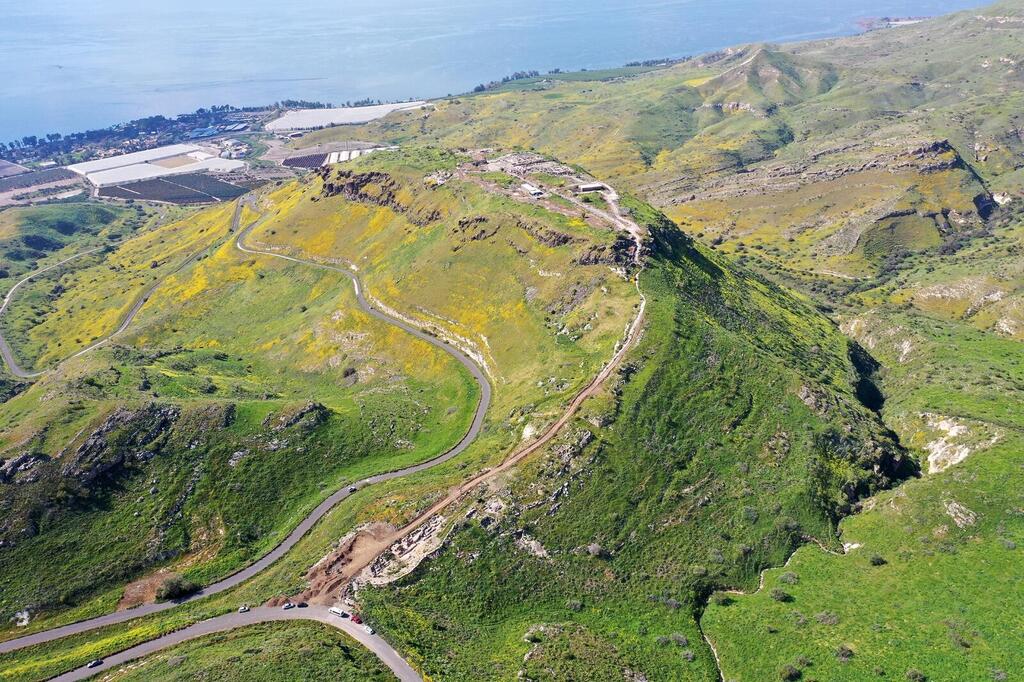
Hippos with the Sea of Galilee in the background – aerial view
(Photo: Dr. Michael Eisenberg/University of Haifa)
Researchers said sling bullets were made by pouring molten lead into stone molds in a relatively simple process that could be carried out even during a military campaign.
The projectile was found south of Hippos in the necropolis area near an ancient road. Researchers believe it was likely part of the ammunition fired by the city’s defenders from the walls at an enemy force advancing to besiege the city, at a distance of about 260 meters.
Lead projectiles were among the cheapest but most effective forms of ammunition in the ancient world, the researchers said. A skilled slinger could hit an enemy from more than 300 meters away.
Many such projectiles were inscribed with the name of a military commander or a city, or with taunting phrases such as “Catch!” Others carried symbols believed to give them power, including a trident, lightning bolt or scorpion.