

On the steep cliffs and along the promenade overlooking Ramon Crater, the noble figure of the Nubian ibex has become an inseparable part of Israel’s desert landscape. But behind the spectacular appearance is an endangered animal facing complex survival challenges in the heart of a fragile ecosystem.
To better understand the world of the Nubian ibex, we spoke with Dr. Jonathan Tichon, an ibex researcher from the laboratory of Dr. Shirli Bar-David and Prof. David Saltz in the Mitrani Department of Desert Ecology at Ben-Gurion University of the Negev.
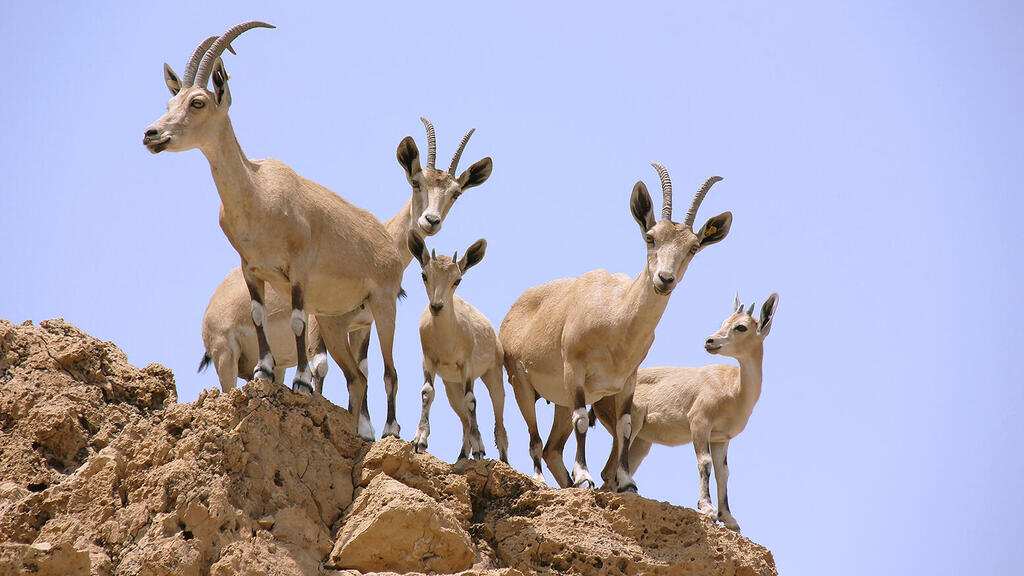
In the Israeli desert, the Nubian ibex is a star. Are there Nubian ibexes elsewhere in the world?
“The species’ range is limited to the deserts of the Middle East and northeast Africa, including countries such as Jordan, Egypt, Saudi Arabia, Oman, Sudan and Yemen. In Israel, there are three core populations of Nubian ibex: one in the Judean Desert, which is considered the largest population in the world, and two additional populations in the Negev Highlands and the Eilat Mountains.
“There is also a fourth, smaller population in the Golan Heights, which resulted from the release of individuals in 1970 outside the species’ historical range. Although the ibexes may seem common, the species’ global status, as determined by the IUCN, is defined as vulnerable. It is estimated that there are fewer than 5,000 mature individuals in the wild worldwide, and their population is declining.”
What makes the ibex so unique compared with other desert animals?
“The ibexes’ most impressive ability is walking on almost vertical walls and jumping between tiny rock ledges. To an observer, it sometimes looks as though they are not bound by gravity. In addition, the ibex is the ‘king of the cliffs’ in an ecological sense as well. There is no other herbivore of its size that fills this niche on the cliff itself. In other words, while gazelles or wild asses inhabit the plains below the cliff, ibexes are the dominant presence on the rocks, as documented as far back as the Bible: ‘The high mountains are for the wild goats’ in Psalms 104.”
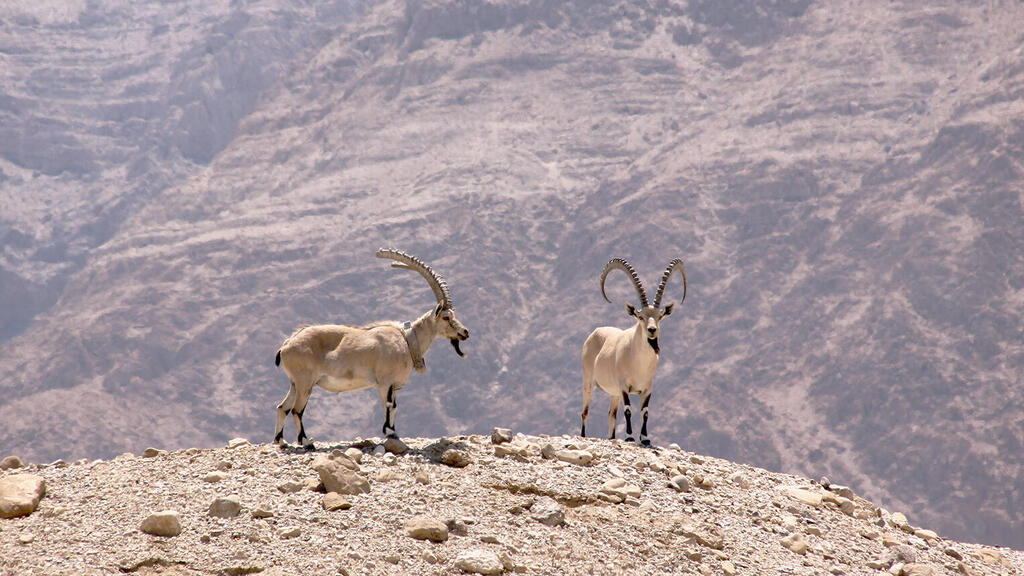
(Photo: Dr. Jonathan Tichon)
“Another fascinating characteristic is the drastic physical difference between the rutting season in the fall and the rest of the year. During the rut, the males grow significantly. Their muscle and fat mass increase, and the circumference of their neck expands by more than a third. Their beige coat becomes shiny, and bright black patches appear on the chest and face.
“During this period, the males embark on long-distance journeys between groups of females in search of fertile females. For example, an adult male we named Ben-Gurion, which is fitted with a tracking collar, was documented during the 2017 rutting season traveling all the way from Nahal Og to Masada and back, a distance of 50 kilometers, or 31 miles, as the crow flies in each direction.”
“Another fascinating behavior is that although group living is generally considered an especially effective defense mechanism against predators, when female ibexes are close to giving birth, they climb alone or accompanied by another female to isolated, high points on the cliffs. There, they give birth and stay with the kids for one to two weeks before returning to the herd.”
How do ibexes manage to survive in the desert?
“Although they are specialists in life in an extreme desert, ibexes must drink water every few days. In a study we published in 2024, we found that in the summer they must drink once every day and a half on average. That is a significant weak point for them. They are highly sensitive to the loss of drinking sources, whether because of climate change or human activity.”
“The relatively large number of ibexes seen on the promenades in Ein Gedi or Mitzpe Ramon does not reflect the reality of the species as a whole. In practice, we do not have precise information on the number of ibexes in Israel, and the official counts miss a large portion of the population.
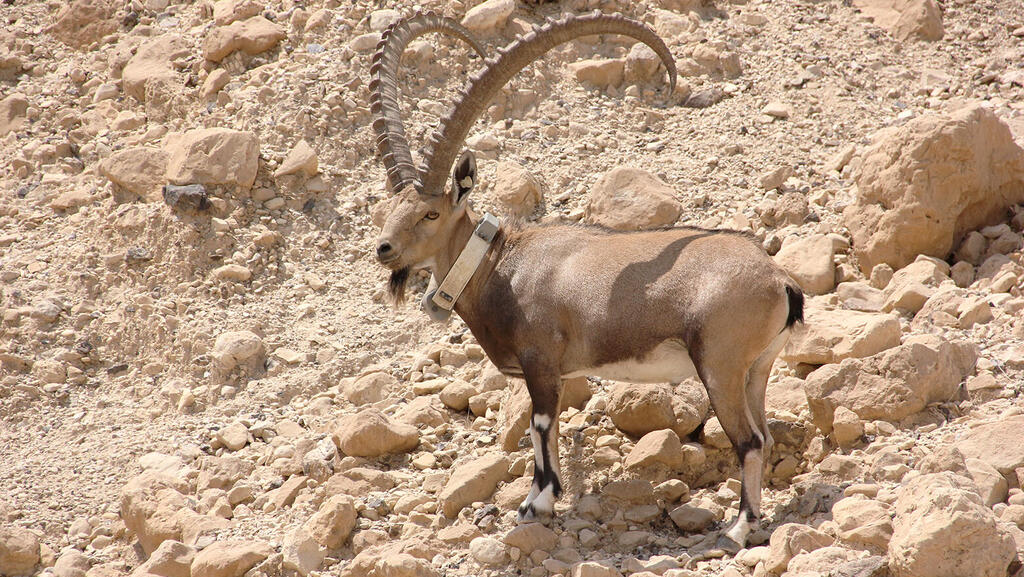
A Nubian ibex with a GPS tracker
(Photo: Dr. Jonathan Tichon)
“In a study we published in 2022, we showed that the counts in the Judean Desert from 2017 to 2019 missed about two-thirds of the population, which means that on the basis of those annual counts, we have no way of knowing with certainty whether the population is stable or declining.”
What are the main threats currently putting ibexes in danger?
“The main threats are roadkill, illegal hunting in the Judean Desert and the Negev, habitat loss due to the construction of hotels and tourism complexes, the conversion of natural areas to agriculture, and the loss of their water sources.”
“In addition, there is a disease caused by a certain species of tapeworm, Taenia multiceps, which causes significant mortality among ibexes. This worm creates a cyst in the ibex’s brain and causes behavioral changes that can lead to death from falling off cliffs, or to collapse and an inability to move.
“In its life cycle, the worm is transmitted to ibexes, as well as to gazelles and oryxes, through infected feces of canids such as wolves, jackals or stray dogs that defecate on vegetation or near water sources. That is how the ibexes become infected.”
“Another threat is proximity to humans. Ibexes that become accustomed to people eat, among other things, plastic bags that fill their rumen and cause starvation and death. They are also more exposed to being run over and to dog attacks inside communities.”
How is the climate crisis affecting the ibex’s survival?
“The climate crisis is reducing natural water sources, and without water, there are no ibexes. In drought years, there is less food on the cliffs, causing ibexes to rely more on the green vegetation that grows along roadsides. As a result, the number of ibexes killed by vehicles rises significantly in drought years. As the frequency of droughts increases, this will have a direct effect on the demographics of ibex populations.”
What have you recently discovered about the Nubian ibex?
“The most surprising discovery was that ibexes cross roads by crawling through incredibly narrow and long drainage passages. In one case, we documented ibexes regularly entering a dark pipe 51 meters long, or about 167 feet, with a diameter that narrows to half a meter, and simply crawling inside to reach the other side of the road.
“This shows just how adaptable they are, and also how important it is to preserve their living spaces and connectivity between habitats, including by adding underpasses beneath main roads.”
What can the public do to help ibexes?
“The most important thing is not to feed them under any circumstances, even if they look cute or hungry. Feeding causes them to become accustomed to humans and lose critical survival behaviors. It is also important to regularly deworm dogs that live near ibexes to prevent the spread of tapeworms.
“In addition, drivers should slow down in cliff areas, and if you hear gunfire coming from a cliff in nature, report it immediately to the Israel Nature and Parks Authority. When you see an ibex in the wild, enjoy it from a distance and do not try to get close for a selfie.”