


Two vultures captured as part of an Israel Nature and Parks Authority monitoring program were released this week in the Lower Galilee equipped with new GPS transmitters. Shortly after their release, the devices provided intriguing information about their movements: One flew toward Mount Carmel while the other made its way to Gamla Nature Reserve in the Golan Heights.
The Israel Nature and Parks Authority believes the younger of the two may be one of the chicks that hatched and fledged in the natural vulture colony on Mount Carmel. In addition to being fitted with transmitters, both vultures received identification tags and had blood samples taken for research and monitoring.
Vultures released in the Galilee
(Credit: Meital Mesica, Israel Nature and Parks Authority)


Dr. Ohad Hatzofe, a wildlife ecologist with the Israel Nature and Parks Authority, said the vultures were captured as part of a nationwide monitoring operation at one of the acclimation facilities operated by the authority.
"Some of the vultures we capture have already been tagged, so we know at least part of their history. Some were born in the captive breeding program and later released into the wild," Hatzofe said. "The younger bird had no previous markings, so we had no prior information about its history or health. This capture is effectively our first encounter with it."
Ahead of their release, blood samples were taken from the vultures for research and monitoring and they were fitted with GPS transmitters that allow researchers to continuously track their flight paths. The samples enable researchers to test, among other things, for pathogens and heavy metals that could affect the vultures' health.
Gallery
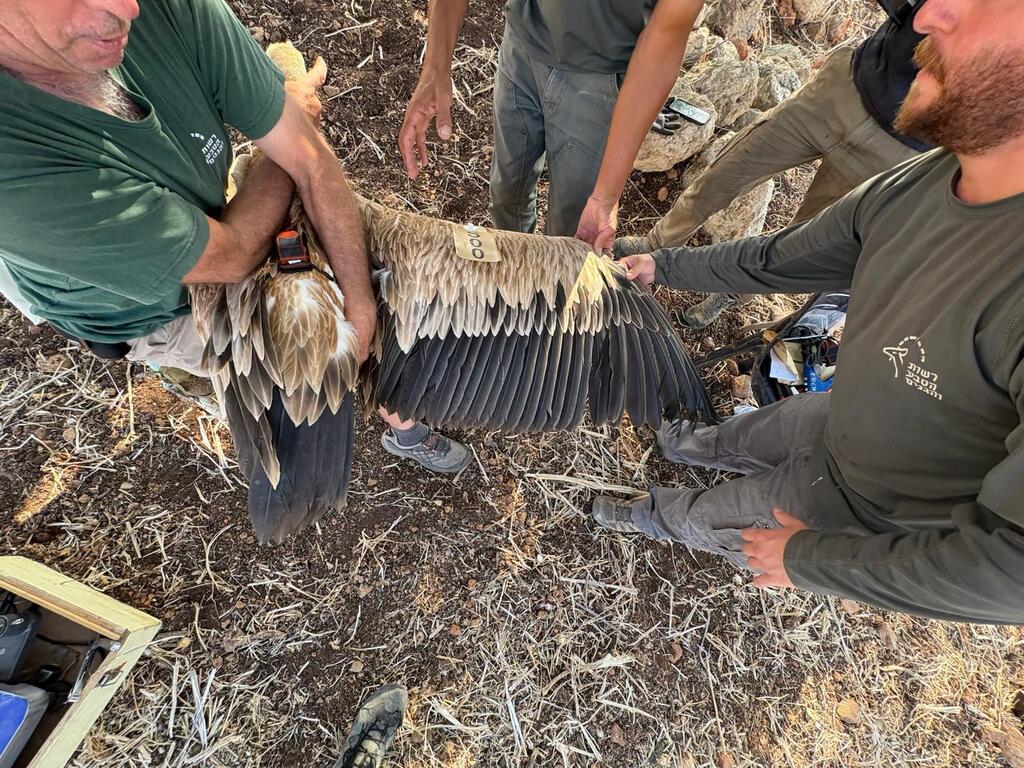
One of the vultures being tagged before its release in the Galilee
(Photo: Meital Mesica, Israel Nature and Parks Authority)
"The information collected helps us learn not only about the condition of the individual birds we capture but also about the state of the vulture population and the environment in which it lives," Hatzofe said.
'The transmitters are our eyes in the field'
The capture and tagging were carried out as part of "Spreading Wings," a joint project of the Israel Electric Corporation, the Society for the Protection of Nature in Israel and the Israel Nature and Parks Authority aimed at preventing the extinction of vultures and other birds of prey and helping restore their populations in Israel.
Alongside local vultures, the monitoring program also captures vultures arriving from the Caucasus and the Balkans. Some spend the winter in Israel while others stop in the country during their southward migration, mainly on their way to East Africa.
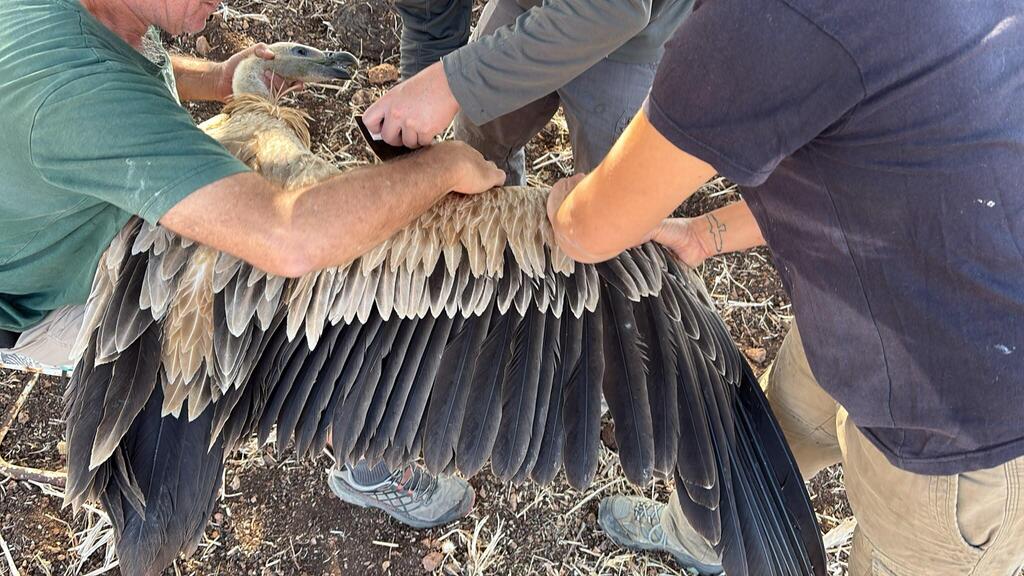
The vultures flew in different directions
(Photo: Meital Mesica, Israel Nature and Parks Authority)
According to Hatzofe, slightly more than 100 vultures currently flying over Israel are equipped with GPS transmitters, representing nearly half of the country's vulture population. The authority plans to fit about 60 more vultures with transmitters this fall in cooperation with researchers from Tel Aviv University. The goal is for about 75% of Israel's vulture population to eventually carry transmitters.
"The transmitters provide us with continuous information about the vultures' locations, flight paths and behavior and are a key tool in protecting them," Hatzofe said. "The alert system allows us to identify unusual incidents in real time."
He said that when a vulture lands at a particular location, the information received allows inspectors to head into the field, determine what attracted it to the site and assess whether there is any danger there. If a vulture is injured, the transmitter allows authorities to locate it quickly, attempt to save it, identify the source of the injury and take steps to prevent similar incidents.
"The transmitters are our eyes in the field. Without them, we are blind," he said.
The acclimation facility where the vultures were captured is used throughout the year to breed and acclimate vultures hatched as part of the captive breeding program before their release into the wild. At the beginning of the 20th century, Israel was likely home to thousands of vultures, but their numbers have declined sharply in recent decades. Poisoning is considered the most serious threat to Israel's vulture population.
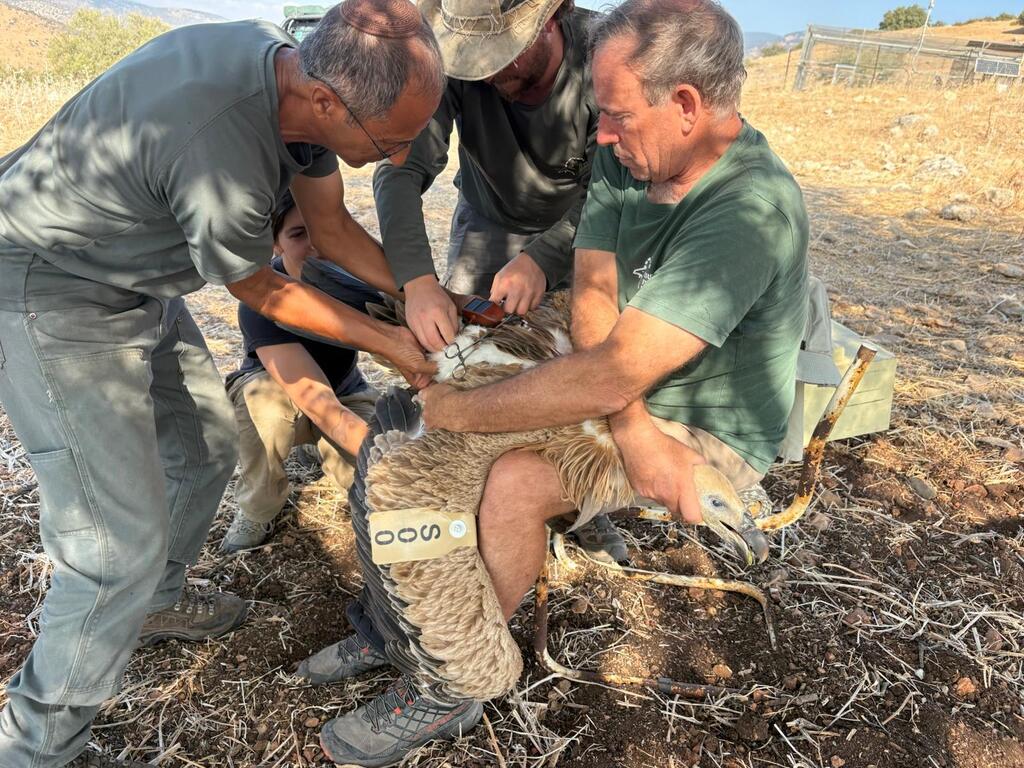
One of the vultures before its release
(Photo: Meital Mesica, Israel Nature and Parks Authority)
Among the causes are poisonings resulting from the illegal use of toxic pesticides against predators. Vultures feed on the poisoned carcasses and are harmed even though they were not the intended targets.
In recent years, another threat has emerged: carcasses of animals treated with veterinary drugs that are dangerous to vultures are left in the field, where they become a food source for the birds.