

Astronomers have detected an atmosphere around an Earth-like rocky planet located in the “habitable zone” of its star — the precise distance where temperatures may allow liquid water to exist on the surface, a condition considered essential for life as we know it.
The rocky planet, known as LHS 1140 b, is located 48 light-years from Earth. According to a new study, it has an atmosphere containing helium, making it the first rocky planet outside the solar system whose atmosphere has been directly detected. It is also the first rocky planet found to have both an atmosphere and a location within the “habitable zone,” also known as the “life zone.” As humanity continues to search the universe for potentially “habitable” planets, this world meets more of the criteria than almost any other planet discovered so far.
Gallery
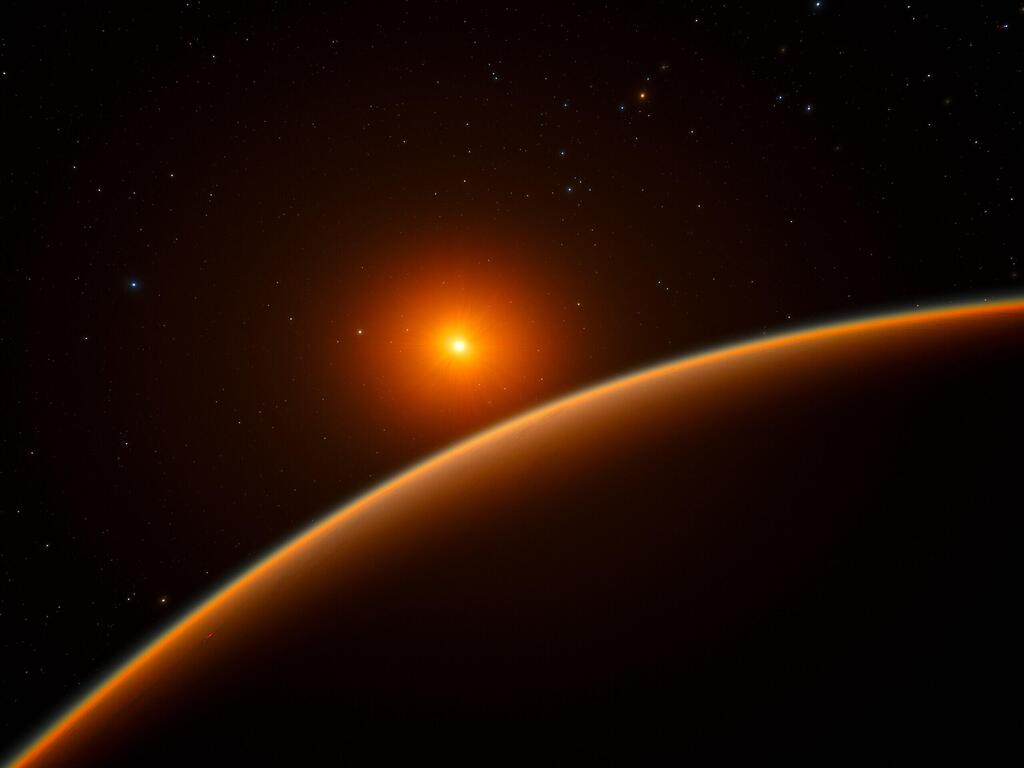
The rocky planet, known as LHS 1140 b, is located 48 light-years from Earth
(Illustration: ESO/spaceengine.org)
"We have actually detected directly the helium present in the atmosphere itself, and that's the first direct detection for any rocky exoplanet, which is really exciting … and then there's this added bonus that it's in the habitable zone, which is super exciting for astrobiology and habitability and searching for life," lead author Collin Cherubim, who recently earned his Ph.D. from Harvard University, told Space.com. "It feels kind of surreal."
Assessing whether it has water
This exoplanet — a planet outside the solar system that orbits another star — was first discovered in 2017 by a team led by astronomer Jason Dittmann, who is now a co-author of the new discovery. "This planet was found like 10 years ago, and we're just now saying, okay, that's an atmosphere," Dittman said. "We're slowly narrowing the gap and checking these boxes … we're finding a planet that's rocky, a planet that's of the right temperature and now … it's like okay, we finally found one that has an atmosphere."
And being a rocky planet, "there's definitely a surface … it's made of rocks,” he added. What that surface looks like remains unknown, but the researchers who discovered its atmosphere believe there is a good chance it contains water.
Although it orbits a red dwarf star — a type of star smaller and cooler than our sun — it orbits much closer than Earth orbits the sun. That distance keeps the temperature within the planet’s “Goldilocks zone.”
"It probably also has a lot of water," Cherubim said. "If it has some amount of atmosphere that can provide a bit of a greenhouse effect, which we know that it does now … it will very likely be what we consider to be habitable conditions on Earth, and conditions that would likely support liquid water."
So is it Earth-like? Although it is certainly not an exact copy of Earth, the planet can be considered Earth-like in two main ways, Cherubim said. The first is its overall composition. The planet is rocky, likely with an iron core, and as researchers now know, it has an atmosphere. The second is its temperature, which is suitable for the liquid water required for life, at least as we understand it on our own planet.
Sunrise over the Earth's horizon
(Photo: Ficta Stock/Shutterstock)
More than 30 years ago, scientists confirmed the discovery of the first planet outside the solar system. Since then, researchers have discovered more than 6,000 such planets, and the number continues to rise. Although several rocky planets have been found in the habitable zones of their stars, only now has an atmosphere been confirmed around a rocky planet in a habitable zone.
One reason scientists have struggled to find such planets with atmospheres is the type of stars they orbit. LHS 1140 b orbits the most common type of star, a red dwarf. These stars remain active for far longer than stars like our sun. This activity means they release extreme radiation bursts such as solar storms — powerful energy eruptions that release radiation and particles — as well as coronal mass ejections, massive eruptions of plasma and magnetic fields into space.
Typically, the extreme radiation around these stars strips away the atmospheres of the planets orbiting them, leading astronomers to question whether planets around such stars can maintain atmospheres at all.
"This discovery is a big deal because it's showing that at least this rocky planet has retained an atmosphere over billions of years," Cherubim said. It's "a bona fide, robust way of saying yes, atmospheres can survive on rocky exoplanets."
'A preferred target for future observations and research'
An Israeli-American research team has already studied LHS 1140 b. The planet is particularly interesting because it has a mass four to six times greater than Earth’s. Researchers estimate that if they can better understand its internal structure while characterizing its atmosphere, for example using the James Webb Space Telescope, they may soon gain a better understanding of the ability of distant planets to host life — and ultimately better assess the possibility of life existing on such worlds.
“As a result of this research, we are establishing LHS 1140 b as a preferred target for future observations and research. Advanced telescopes that already exist today allow us to collect more precise data about its atmosphere and surface characteristics,” said Dr. Lev Tal-Or from the Department of Physics at Ariel University. “Every new discovery of a planet with characteristics similar to Earth brings us one significant step closer to answering the great question: Is there life beyond Earth?”