

With their long ears, twitching noses and soft fur, rabbits are often seen as easy, child-friendly pets. But animal rescuers in Israel say that image hides a much harsher reality: widespread abandonment, poor breeding practices and a steady stream of animals left outdoors with little chance of survival.
Dozens of rabbits are abandoned across Israel every day, according to Beit Nathanel, the country’s only organization dedicated specifically to rescuing, rehabilitating and rehoming rabbits.
Gallery

A rabbit rescued by Beit Nathanel volunteers from a school in Beit Shemesh, where it was kept in poor conditions
(Photo: Beit Nathanel)
Unlike wild rabbits, domesticated rabbits are poorly equipped to survive outdoors. Once abandoned, they can die from hunger, dehydration or heatstroke, or be killed by dogs, cats, jackals and birds of prey.
Beit Nathanel has been operating since 2019 without institutional funding, relying largely on a small group of volunteers.
“In the past year, things have deteriorated so dramatically that we feel like we’re drowning in abandoned rabbits,” founder and director Talia Nathanel said. “No authority or official body acts on their behalf. We receive calls 24 hours a day, and the financial, medical and physical burden is a daily challenge.”
The organization currently cares for around 250 rabbits. Roughly half are permanent residents because they came from severe cases of abuse or neglect. The rest have been rehabilitated and are waiting for adoption.
The problem starts with unregulated sales
Rescuers say one of the main causes of the crisis is a lack of public awareness combined with poorly regulated rabbit sales.
Female rabbits can reproduce frequently, yet sellers often offer rabbits in pairs without correctly determining their sex or explaining how quickly they can breed.

A rabbit abandoned in a Kiryat Ata apartment building parking lot spent several days in the heat without food or water before dying
(Photo: Beit Nathanel)
Families may buy what they think is a simple pet for a child, only to find themselves with multiple litters within months.
From there, rescuers say, abandonment can follow quickly.
“They are adopted from us under an adoption agreement after being spayed or neutered, examined by a veterinarian and found to be healthy,” Nathanel said.
She places much of the blame on irresponsible sellers.
“A lot of this happens because traders simply don’t bother giving proper guidance to the people buying them. They just want to make money,” she said.
Rabbits are also frequently sold as “dwarf” breeds when they are in fact merely very young and have been separated from their mothers too early, she said.
Combined with the sale of sick animals from breeding facilities, the result can be high mortality and considerable suffering.
Rabbits are not cage animals
Another problem, Nathanel said, is the widespread misconception that rabbits are simple animals that should live in small cages and eat mainly lettuce and carrots.
In reality, she said, rabbits are intelligent, curious and social pets with complex needs.

A roughly 2½-week-old rabbit found dying in the courtyard of a Tel Aviv apartment building. It did not survive
(Photo: Beit Nathanel)
“Rabbits are full-fledged members of the household,” Nathanel said. “They can easily learn to use a litter box just like a cat, they like to move freely, they form deep and loving bonds with family members and they even ask to be petted.”
Their diet is also widely misunderstood.
“Eighty percent of their diet is hay, and carrots are really only a once-a-week treat,” she said.
Rabbits are also particularly fragile. They do not cope well with extreme outdoor temperatures and may show few obvious signs when they are sick or in pain.
“They are especially delicate animals that do not cry out or express anger when they are suffering,” Nathanel said. “They need a protected environment inside the home and devoted care in order to live happily.”
Her recommendation is that rabbits be raised indoors much like cats or dogs.
Potential owners should also understand that the commitment is long-term: rabbits can live for eight to 12 years.
A rescue system at breaking point
Each successful adoption helps in two ways, Nathanel said. It gives one rabbit a permanent home while freeing space for another animal in need.
But the organization, currently based in Beit Lehem HaGlilit in northern Israel, says its capacity is under growing strain.
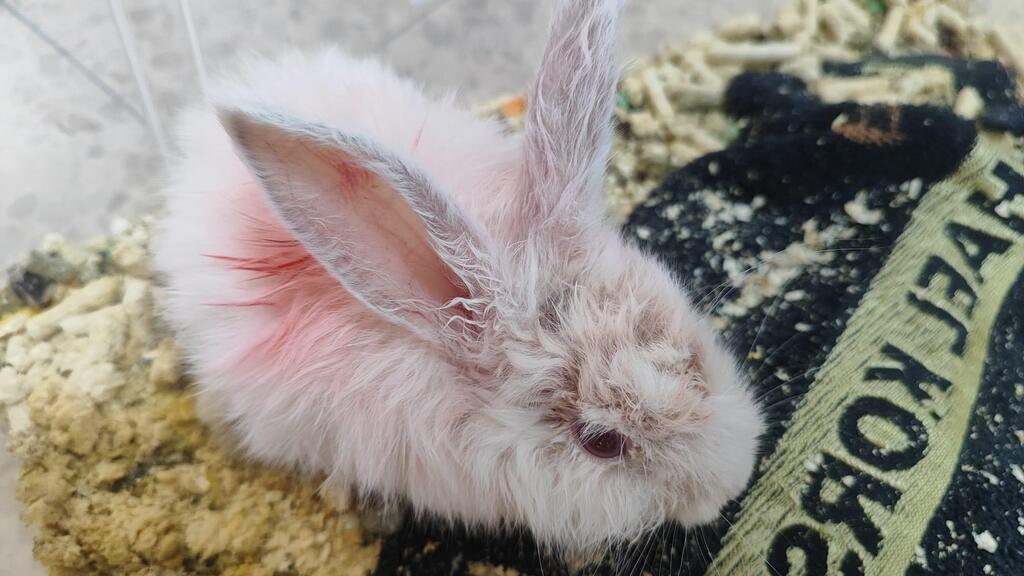
A rabbit found in Hadera after its owners scribbled on its body with a red marker
(A rabbit found in Hadera after its owners scribbled on its body with a red marker)
“The rabbits only have us, and we need help in order to help them,” Nathanel said.
Alongside animals that are rescued and given a second chance, she said, many others are abandoned and die painfully before help reaches them.
The organization says it is facing a serious shortage of manpower.
Rescues, trapping, transportation, daily care, cleaning and maintenance are all being carried out with too few volunteers.
Beit Nathanel is also urgently looking for a permanent site in the Jezreel Valley area, preferably a farm or property with suitable animal facilities, where it can establish a more stable long-term base.
The group is asking the public for help finding a suitable property, volunteering, donating and, above all, adopting.
“Every rabbit that finds a warm and loving home allows us to help the next rabbit waiting in line,” Nathanel said.
For adoption, volunteering or support, Beit Nathanel can be contacted through its website and social-media pages.