

In recent weeks, snake catchers across Israel have been busy as reptiles emerge from winter dormancy and increasingly make their way into residential areas. But this week, snake catcher Eran Ben Basat received an unusual call when he was asked to remove a reptile from a toilet in a home in Maccabim, part of the city of Modi'in-Maccabim-Re'ut. Upon arrival, he discovered it was not a snake but a legless lizard known as the forest glass lizard.
Ben Basat wrote on Facebook: "'It's my worst nightmare' is what most people tell me. To be honest, I would be a little startled too if I unexpectedly encountered a snake or lizard in a toilet. These cases are quite rare in Israel. To help avoid them, especially in single-family homes, make sure sewer covers are tightly sealed, and it may be worth considering installing a backflow valve that is also suitable for preventing rats."
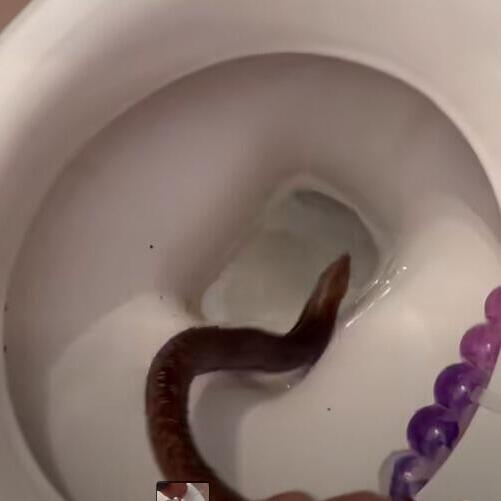
Ben Basat recounted the unusual call in an interview with ynet. "A woman called me and said, 'Listen, my cleaning lady opened the toilet, saw a snake and screamed. We immediately closed the lid and put something on top of it so it couldn't get out. How quickly can you get here?' I arrived in about 15 minutes. In the end, it wasn't a snake. It was a legless lizard called a forest glass lizard. It's completely harmless, not aggressive and doesn't bite."
He added: "I know that probably doesn't do much to lower the anxiety of finding something like that when you open the toilet, but that's what it was."
So how do reptiles such as snakes and lizards end up in toilets? Ben Basat said such incidents are extremely rare in Israel.
"It mostly happens in single-family homes where there is an open sewer cover or some other access point to the sewer system outside the house. They get in but don't know how to get back out, so they keep looking for an exit and eventually emerge through the toilet. They don't live there. Neither snakes nor lizards live in sewers. They usually live on the ground, climb trees and shrubs, and can swim and manage well in water, but sewers are not their natural habitat."
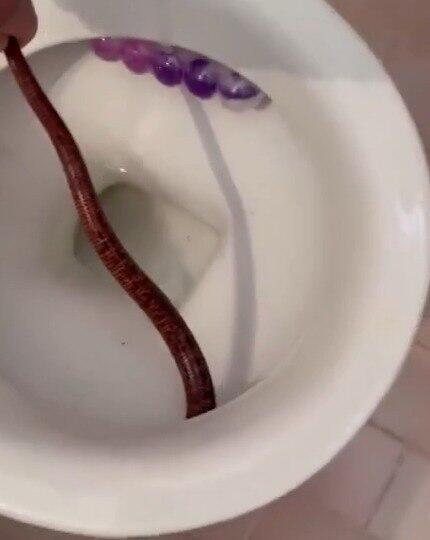
(Photo: Eran Ben Basat)
Asked how such incidents can be prevented, Ben Basat said there is no need to change daily routines. Instead, homeowners should check for broken sewer covers or other openings that provide access to the sewer system.
"I've also seen cases where a snake entered a pipe and, out of panic, people sealed it off. They said, 'Let's seal it and let it die in there,'" he said. "That was their mistake, because the snake wanted to find a way out and eventually ended up coming through the toilet. So if you see a snake disappear into a pipe, don't seal it off. Let it find its way back out."
Ben Basat also offered advice on what to do if a snake is encountered inside a home.
"Keep your distance and call a local snake catcher. I always recommend saving the number in your phone in advance. Nobody wants to be searching for a snake catcher in a panic. Keep your distance. I can assure everyone that there is no snake in the world that will voluntarily approach or chase a person. It doesn't work that way. Snakes are at least as afraid of people as people are of them. Keep your distance and call a snake catcher. They are shy, timid animals. People do encounter them from time to time, but they are extremely common here."